Friday, January 15, 2016

HERALDRY | Eagle in the Great Seal of USA (Updated July 21, 2016)

Thomson's design of the Great Seal of the USA, 1782.
January 15, 2016–George Washington presented the Stars and Stripes to the Continental Congress saying that the stars represented "a new constellation".

In the canton of the flag that had previously been used to represent the new nation, the Union Jack was replaced by a solid dark blue background or field, with 13 white stars on it, representing the 13 states.

Congress voted to accept the new design of the flag on June 14, 1777, and June 14 is now designated Flag Day.

Five years later, Congress asked 53-year-old Charles Thomson to design America’s Great Seal based on reports and drawings of the three committees that had looked into it.

Thomson had served the previous eight years as Secretary of the Continental Congress. He had previously been a Latin master at an academy in Philadelphia.

His sketch of a design is shown above. His description of it shows he has in mind the 13 original colonies leaning into one another to make the red-and-white chevron or upside-down V. This substitutes for the stripes on the flag, or the bars on the Washington shield.

The Great Seal looks a lot like the one the White House uses today. The bird, stars and stripes on the seal includes the major elements of the Washington coat of arms. The bird on the seal has morphed into the American bald eagle and two main additions have been made:
  • In the eagle’s beak, Thomson placed a scroll with the first committee’s motto: E Pluribus Unum (Out of Many, One).
  • The eagle is now facing the olive branch in one talon instead of the bundle of arrows in the other. In the sketch, Thomson has the eagle's head looking in the direction of peace. This was reversed in the final version, perhaps to make the eagle look more threatening to a possible invader. Britain did try to retake their colonies in 1812 and were fighting again here until January 1815, although a peace treaty was signed in Ghent a month before. The direction that the eagle faces was reversed again after World War II.
Several different reasons, not necessarily contradictory, have been advanced for the post-World War II change in the direction faced by the eagle:
So we now have at least three people (FDR, Elsey and Truman) to credit with the post-WW2 change, and at least three good reasons for making it.

Friday, January 8, 2016

R.I.P. | Natalie Wales Douglas-Hamilton

Working on Bundles for Britain.
Natalie Wales Douglas-Hamilton, also known by her husband's first name as Lady Malcolm, passed away on January 14, 2013 at 103.

Born Natalie Scarritt Wales in 1909, she grew up in Boston and New York City, where she attended Nightingale School, graduating in 1928, and then Columbia University. She became an American Florence Nightingale, aggregating volunteer help and money to assist those suffering in World War II.

She was first married to Kenelm Winslow in 1928, and with him gave birth to Natalie Wales Mead (1930-1988), known as Bubbles, and Mary-Chilton Winslow Mead (1934-2014), known as Mimi, who also attended Nightingale before going on to Brearley and then Radcliffe.

Natalie divorced Winslow and remarried in 1937. In 1939, soon after Britain declared war on Germany, when she was known as Natalie Latham, she asked the British Ambassador to the United States what Britain needed that ordinary Americans could supply.
The answer: knitted caps for sailors. So she got to work, building a national organization with nearly 2,000 branches and over 1.5 million volunteers working to send to Britain not only knitted items but also X-ray machines, ambulances, children‘s cots, surgical instruments and more, all labeled “From your American friends.” 
She enlisted the help of Joan Crawford, Clementine Churchill, Janet Murrow, Louise Carnegie and Queen Elizabeth the Queen Mother. For her services in WWII, she was named the first non-British woman to be named an honorary Commander of the British Empire (C.B.E.) by King George VI in 1946. Bundles for Britain was just the first of many organizations she founded. At the request of the White House, she created a related group, Bundles for America, to aid Americans during the war. In 1947 she established Common Cause, an anticommunist group, and thereby met her third husband, Edward Bragg Paine. Among other things, the organization shipped food during the Berlin airlift and sheltered refugees (sometimes in her own home).

After the death of her third husband, Natalie met Lord Malcolm Douglas-Hamilton, and they married in 1953. Together, they started the American-Scottish Foundation to strengthen ties between Scotland and the United States. After Lord Malcolm‘s tragic death in a plane crash in 1964, Lady Malcolm continued to devote herself to the foundation, organizing “Scotland Week” in New York City and creating the annual Scottish Ball fundraiser. She also established the Wallace Award, celebrating an individual's contribution to American-Scottish relations, as well as Scotland House, a gathering place for those with Scottish roots and a center for Scottish culture. [Sources: the Nightingale-Bamford School, The Blue Doors, Fall 2013; the Boston Globe; and the New York Times.]

Saturday, January 2, 2016

R.I.P. | Edward B. McMenamin (1912-1994), Economist, Columbia Provost

Edward B. McMenamin was born in 1912 in Portland, Me., and graduated from Bowdoin College in 1933 with a degree in economics. [He started his career in the FDR administration in the same office as Spike Marlin, who was born three years earlier than McMenamin and died eight months later in 1994.]

During World War II, he served with the United States Marine Corps in the Pacific Theater, and later was in government service in Washington and abroad as an administrator with international economic cooperation programs such as the Marshall Plan, the Mutual Security Agency in Paris and the International Cooperation Administration.

After he retired from civil service and came to Columbia University as associate provost 1957-61 and then director of personnel from 1959 on, and secretary of the University from 1961 until his retirement in 1972.  After retiring from Columbia, he continued to work as a consultant to the federal government, the city of Boston, the Aspen Institute and several environmental agencies. He also worked for St Bernard's School.

He died Apr. 18, 1994 at a Manhattan apartment where he and his wife were staying. He had been in declining health for three years. He lived in Bridgehampton, L.I.  He is survived by his wife, Joan Stitt McMenamin, who at the time was Head Mistress of the Nightingale-Bamford School.

I attended his 1994 memorial service, which was well attended thanks in part to the participation of many Nightingale students. Mrs. McMenamin died in 2004. Sources include Columbia University Record (19:26), April 29, 1994; New York Times obit.

Wednesday, November 25, 2015

WW2 | Mark II Halifax Bomber

A Mark II Series 1 Halifax bomber operating out of the 10th
Squadron in Melbourne, Yorks., UK.
My mother's brother Willem van Stockum died during the week of D-day, June 1944,  in a crash of a Handley-Page Halifax Mark II bomber. 

He was one of seven crew members on the plane, and it was one of two planes that crashed the same night.

Uncle Willem knew the plane well because he had been a flight instructor for this plane for the Royal Canadian Air Force (RCAF) before he became a pilot.

Naturally I have been curious about the   plane he flew in and how it fared during the war:
  • Was this a good plane? Where did it rank in the hierarchy of the air? 
  • How many sorties were made in this plane?
  • What was the experience of 10th RAF Squadron, flying out of Melbourne, Yorkshire?
  • What was the experience of all of the RAF Halifaxes during June 1944?
I have some answers to these questions. Some of these answers come from my own counting and are therefore new.

The Halifax Bomber

The Lancaster bomber had a somewhat better reputation, but in June 1944 the Halifax was second only to it. It was a plane of preference. That is, the Mark II version did. The Mark I version had a dangerous tendency to go into an uncontrollable tailspin occasionally under extreme conditions. The tail was improved and the Mark II shook this problem.

The Bomber Command Museum of Canada, provides excellent data on Halifax Sorties and Losses in WWII (1941-1945). It reports that of those who flew for the bomber command at the beginning of WWII, only 10 percent survived. Willem van Stockum, as a mathematician and a flight instructor, would have been intimately familiar with these numbers, as is pointed out in Robert Wack's Time Bomber. Here is what the Museum says about the Halifax  bomber crews:

Of every 100 airmen who joined Bomber Command, 45 were killed, 6 were seriously wounded, 8 became Prisoners of War, and only 41 escaped unscathed (at least physically). Of the 120,000 who served, 55,573 were killed, including more than 10,000 Canadians. 

Of those flying at the beginning of the war, only ten percent survived. It is a loss rate comparable only to the worst slaughter of the First World War trenches. Only the Nazi U-Boat force suffered a higher casualty rate. 

On a single night (the night that Willem van Stockum was downed, June 10, 1944), Bomber Command suffered more losses than did Fighter Command during the entire Battle of Britain. 

The loss rate varied greatly as the war progressed and was considerably lower as the end of the war approached in late 1944 and early 1945. For most of the war, the majority of those who entered Bomber Command did not survive. During the RCAF's Halifax operations between March 1943 and February 1944, the average loss rate was 6 percent, producing a mere 16 percent survival rate for a tour of 30 operations.
Yet despite the chilling odds, the flow of volunteers never faltered. The price was known to be enormous, but it was a price which continued to be paid with unquestioning courage. If today it represents a debt which can never be repaid, it is at least a debt which must never be forgotten.
Canadian pilot and author Murray Peden said:
The crews faced formidable odds, odds seldom appreciated outside the Command. At times in the great offensives of 1943 and 1944 the short-term statistics foretold that fewer  than 25 out of each 100 crews would survive their first tour of 30 operations. [...] Yet the crews buckled on their chutes and set out with unshakeable resolution night after night. They fell prey to the hazards of icing, lightning, storm and structural failure, and they perished amidst the bursting shells of the flak batteries. But by far the greater number died in desperately unequal combat under the overwhelming firepower of the tenacious German night fighter defenders. [Emphasis added.]
More Data on Sorties

Dates are based on what the date was at 12:01 a.m. So the night of June 1-2 would be recorded as June 2.


Data on Halifax Bomber Losses, June 1944

Night and Losses
June 2 - 1 down
3 - 15 down out of 105 out (Trappes); none were lost on 119 sorties to coastal batteries
6 - 2 down out of 412 attacking Normandy batteries
7 - 1 down out of 418 attacking French roads and rail
8 - 11 down out of 195 attacking French roads and rail (as Willem predicted, the Germans got wise and were more prepared the next night)
10 - 2 down out of 175 attacking French airfields (the two were shot down over Laval in Mayenne). 
Total of 32 down in ten days. For the whole month of June it would be 105 planes down.
105 lost in 5095 sorties was a 2.06 percent loss rate
Since each plane had a crew of 7, that meant 735 dead 

Loss Rates for Halifax vs. Other Planes


Lancaster losses can be found here, Halifax losses can be found here. The record of losses for both planes was tragic, but the Halifax seems to have done slightly better than the Lancaster. 
For example, in June 1944 the loss rates were:
Mossie (Mosquito) - 7 lost in 1487 sorties for a 0.47% loss rate
Lancaster - 182 lost in 8614 sorties for a 2.11 percent loss rate
Halifax - 105 lost in 5095 sorties for a 2.06 percent loss rate

Since the Lancaster was considered a superior plane, it may have taken more risks...

It would be interesting to have the numbers for the U.S. B-25. We do have:
American heavy bomber, ETO - 520 lost in 28,925 sorties for a loss rate 1.8 percent (ref AAFSD) 

Friday, November 20, 2015

TERROR | Global Index, 2015

Terrorism fatalities rose 80 percent in 2014.
The Institute for Economics and Peace reports that deaths from terrorism increased 80 percent in 2014, to the highest level ever, with 32,658 people killed, compared with 18,111 in 2013.

Boko Haram and ISIL/ISIS/Daesh were jointly responsible for 51 percent of all claimed global fatalities in 2014.

Iraq continues to be the country most affected by terrorism, with 9,929 terrorist fatalities – the most  ever recorded in a single country.

Five countries account for 78 percent of all deaths from terrorism and 57 percent of all attacks:
  • Afghanistan
  • Iraq 
  • Nigeria
  • Pakistan
  • Syria
More.

Sunday, November 8, 2015

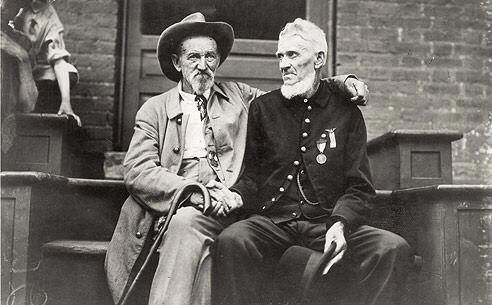
VETS UNITE | Gettysburg Reunion, 1938

The Gettysburg 1938 Reunion and Dedication of the Eternal Light Memorial.
For Veterans Day, I am reading about the 1938 Gettysburg reunion and commemoration by veterans of both sides of the Civil War, 75 years later.

The event attracted nearly 1,850 veterans of the Civil War, three-fourths of them from the Union side. Of them, 25 were veterans of the battle – their average age was 94.

The event brought some 400,000   onlookers. FDR came and spoke to them on July 3, dedicating the Eternal Light Memorial.

Gray and Blue Reconciled Veterans.
Initially there was opposition ton the reunion from both sides. For example, questions about whether the Confederate veterans could bring their flags were asked by both sides. Veterans in the south did not see the point of going back to Gettysburg to be subjected to the condescension of "damn Yankees". On the northern side, the veterans did not want to have to look again at the symbols of the confederacy.

There were different feelings about Gettysburg
  • Pride in having fought there,  a defining moment of soldiers' lives.
  • Victory barely won and lost.
  • Horror at the loss.
  • Loyalty, disloyalty, sacrifice, freedom.
  • When together as Union (Army of the Potomac) veterans, they celebrated the end of slavery..
Gettysburg was the geographic center of the memory of the war. The 1938ncommemoration was a big success because it was 
  • A Reunion.
  • Memory of Reconstruction, coming back to a different society.
  • Reconciliation - among people who spent four years trying to kill one another.
In 1869 Gettysburg was dedicated as a soldiers' cemetery.  Initially, it was a cemetery for Union soldiers. But a Union general, George G. Meade, spoke on this occasion and acknowledged that Confederate soldiers should be left to their Maker to be judged – they should be remembered here as well as Union soldiers. By 1895 the Gettysburg monument covered 500 acres and some Confederate soldiers were reburied there.

Here is a well-presented history of the Gettysburg memorial:
https://www.youtube.com/watch?v=4ayaLqWfZgM

Friday, November 6, 2015

ART BIZ | "Hope", Museum of Visionary Art - Yanni Posnakoff

Yanni Posnakoff, "Everything Is Possible."
I'm in Baltimore and today visited the "Hope" show at the Museum of Visionary Art. Much of the art is "folk" or self-taught or "naive". It has a curious appeal when combined with the theme of hope.

For example, there is a film show in which a 22-year-old man tries for the third time to jump off the Golden Gate Bridge. The speaker, a former police officer, was trying to talk the would-be suicide out of what he was trying to do. (He notes that dying this way is grisly and, contrary to the belief of some, often gruesomely painful.)

The young man asked the police officer - "Have you every heard of Pandora's Box?" The officer replied yes, the box was given by Zeus to Pandora (from a story in Hesiod) with the instruction that it was full of evils and she should never, ever to open it. Pandora couldn't resist opening it and all the evils flew out, leaving only Hope.

Yanni Posnakoff, "Even Toy Soldiers Must Be
 Abolished. We Must Disarm the Nursery."n.d.,
Watercolor, ink and acrylic on paper. Courtesy
Philip Binioris.
Then the young man said: "What if the box is empty, and there is no hope left?"

Then he jumped to his death.

Some of the art in the show is about people who have suffered intensely but have translated their suffering into a determination to hope and to work toward a goal that will help others to hope.

Yanni Posnakoff is one of these artists.


Another story of hope - Sadako Sasaki.