Showing posts with label E. R. Marlin. Show all posts

Tuesday, August 15, 2017

VETS | Spy Museum and the O.S.S.

Montreal, 1948. Front row L to R: John, Spike
(O.S.S.), Liz, Hilda, Sheila. Back row,
L to R: Olga, Randal, Brigid. 
August 15, 2017 – The role and successes of individual American spies in World War II could not be discussed for decades after the war.

These intelligence workers were gagged when the war was over and they returned to civilian life.

1. Malcolm Nance

A member of the board of the expanding Spy Museum in Washington, D.C., Malcolm Nance, was visiting East Hampton, N.Y. over the weekend to promote his books – Hacking ISIS and The Plot to Hack America (both New York: Skyhorse Publishing, 2017).

Malcolm is interested in the stories of spies from a family perspective and is seeking memorabilia related to them fro the museum He spoke with Michael and me about our fathers' work in espionage.

This post is about these two Americans in Europe during the war doing intelligence work, how their children came to find out what their fathers did, and the connection between them.

2. E. R. (Spike) Marlin, Dublin and London

My Dad, E. R. "Spike" Marlin took a competitive exam to work in  FDR's government in 1933 and was one of about 300 who was awarded a position, out of thousands who applied. His first job was at the Farm Credit Administration under Henry Morgenthau, Jr. – before Morgenthau succeeded William H. Woodin as Secretary of the Treasury.

L to R: Michael Collins and Malcolm Nance.
Photo by JT Marlin.
When Germany began invading its neighbors, my Dad was recruited by the O.S.S. to go to the Republic of Ireland under the light cover of an assignment in the U.S. Mission to Ireland (i.e., the 26 southern counties making up the Irish Free State or Éire).

Spike's primary qualifications were that he had (1) already established a decade-long U.S. Government service record in Washington, D.C. and (2) as a graduate of Trinity College, Dublin he  knew many residents of Éire.

The United States recognized the Irish Free State in 1924, after various legislative processes established partition between the six counties that make up Northern Ireland and the 26 that make up the Irish Free State. The United States did not send a full Ambassador to Éire until 1950. From 1940 to 1947 the U.S. "Envoy Extraordinary and Minister Plenipotentiary" (shortened in practice to "Minister") was David Gray, Jr. (1870-1968), a novelist and playwright whose two main qualifications were that he (1) was married to Eleanor Roosevelt's aunt and close confidante Maude Hall Gray (1877-1952) and that he (2) had spent a lot of time in Cork writing a book and enjoying the excellent local hunting and fishing. Gray, who was 70, told his predecessor he wanted the post (http://bit.ly/2uYmwN3) and it was offered to Gray when the previous incumbent returned home.

Gray was unique as a U.S. envoy in that he was actively hostile to its leader, Éamon de Valera. As an opponent of the neutrality of the Éire government, Gray accused the Irish Free State of cooperation with the Nazi Axis. O.S.S. chief "Wild Bill" Donovan was sympathetic to the Éire government's need to maintain its neutrality given the recent history of partition, and wanted to find out whether Éire was cooperating fully with British intelligence. My father, reporting to Francis Pickens Miller in London, collected evidence that showed that the Éire government was working closely with British intelligence. Both the presence of the O.S.S. and my Dad's success in collecting the information that Donovan expected him to find were thorns in Gray's side.

Eventually, having done his work, Spike was reassigned to O.S.S. in London and a new spy was recruited who was not assigned to the U.S. mission and had the cover (revealed in a book Spies in Ireland) of a movie producer. I have spoken with the author.

After the war was over and the O.S.S. was disbanded, Spike was sent to San Francisco as a Budget Bureau representative to the formation of the U.N. He was seconded to the Provisional International Civil Aviation Organization (PICAO) as Secretary and headed the secretariat for the creation of the ICAO in Chicago. FDR in January 1939 ramped up his interest in manufacturing airplanes and that year he showed his interest in aviation by making Orville Wright's birthday on August 19 (this coming Saturday) as National Aviation Day. Spike then joined the United Nations and became Director of Technical Assistance for the ICAO in Montreal. He spent the next two decades working for the U.N., ending as the highest-ranking American at the UNHCR in Geneva under Ambassador Félix Schnyder (who was the High Commissioner in 1960-65) and Sadruddin Khan. Spike then served in the State Department for three years in 1964-67 when I was working across the road for the Federal Reserve Board.

I didn't discover that my Dad had been in the O.S.S. until the 1970s, when a Ph.D. student contacted me with questions.

Sgt. Tom Collins
3. Tom Collins, Bletchley Park

My neighbor Michael Collins didn't find out that his father Tom was in the cryptography area until the end of the last century.

Sgt. Tom Collins was selected at 19 years of age to accompany the American Dragon 1 cryptographic machine, essentially an early computer.

His primary qualification is that in his civilian life before his war service, he was a telephone installer for Western Electric and would understand the wiring protocols for the machine that the company developed with U.S. cryptographers to crack the German code. He accompanied the Dragon 1 to Bletchley Park and spent year at the Park assisting British cryptographers under Turing with the maintenance of the Dragon 1.

References

1. Malcolm Nance: Hackers and MICE
2. E. R. (Spike) Marlin: Origins of the O.S.S.Post at ICAO
3. Tom Collins and his work in Bletchley:  CRYPTOGRAPHY | Americans at Bletchley Park . VET STORIES | Tom Collins, 1921-2011 .  BLETCHLEY | U.S. Contribution to British Cryptography . VETS | The Funeral of Tom Collins
4. Spy Museum: Spies' Choices

Saturday, October 24, 2015

UN OPENS | My Dad Joins ICAO (Comment)

The two-month, April 25-June 26 Conference in San Fran-
cisco. My Dad was sent by FDR's Budget Bureau, but it
became Truman's when FDR died on April 12.
October 24–This day in 1945, the United Nations Charter came into effect.

It had been adopted and signed four months earlier, on June 26, 1945.

The U.N. was intended to be an improved version of League of Nations. The principles of the U.N. Charter originated in the San Francisco Conference, presided over by the Yalta powers - the United States, Britain and the Soviet Union.

It was attended by a huge international assembly -3,500 representatives of 50 nations, including nine continental European states, 21 North, Central, and South American republics, seven Middle Eastern states, five British Commonwealth nations, two Soviet republics in addition to the USSR, two East Asian nations, and three African states.

The conferees were determined to create a better organization than the League of Nations. The goal was create something to
save succeeding generations from the scourge of war,…to reaffirm faith in fundamental human rights,…to establish conditions under which justice and respect for the obligations arising from treaties and other sources of international law can be maintained, and to promote social progress and better standards of life in larger freedom.
A feeling for the meeting is given by the BBC World Service,  which interviews Steve Schlesinger and others on the founding of the U.N. Negotiating and maintaining the peace was the practical responsibility of the new U.N. Security Council, composed of the United States, Great Britain, France, the Soviet Union, and China. Each would have veto power over the other.

One of the specialized agencies of the U.N. was the International Civil Aviation Organization, ICAO (properly pronounced ee-KAY-oh, says my brother Randal). My Dad, E. R. Marlin, became Director of Technical Assistance and by the mid-1960s of the 1,700 employees of ICAO, about 1,500 worked for the bureau that he headed.

Service cover sent by the UN Technical Assistance Board to E. R. Marlin,
Director, ICAO Technical Assistance Bureau. Postmark dated May 11, 1954.
ICAO’s Technical Co-operation Bureau was created to provide in-depth technological assistance to States with their aviation projects.

It supports ICAO’s Strategic Objectives - Aviation Safety, Air Navigation Capacity and Efficiency, Security and Facilitation, Environmental Protection, Sustainable and Economic Development of Air Transport.

It also contributes to the global and uniform implementation the International Standards and Recommended Practices (SARPs).

The ICAO Technical Co-operation Program has been in operation since 1951. It has made valuable contributions to international civil aviation safety and growth and remains a permanent priority activity of ICAO.

Since its establishment in 1952, the Technical Assistance Bureau has implemented civil aviation projects with an accumulated value in excess of $2 billion. With an average annual progra size of more than $120 million, it is involved in approximately 250 projects each year with individual project budgets ranging from less than $20 ,000 to more than $120 million. To date, TCB has provided assistance to more than 115 countries, deploying annually approximately 1200 international and national experts.

E. R. ("Spike") Marlin was a Member of the Secretariat at the Conference on International Civil Aviation held in Chicago in 1944. He was one of the first Members of the PICAO Secretariat, and served with the Organization for 17 years. The first years of this period saw Marlin successively as Administrative Officer, Liaison Officer and External Relations Officer for ICAO. When the Expanded Program of Technical Assistance of the United Nations and the Specialized Agencies began, Marlin was assigned to direct ICAO's participation; he became the first Director of the Technical Assistance Bureau when this Office was created in November 1952.

Comment by Randal Marlin, My Brother (October 24, 2015)

The location of ICAO in Montreal was Dad's idea. I asked him once about this and he stated clearly stated this was so. He was internationalist in spirit [he wrote a League of Nations column for the Irish Times] and wanted the organization to work in at least a bilingual region. Dad understood the historical arrival of decolonization and wanted to prepare for it by training aviation personnel in less developed areas so that they would operate safe airports and aircraft. This was quite against the spirit of American exceptionalism and world domination that we find today among neoconservatives.

In Canada, we just had an election whereby a neoconservative government was replaced by a Liberal one. Most people are probably not aware that Canada was in danger of losing the headquarters of ICAO to some other country as a result of Prime Minister Stephen Harper's unwavering and uncritical support of the Israeli government of Netanyahu, despite its actions in the West Bank and Gaza. Arab and Muslim nations were looking for some way of showing their displeasure with Canada's policy and this was one possibility that was suggested.

Tuesday, July 14, 2015

WW2 | Willem van Stockum Bench at Trinity College, Dublin

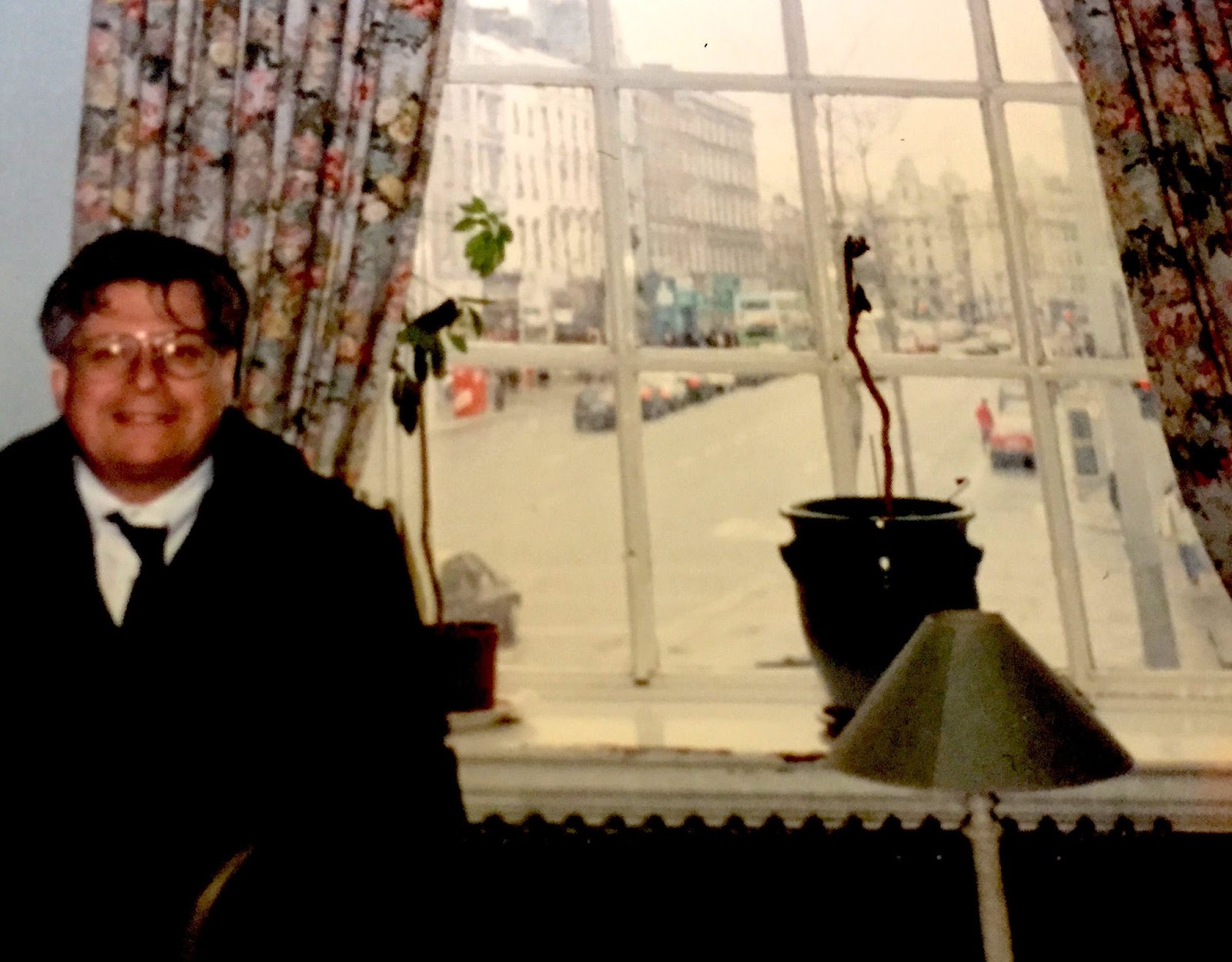
Visiting Randal's office at Trinity College,
Dublin, Feb. 12, 1994. The view is of
O'Connell Street. Photo by R Marlin.
My brother Randal most of his life has been a philosophy professor at Carleton University in Ottawa, Canada.

In 1993-1994 he took a sabbatical year and used it to bring his family to Dublin. He had an appointment at Trinity College, Dublin with a fine view of O'Connell Street.

I visited in February 1994, during the 50th anniversary year of the D-Day assault on Normandy. I got to see the memorial that my parents chose to honor my uncle Willem van Stockum after the war. He was shot down on June 10, 1944 while on a mission for the RAF.

A memorial was erected in France last year, on the 70th anniversary, to each of the two crews that were downed that night.

Randal on the Memorial Bench. Photo by JT Marlin.
The Irish memorial is simply a bench with the inscription: "To the Memory of Willem van Stockum / 30 November 1910-10 June 1944 by His Sister."

Spike Marlin and Willem van Stockum were roommates at Trinity. When Spike learned that Willem had a sister, he decided then and there that he was interested in marrying her, so fond he was of her brother Willem.

My Dad died in December 1994. Mom lived another 12 years.

My turn on the Bench. Photo by R Marlin.
Another member of the group was David Grene, a classicist who went on to be a co-founder of  the University of Chicago's Committee on Social Thought. He died after my father and before my mother, in 2002.

When my Dad died we made a gift to Trinity College, Dublin of another bench, named for my father, and we had the one for Willem renovated. They were placed on opposite sides of the entrance to the Book of Kells.