Showing posts with label George Washington. Show all posts

Monday, October 12, 2015

US NAVY | Oct. 13–Navy's 240th Birthday

Proudly 240 Years Old Today.
This day in 1775, the Continental Congress created the American Navy.

The Navy did not come out of thin air:
  • American naval prowess was built on the large number of sailors, captains and shipbuilders who made their living from trade and passenger travel in the colonial era. 
  • On June 12, 1775 Rhode Island's assembly commissioned a navy, which fought back against British ships.
  • Massachusetts and Connecticut also had their own navies and in due course eight other colonies had their own navies during the Revolutionary War, notably Pennsylvania, Virginia and South Carolina. 
The establishment of a national navy was a contentious issue in the Second Continental Congress.

Supporters argued that a navy would protect shipping, defend the coast, and make it more likely that other countries would come to the aid of the colonies.

But others considered it foolhardy to challenge Britain's Royal Navy, then the world's preeminent naval power.

However, after the Battle of Lexington in April, the British Government sent a fleet to suppress the rebel colonies. Something had to be done. While debate over a Navy dragged on, the Commander-in-Chief of the Continental Army (founded June 10, 1775),  General George Washington, decided he couldn't wait and he commissioned seven ocean-going cruisers, starting with the schooner USS Hannah, to interdict British supply ships, and reported captures of British ships to the Congress.

Washington said: "[W]ithout a decisive naval force we can do nothing definitive, and with it, everything honorable and glorious."

On October 13,  the Continental Congress decided to establish the Continental Navy, and this is the Navy-recognized birthday of the service, predating the Stars and Stripes flag, which was established the following year.

On December 22, Esek Hopkins was appointed as the first commander in chief of the Continental Navy, with four captains reporting to him - Nicholas Biddle, John Burrows Hopkins, Dudley Saltonstall, and Abraham Whipple.

The Continental fleet then consisted of eight ships - the 24-gun frigates Alfred and Columbus, the 14-gun brigs Andrew Doria and Cabot, and three schooners, the Hornet, the Wasp and the Fly.

Thirteen lieutenants were commissioned - five first lieutenants, including future American hero John Paul Jones, five second lieutenants and three third lieutenants.

Esek Hopkins was called "Admiral" Hopkins and was sent to find out whether it would be feasible to attack the British fleet in Chesapeake Bay. He decided it would not be feasible and instead attacked the British port of Nassau in the Bahamas. For this he was relieved of his command upon return.

The Continental Navy achieved mixed results. It successfully preyed upon British merchant shipping and won some encounters with British war ships. But it lost 24 of its vessels to the Royal Navy and at one point was down to two vessels in active service.

After the Revolutionary War, the Navy was disbanded for nearly a decade, leaving merchant ships open to pirate attacks. In 1790-97, only the U.S. Revenue Cutter Service (USRCS) had a fleet. This fleet evolved into the U.S. Coast Guard.

Not until the Naval Act of 1794 did Congress establish a permanent standing navy. The Naval Act ordered the construction and manning of six frigates. Three were in service by 1797 - the USS Constellation, USS Constitution and USS United States - and the U.S. Navy Department as we know it today was in place by April 1798.

The original stars and stripes
(The Constellation got its name from the stars in the canton of the Stars and Stripes, the flag that was adopted in 1776. After the Battle of Lexington in April, the Founding Fathers were determined to drop the Union Jack in the Grand Union Flag used in 1775. George Washington in 1776 presented to Congress a flag that replaced the Union Jack with 13 white stars on a dark blue field, which he referred to as representing "a new constellation". The U.S. military in due course flew the stars and stripes. The "star-spangled banner" that flew over at Fort McHenry in 1814 had 15 stars and 15 stripes.)

Thomas Jefferson (President, 1801-1809) did not favor a strong navy, arguing that small gunboats in the major harbors were all that the nation needed to defend itself. But the gunboats showed themselves to be inadequate when the United States was in conflict first with France and then again with Britain.

Thursday, December 25, 2014

YOUNG AMERICA | Dec. 25–Washington Attacks Trenton

Washington Crossing the Delaware, Emmanuel Leutze, 1850
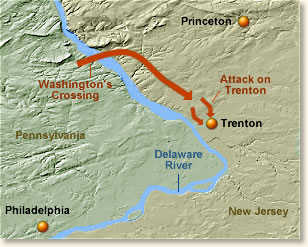
On this day in 1776 George Washington led the Continental Army across the Delaware River in a surprise attack on Hessian mercenaries.

The previous August, the British army arrived–one-fourth of them Hessian soldiers from Germany. The Brits invaded Long Island and forced the Continental Army to Manhattan. The British then attacked Manhattan and forced Washington's troops to retreat along the Hudson River to New Jersey. The British followed, chasing the Americans across the Delaware into Pennsylvania.

At this point the American rebels seemed to be crushed. General Washington was on the run. General Cornwallis was satisfied that the Continental Army was not going to be a threat, having had many defeats and no victories in more than five months.

American morale was low, with many men sick and wounded. Shabbily dressed and poorly trained, they were deserting at high rates. On top of all that, enlistments of most of the militias under Washington's command were due to expire at the end of December and many would be going home. Even Washington thought privately that the jig might be up for the Revolution. By the following spring there would be no army left.

A Marker Nine Miles Upriver from Trenton
Washington had to do something. Then he got word that about 1,500 Hessian soldiers were camped across the Delaware in Trenton. The Hessian mercenaries, one-fourth of the British forces in America, had a deserved reputation as skilled, effective soldiers. The only way for his irregulars to have a chance of defeating them, even with superior numbers, was a surprise attack. Washington decided to risk everything on an attack.

The weather was terrible, with snow, sleet, and gale-force winds. Washington decided the weather would work in his army's favor, because no one would imagine that the Continental Army would attack during a blizzard.

A few hours before attempting the mission, Washington read aloud to his soldiers from Thomas Paine's The American Crisis. The army was divided into at least three different groups to cross the Delaware, each with a different destination point around Trenton; Washington led one group and put commanders in charge of the others. The river was moving quickly, carrying huge chunks of ice, and they were traveling through a blinding snowstorm.

On Christmas Eve, 2,400 men, 18 cannons, and some horses crossed the river in small boats. Only Washington's group persevered through the brutal weather–the other commanders turned their troops around.

Washington's army crossed nine miles northwest of Trenton.
Washington's men marched the nine miles on Christmas Day to Trenton, many of the soldiers with frostbitten feet as they marched on snow barefoot or with rags tied around their feet.

The Tide Was Turned

Early morning December 26, the Continental Army attacked Trenton, surprising a camp composed entirely of unprepared and hungover Hessians. After the loss of their commander, the Hessians surrendered. Washington's victory was complete but his situation precarious. Taking  900-1,000 soldiers captive, they retreated back across the river to Pennsylvania.

It wasn't fully clear at the time, but this victory turned the tide toward the Revolutionaries. It restored everyone's faith in the Continental Army's abilities.

The battle's outcome gave Washington and his officers the confidence to mount another campaign. On December 30 they again crossed the Delaware, this time winning another victory at Trenton on January 2, 1877 and then pushing on to Princeton, where they defeated the British on January 3. The victories stunned the British and were a magnet for support of the new nation by potential allies– France, Holland and Spain.

Eye Witness Report

Elisha Bostwick, a soldier in the Continental Army, said in his memoirs of the battle:
[We] encamped on the Pennsylvania side [of the Delaware] and there remained to the 24th December. [T]oward evening [we] began to re-cross the Delaware but by obstructions of ice in the river did not all get across till quite late in the evening, and all the time a constant fall of snow with some rain, and finally our march began. 
[General Washington rode by and said:]  "Soldiers, keep by your officers. For God's sake, keep by your officers!" Spoke in a deep and solemn voice. ... Our horses were then unharnessed and the artillery men prepared. We marched on and it was not long before we heard the out sentries of the enemy both on the road we were in and the eastern road, and their out guards retreated firing, and our army, then with a quick step pushing on upon both roads, at the same time entered the town. Their artillery taken, they resigned with little opposition, about nine hundred, all Hessians, with 4 brass field pieces. When crossing the Delaware with the prisoners in flat bottom boats the ice continually stuck to the boats... [T]he next day [we] recrossed the Delaware again and returned back to Trenton, and there on the first of January 1777 our years service expired, and then by the pressing solicitation of [General Washington,] a part of those whose time was out consented on a ten dollar bounty to stay six weeks longer, and although desirous as others to return home, I engaged to stay that time.
Sources: Garrison Keillor, Writer's Almanac, December 25, 2014. Henry Steele Commager and Robert B. Morris, The Spirit of 'Seventy Six (1958). David Hackett Fischer, Washington's Crossing (2004). "Washington Crosses the Delaware, 1776," EyeWitness to History (2004).

Monday, December 2, 2013

GEO WASHINGTON | Dec 4–Farewell at Fraunces Tavern, NYC

General George Washington says farewell to his officers.
On this date in 1783, General George Washington tearfully said goodbye to his officers in the Long Room at Fraunces Tavern, 54 Pearl Street (at Broad). The tavern now encompasses a museum.

Washington was described as so overcome with emotion that he was barely able to speak. The context was that the British soldiers left New York City two weeks before. This was the final victory, more than two years after they surrendered at Yorktown, Virginia. In the meantime the under-supplied and overworked Continental Army had narrowly survived several mutinies and, the autumn before, a near-coup. The Treaty of Paris was not signed until September 3, 1783, 20 years after the Treaty of Paris that ended the French and Indian Wars and made the independence of the colonies possible.

Following the signing of the Treaty, General Washington resigned as commander in chief of the Continental Army and retired to his home -- Mount Vernon, Virginia.  He said goodbye to Congress as follows:
Happy in the confirmation of our independence and sovereignty, and pleased with the opportunity afforded the United States of becoming a respectable nation, I resign with satisfaction the appointment I accepted with diffidence; a diffidence in my abilities to accomplish so arduous a task; which however was superseded by a confidence in the rectitude of our cause, the support of the supreme power of the Union, and the patronage of Heaven.
Washington begged Congress to treat the veterans of the Revolutionary War with appreciation:
While I repeat my obligations to the army in general, I should do injustice to my own feelings not to acknowledge, in this place, the peculiar services and distinguished merits of the gentlemen who have been attached to my person during the war. It was impossible the choice of confidential officers to compose my family should have been more fortunate. Permit me, sir, to recommend in particular, those who have continued in the service to the present moment, as worthy of the favorable notice and patronage of Congress.
Washington's return to civilian life transformed a war into a revolution. He had been given dictatorial powers during the war. Some wanted Washington to become king. But he did not want this. Instead, he asked for land to be given to his veteran officers. The western lands offered this possibility.  Washington's farewell to the nation and to his officers was short-lived. Five years later he was elected to the first of his two terms as president of the United States.

Sunday, December 1, 2013

VET STORY 7 | Nov. 28–Friedrich Steuben, "Father of the Modern U.S. Army"

Baron Friedrich Wilhelm von Steuben, 1730-1794.
Baron Friedrich Wilhelm von Steuben died this day in 1794. He was born September 17, 1730 in the fortress of the Duchy of Magdeburg, in what is now Germany. His father was an engineer with the rank of captain in the military, stationed at the fortress.

Steuben inherited the title of Baron (the lowest level of German nobility, signified by the "von") from his father. The "von" should be dropped when referring to him as an American citizen,which he became.

Steuben is an important figure in U.S. military history because he helped shape up George Washington's army in the long struggle for American independence.

While General George Washington earned the title “father of the American Army” as well as father of his country, Steuben -- who was General Washington's chief of staff in the final years of the war and had the rank of General -- is given the title of “father of the modern American army.”

Steuben was a one-man West Point, teaching the Continental Army what were then the world's most advanced military drills and tactics. He wrote the drill manual that served the American Army until the War of 1812.

Steuben studied in Breslau with Jesuits and was a Prussian military officer at 17. In the Seven Years War (what Americans know as the French and Indian wars), he was in a Prussian infantry unit and a staff officer when the Prussians and their allies, notably Britain under its monarch George II, were defending themselves against the Austrian-French alliance. Steuben gained great experience during these years, becoming a member of the headquarters of the General Staff of the Prussian King Frederick II, a k a Frederick the Great.

In a word, he learned about military strategy and tactics from the world's best military leader of his time. Napoleon described Frederick the Great as the greatest military genius in history.

Two examples of Frederick the Great's strategies that had great importance for the training of George Washington's army, and contributed to the success of the Continental Army, are:
  1. Maneuver to keep enemy forces divided, constantly looking for ways to  divert them from recombining, and 
  2. Use a smaller force to attack a larger one via the tactic of "oblique order", i.e., attacking an opposing force from the flank, thereby cutting off a segment from the main force and defeating it. (Admiral Nelson applied this principle at the Battle of Trafalgar, barging through the enemy line of ships to defeat the larger combination of Spanish and French navies. The French navy lost all of its officers in the French Revolution, because to be an officer in the ancien regime, all four of your grandparents had to be noblesse. The officers fled the country, were killed or went into hiding in some way.)
At the end of the Seven Years War, in 1763, Baron von Steuben was at loose ends. Having stepped on some superior officers' toes in the Prussian army, he had to look elsewhere for work. He first got a job as chamberlain (grand marshal) in the bodyguard of the impecunious and debt-ridden Catholic prince of the small Hohenzollern-Hechingen area of southern Germany, on the borders of Baden and Würtemberg. Von Steuben accompanied the prince on a trip to France in 1771 to seek a substantial loan. After four years, they both returned to Germany in 1775, the trip futile for the prince, who was  now even deeper in debt.

However, the trip was not futile for von Steuben. During his time in France, he met the French Minister of War, Claude Louis, Comte de Saint-Germain. The Comte wanted to help George Washington fight against the British, but in such a way that the British would not know that France was violating its claim of neutrality.

Having been on the losing end of encounters with Frederick's army, the Comte saw the value to General Washington of an officer with Prussian-general-staff training. So he introduced Steuben to Benjamin Franklin, who promptly sent a clever letter to Washington introducing Baron Steuben as "Lieutenant General in the King of Prussia's service". The French then loaned Baron von Steuben travel funds for the trip from Marseilles to Portsmouth, N.H. so that Steuben could present himself to Washington as a volunteer.

On September 26, 1777, the Baron disembarked at Portsmouth with his Italian greyhound Azor and four companions including his young aide-de-camp Louis de Pontière and his military secretary Pierre Etienne Duponceau. Congress was then meeting in York, Pennsylvania, after having been pushed out of Philadelphia by the advancing redcoats. By February 23, 1778, von Steuben had engineered his way to reporting for duty to Washington at Valley Forge.

Once on staff, von Steuben went right to work. With the help of Colonel Alexander Hamilton and General Nathanael Greene, Steuben drafted a training program (and later a manual) for the Army, and had it it approved by Washington:
  • The program began with a "model company" -- 120 chosen men who were trained first without, and then with, arms. This turned out to be a much better approach than simply assigning personnel to regiments to train them. Steuben was looking for a change in the attitude of the soldiers and this was easier to achieve in a smaller group.
  • With this model company at its core, the program went on to train larger groups, at the Regimental and Brigade levels. 
  • Each company commander was made responsible for the training of new men, but instruction was done by sergeants selected for this purpose.
  • Crucially, Steuben trained men in the use of the bayonet. Throughout the early course of the Revolutionary war, Americans used the bayonet mostly as a skewer for cooking meat. Steuben introduced the concept of bayonet charges, and in the Battle of Stony Point, American soldiers attacked with unloaded muskets.
In addition, Steuben helped the young army in establishing guidelines for sanitation and camp layouts that remained standards for another 150 years.
  • Steuben laid out a plan to have rows for command, officers and enlisted men, with company and regimental streets. 
  • Previously, men relieved themselves where they wished. Kitchens and latrines were created on opposite sides of the camp, with latrines on the downhill side.
His eccentricity was part of his mystique. He turned up in full military dress in front of the Continental Army soldiers, who were famously by this time wearing little more than rags. He spoke little English and yelled at the men in German and French. When that and gesticulation/yelling failed, von Steuben recruited Captain Benjamin Walker, his French-speaking aide, to curse at them in English. Steuben wrote out each day's orders in German, Walker translated them into French, and a French-speaking officer would then translate them into English. (This might have been an experience more common in our own lifetimes if the Nazis had won World War II.)

In the end it was all of great value to Washington.  Steuben's training helped win the Battle of Barren Hill, 20 May 1778 and the Battle of Monmouth in June 1778. Steuben, who was by then serving in Washington's headquarters, was the first to figure out that the redcoats were on their way to Monmouth. His early alert made Washington's troops better prepared for battle.

Washington recommended appointment of Steuben as inspector general on April 30, 1778. Congress approved this on May 5. Steuben was given the rank and title of Major General. During the winter of 1778–1779, Steuben prepared Regulations for the Order and Discipline of the Troops of the United States (the "Blue Book"), based on the plan he devised at Valley Forge. At the final campaign at Yorktown, Steuben commanded one of the three divisions of Washington's troops. Steuben gave assistance to Washington in demobilization in 1783 as well as preparing a defense plan of the new nation (the British would be back within 20 years and would occupy New York and burn Washington). He was discharged from the military with honor on March 24, 1783.

Steuben became an American citizen by act of the Pennsylvania legislature in March 1784, and later by New York State in July 1786. Since the United States forswore titles, the "von" should be dropped from his name once he became a U.S. citizen; however, usage varies. With the war over, Steuben resigned from service and first lived in Manhattan. In December 1783, the State of New Jersey presented him with an estate now known as Zabriskie-Steuben House, confiscated from Jan Zabriskie in 1781 for his siding with George III in the Revolution. Steuben eventually sold the estate. In 1790, Congress gave Steuben him a pension of $2,500 a year for life.

Steuben settled ultimately on a small estate in the vicinity of Rome, New York, on land granted to him for his military service. He later helped found the Society of the Cincinnati and was appointed a regent for what became the State University of New York. He never married and had no children. He left his estate to his aides-de-camp General Benjamin Walker and Captain William North. He is said to have had an "extraordinarily intense emotional relationship" with them. He is buried at what is now the Steuben Memorial State Historic Site.

Since 1958, von Steuben Day has been celebrated in New York City, Chicago and Philadelphia every September, the month he was born. It is the German-American event of the year. The Steuben Society was founded in 1919. A warship, a submarine, and an ocean liner later pressed into military service were named in Steuben's honor. Steuben is one of four European military leaders assisting the American rebels who are honored with a statue in Lafayette Square just north of the White House in Washington.

Von Steuben's sexuality was an issue in Germany, and a topic of discussion in the colonies. He left Baden involuntary, having been threatened with prosecution for homosexuality. When he joined Washington's army at Valley Forge in February 1778, it was observed:
  • He was accompanied by two young (one was 17) European aides.
  • Their late-night parties were the subject of gossip. 
However, Steuben was never investigated and received a Congressional pension after the war. Either he violated no colonial laws, or was given a pass because his services were so valuable.

Resources:
Hershberger, Kevin (Director), Von Steuben's Continentals: The First American Army, 60-minute DVD, LionHeart FilmWorks (2007). Details the life, uniforms, camp life, food, weapons, equipment and drill of the Continental soldier (1775-1781).

Lockhart, Paul (Wright State University, Dayton, Ohio), The Drillmaster of Valley Forge. This is the first major biography of General von Steuben in more than 80 years.

Tuesday, September 17, 2013

September 17 – Birthday of the U.S. Constitution

The Constitution of the United States, signed today, 1787.
The Warrior Family Foundation takes note of Constitution Day, commemorating the birthday in 1787 of the U.S. Constitution, which was born largely out of military disarray and created the written document that has been admired throughout the world since then.

It creates the system whereby the President and Commander-in-Chief of U.S. military forces is elected along with a House and Senate. The Commander-in-Chief's budget must be initiated by the House and senior appointments and treaties must be approved by the Senate.

In 1787 The war with Britain had officially ended four years before, in 1783. But the new American government was not functioning. The United States was vulnerable to another British invasion. Yes, the Second Continental Congress had created the Articles of Confederation to outline the rights of the federal government.

But Americans were reluctant to get rid of a tyrant in London only to succumb to a new one in America. As a result:
- Not one state was paying all of its federal taxes.
- The Federal Government had no way to force collection.
- Pirates were attacking American ships with impunity.
- Troops were deserting and states felt defenseless.

Congress technically had the authority to wage war, regulate currency, and conduct foreign policy, but it had no way to force the states to supply money or troops. So James Madison and other leaders convened the Constitutional Convention to get the states to create a unified central government. In May 1787, the 55 delegates spent four months in a hot summer in Philadelphia, fighting off bloodthirsty bugs. The average age of the delegates was just 42, but overall they were highly educated. The delegates included:
• Benjamin Franklin, who at 81 had to be carried around Philadelphia in a sedan chair because he could no longer walk.
• Alexander Hamilton, who was lax in attendance but afterward emerged as the principal author of the Federalist Papers, famous essays arguing why the Constitution should be ratified.
• James Madison, who showed up every single day, took detailed notes on all the proceedings, and argued tirelessly for a strong central government. Madison was small, 5'6" and 120 pounds, but he became known as the best informed person at the convention and became known as "the Father of the Constitution."
• Governor Morris, a charming man with a peg leg, who did more than flirt with other mens' wives, gave 173 speeches and wrote the Constitution's Preamble.
• George Washington, who was immediately elected president of the Convention and rarely spoke throughout the convention.

The resulting document was not just a revision of the Articles of Confederation. It became a new document, a Constitution of the United States. The delegates eventually came to an agreement on the essential purposes of government, a system of checks and balances, the division of powers between federal and state governments, rules for interstate trade, war-making powers and representation according to population.

(John Tepper Marlin, Ph.D., is Chief Economist of the Warrior Family Foundation. His summary of the Convention is abbreviated and adapted from Garrison Keillor's comments on the day in The Writer's Almanac.)