Showing posts with label Princeton. Show all posts

Tuesday, March 20, 2018

CHARLIE MINER, R.I.P. | WW2 Bomber Pilot

Charlie Miner (R) enjoying his great-nephew and
 great-great-niece and her (unrelated) Angry Bird.
(Photo by JT Marlin.) 
March 20, 2018 – Charlie Miner, Jr. interrupted his studies at Princeton (Class of 1943) to join the U.S. Army Air Forces.

He was studying  engineering, and that's who they wanted.

After serving as a test pilot, he signed up as a  bomber pilot and saw combat in Europe.

He died yesterday, according to his daughter, and Vero Beach resident, Charmaine Caldwell.

memorial service in Vero Beach, Fla. is planned for May 3 and possibly another one later in East Hampton, N.Y. 

The following is a slightly edited version of an article I wrote about Miner for The Vero Portfolio, May-June 2015 issue, p. 24. The ending is, of course, updated.

Charlie Miner, Jr. – also called Chas, but rarely Charles – was one of seven grandchildren of his illustrious grandfather, FDR’s first Treasury Secretary, Will Woodin. His mother was Woodin's eldest daughter, Mary, who married an infantry captain, Robert Charles (Charlie) Miner, Sr.

Miner divided his time at the end of his life between Vero Beach and East Hampton. When his beloved cousin Anne Gerli died in 2016, he gave up spending time in East Hampton. 

At Princeton, Miner studied engineering and joined the war effort as pilot of a B-25 Mitchell twin-engine bomber, which had a crew of three or more. Miner flew many of the 17 bombing missions of his Air Force unit over northern Italy. [More about his contribution to the war effort here.]

He was lucky to have survived. Of 16 million American veterans of World War II, fewer than one in 16 survived as of 2015, only 80,000 in Florida. That year Miner was one of only about 250 World War II vets left in Indian River County, and may be Indian River County's oldest surviving European-theater WWII bomber pilot.

Miner told me how much he loves Vero Beach, Fla. Years ago in the 1950s and 1960s, he spent time with his mother (who divorced Charlie Sr. and did not remarry) in the Riomar social life. It  revolved, he said, around rotating dinners and celebrations among the original 12 houses. The 30 residents took turns throwing parties. The Riomar Inn came later. John's Island—where Miner and his late wife Maisie lived now—opened in 1970 and was at first resented because it drew people away from Riomar (and then it became successful and was imitated by the Moorings). 

Charlie Miner’s grandfather, Will Woodin, was the man who dealt with the Wall Street and banking panic that started in 1929 and was not put to rest until FDR came into office in March 1933. FDR's first Treasury Secretary was given wide latitude in addressing the problem. 


Will Woodin was born in Pennsylvania and settled in New York after a successful career as the CEO of a huge business selling railroad rolling stock. He had four children. The eldest and youngest settled in Vero Beach — Mary Woodin Miner and Libby Woodin Rowe. Libby’s husband, Wally Rowe, and a brother bought homes in Riomar. Mary and Libby eventually lived in Vero Beach most of the year. Charlie’s mother lived in John's Island after Riomar and died in 2007 at 102.

Charlie remembers not just the bridge that connected the two sides of the Indian River, "Beachland Boulevard" where Route 60 crosses, before the concrete-arch Barber Bridge.  He remembers the drawbridge that was built earlier, in 1995. Before that, back in the 1930s, there was a bridge made of wooden railroad ties and swung around horizontally to let boats through the Indian River. 

Back in those early days Beachland Boulevard was the northern edge of Vero Beach, and there wasn’t a Riverside Theater. Charlie says the money was raised in several ways. Rosie and Sterling Adams organized a dance every year. He and his cousin, Bill Rowe, used to sell season tickets and organized an auction of donated prizes to raise money for the theater. The Theater is, of course, now a major institution in Vero.

Charlie (R) and me in 2014. Photo by
Alice Tepper Marlin.
What Charlie Miner liked about Vero is that it is quiet. That was one of the original motivations of the developers, along with the availability of rail transportation and ocean beaches. There is no strip with night clubs, no airport. As Charlie says, “I’m not a teenager anymore.”

Charlie’s Advice for a Long and Happy Life:
  • For a long life: Every morning a meal of two eggs and tomato juice or V-8 (with or without the hair of the dog). 
  • For a happy life: “Enjoy life while you can. If you want to do something, don’t wait. Do it while you can because life goes by quickly. You may never get another chance.” He says his 93 years have “Gone… Boom!”
During these four years that I have been studying and writing about FDR's forgotten first Treasury Secretary, Charlie's grandfather, I and my wife Alice have been amused and impressed by Charlie's joie-de-vivre and his sharp recollections from his long life. Learning of his death at 96 years old was a sad moment.

Thursday, December 25, 2014

YOUNG AMERICA | Dec. 25–Washington Attacks Trenton

Washington Crossing the Delaware, Emmanuel Leutze, 1850
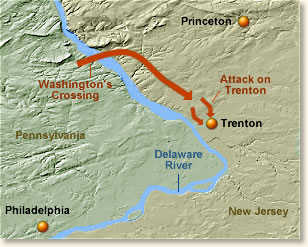
On this day in 1776 George Washington led the Continental Army across the Delaware River in a surprise attack on Hessian mercenaries.

The previous August, the British army arrived–one-fourth of them Hessian soldiers from Germany. The Brits invaded Long Island and forced the Continental Army to Manhattan. The British then attacked Manhattan and forced Washington's troops to retreat along the Hudson River to New Jersey. The British followed, chasing the Americans across the Delaware into Pennsylvania.

At this point the American rebels seemed to be crushed. General Washington was on the run. General Cornwallis was satisfied that the Continental Army was not going to be a threat, having had many defeats and no victories in more than five months.

American morale was low, with many men sick and wounded. Shabbily dressed and poorly trained, they were deserting at high rates. On top of all that, enlistments of most of the militias under Washington's command were due to expire at the end of December and many would be going home. Even Washington thought privately that the jig might be up for the Revolution. By the following spring there would be no army left.

A Marker Nine Miles Upriver from Trenton
Washington had to do something. Then he got word that about 1,500 Hessian soldiers were camped across the Delaware in Trenton. The Hessian mercenaries, one-fourth of the British forces in America, had a deserved reputation as skilled, effective soldiers. The only way for his irregulars to have a chance of defeating them, even with superior numbers, was a surprise attack. Washington decided to risk everything on an attack.

The weather was terrible, with snow, sleet, and gale-force winds. Washington decided the weather would work in his army's favor, because no one would imagine that the Continental Army would attack during a blizzard.

A few hours before attempting the mission, Washington read aloud to his soldiers from Thomas Paine's The American Crisis. The army was divided into at least three different groups to cross the Delaware, each with a different destination point around Trenton; Washington led one group and put commanders in charge of the others. The river was moving quickly, carrying huge chunks of ice, and they were traveling through a blinding snowstorm.

On Christmas Eve, 2,400 men, 18 cannons, and some horses crossed the river in small boats. Only Washington's group persevered through the brutal weather–the other commanders turned their troops around.

Washington's army crossed nine miles northwest of Trenton.
Washington's men marched the nine miles on Christmas Day to Trenton, many of the soldiers with frostbitten feet as they marched on snow barefoot or with rags tied around their feet.

The Tide Was Turned

Early morning December 26, the Continental Army attacked Trenton, surprising a camp composed entirely of unprepared and hungover Hessians. After the loss of their commander, the Hessians surrendered. Washington's victory was complete but his situation precarious. Taking  900-1,000 soldiers captive, they retreated back across the river to Pennsylvania.

It wasn't fully clear at the time, but this victory turned the tide toward the Revolutionaries. It restored everyone's faith in the Continental Army's abilities.

The battle's outcome gave Washington and his officers the confidence to mount another campaign. On December 30 they again crossed the Delaware, this time winning another victory at Trenton on January 2, 1877 and then pushing on to Princeton, where they defeated the British on January 3. The victories stunned the British and were a magnet for support of the new nation by potential allies– France, Holland and Spain.

Eye Witness Report

Elisha Bostwick, a soldier in the Continental Army, said in his memoirs of the battle:
[We] encamped on the Pennsylvania side [of the Delaware] and there remained to the 24th December. [T]oward evening [we] began to re-cross the Delaware but by obstructions of ice in the river did not all get across till quite late in the evening, and all the time a constant fall of snow with some rain, and finally our march began. 
[General Washington rode by and said:]  "Soldiers, keep by your officers. For God's sake, keep by your officers!" Spoke in a deep and solemn voice. ... Our horses were then unharnessed and the artillery men prepared. We marched on and it was not long before we heard the out sentries of the enemy both on the road we were in and the eastern road, and their out guards retreated firing, and our army, then with a quick step pushing on upon both roads, at the same time entered the town. Their artillery taken, they resigned with little opposition, about nine hundred, all Hessians, with 4 brass field pieces. When crossing the Delaware with the prisoners in flat bottom boats the ice continually stuck to the boats... [T]he next day [we] recrossed the Delaware again and returned back to Trenton, and there on the first of January 1777 our years service expired, and then by the pressing solicitation of [General Washington,] a part of those whose time was out consented on a ten dollar bounty to stay six weeks longer, and although desirous as others to return home, I engaged to stay that time.
Sources: Garrison Keillor, Writer's Almanac, December 25, 2014. Henry Steele Commager and Robert B. Morris, The Spirit of 'Seventy Six (1958). David Hackett Fischer, Washington's Crossing (2004). "Washington Crosses the Delaware, 1776," EyeWitness to History (2004).

Saturday, June 21, 2014

VET STORY 5 | Jerry Goodman ("Adam Smith")

George J. W. ("Jerry") Goodman, aka
"Adam Smith", Rhodes Scholar 1952
Jerry Goodman was a Harvard graduate, a Rhodes Scholar, and then became a soldier.

Ann Medlock just told me that Goodman talked with her once before he died about his basic training in the army around the time of the end of the Korean War.

He said he "hated what they did, and thought it was stupid at the time," but then added that when he finished the training, “I was a soldier.”

The April 30 memorial service in New York City for George Jerome Waldo ("Jerry") Goodman will stick with me as a reminder of how such events should be conducted. Goodman died on January 3 this year at the University of Miami Hospital, after a long effort to fend off the bone-marrow disorder myelofibrosis.

Goodman was elected a Rhodes Scholar from Missouri in 1952, but resigned from residence at Oxford University because of plumbing and padlocks at Brasenose College.

His moniker "Adam Smith" was reportedly given to him by Clay Felker when he was editing New York Magazine, to preserve Goodman's anonymity as he tried to stay in the business while pillorying it. Goodman said others have also claimed credit. Later, Goodman used the nom-de-plume for his wildly popular books about Wall Street and then as a trademark for a widely praised show on economics for the general public.

Goodman was born in St. Louis on August 10, 1930. He was the son of Alexander Mark Goodman, an attorney, and Viona Cremer Goodman. Jerry Goodman's officemate and friend, Craig Drill, has written a testimony to the public-spiritedness of Alexander Goodman in the attached comments at the memorial service.

Jerry Goodman attended Harvard College, graduating magna cum laude in 1952, and was an editor of The Harvard Crimson. Goodman won a Rhodes Scholarship to Brasenose College, Oxford, where he studied political economy. However, he quit the college before the end of the first year of his scholarship. As his son Mark told in April:
He liked the people at Oxford, but he did not like the facilities. He also didn't like the fact that the college gates were locked every night and he had to climb over to walls to get back in.
Instead of a thesis at Oxford, he spent his time writing a novel, The Bubble Makers, published in 1955, about a Harvard student in conflict with his grandfather. He wrote several other novels and a book for children.

Then, in 1954, he joined the US Army First Special Forces (later called the "Green Berets") in the Intelligence Group known as Psywar (psychological warfare). Although there was a cease-fire in Korea, the Cold War was very much alive.

In 1961, Goodman married an actress from Phoenix, Sally Cullen Brophy, who had a full Broadway and television acting career in the 1950s and 1960s. When she retired from acting, they moved to Princeton. She taught theater arts at local universities. She died of non-Hodgkin's lymphoma in 2007. Their two children, Susannah and Mark, both spoke at the memorial service, with warm words for Goodman's participation in their childhood activities, and an emphasis on the music that they shared a love for.

Goodman pioneered a style of financial writing that made the language and concepts of Wall Street more understandable and accessible to the typical investor. He was founding editor of Institutional Investor in the second half of the 1960s, and in the process transformed financial writing. Michael Lewis at his best is channeling Goodman. The first non-fiction book that Goodman wrote, The Money Game, was published in 1968 when he was at Institutional Investor and was soon Number 1 on the bestseller list. A colleague who was at the Harvard Business School at the time told me after the memorial service yesterday:
It is hard to imagine the impact that Adam Smith and the book had on B School students at the time. When the first piece about "Red-Dogged Motorola" came out in New York Magazine, we rushed out to get on the phone. We got early copies of The Money Game and we couldn't get enough of Scarsdale Fats and the other characters.
In the book he memorably introduced the joke that ends with an economist on a desert island proposing to two fellow storm survivors faced with cans they can't open: "Assume a can opener". His point was to make fun of economists who make unwarranted assumptions.

His love of music, and especially opera, led him to interview Placido Domingo, during a period when Domingo was singing in Wagner's Ring Cycle at the Met. Jerry showed him why so many Americans know the "Ride of the Valkyries" theme. He played a clip of Elmer Fudd in a Warner Brothers cartoon, bedecked in a Teutonic helmet and plunging a spear in the ground as he goes, singing as he chases Bugs Bunny from hole to hole:
Kill Da Waabbit, Kill Da WAAAbbit, Kill Da WAAABit... etc. (see video clip here)
After they watch the clip, Jerry sings the theme again, and Placido Domingo lustily joins in. A cartoonist celebrated Jerry's 70th birthday with a picture of Lincoln Center lights advertising the duet - "Placido Domingo/Adam Smith sing KILL DA WABBIT".

I met Jerry through a fellow alum of Trinity College, Oxford -  Ham Richardson, the late Louisiana-born top-ranked tennis great who moved to New York City after his tennis career was over to participate in venture capital and other Wall Street deals. We got talking about the British Empire, Rudyard Kipling, The Just-So Stories that we both loved (done up by Disney as The Jungle Book) and then the "great grey-green greasy banks of the Limpopo River, all set about with fever trees." Jerry said the Limpopo River was in the Congo, and I said that didn't make sense, Kipling was writing about South Africa, and I said the my recollection was that the Limpopo ran through the top of the eastern end of South Africa. He was interested, and bet me $10 that I was wrong. So we Googled it on our iPhones (actually, no - it took a while for us to get an Atlas in Ham's library, and find the river), and when he saw I was right he immediately handed over a $10 bill with no hesitation. Not as exciting a betting amount as the one that starts Liar's Poker, but Jerry got something he seemed always willing to pay something for - good information. I saw him many time after that and we always updated each other in a bantering tone.

During a stint in Hollywood, he wrote screenplays, including an adaption from one of his novels,  The Wheeler Dealers (still a good flick), starring James Garner and Lee Remick.

He was a member of the Editorial Board of The New York Times, an editor of Esquire Magazine, a writer for Fortune, and a founding member of New York magazine.  In 1984, PBS television launched him as the anchor and editor-in-chief of Adam Smith's Money World, which won eight Emmy nominations and five of its Awards. The program was aired in more than 40 countries and the Soviet Union ran a Russian-language-dubbed edition, doubtless watched by a young Vladimir Vladimirovich Putin, who was born the year that Goodman was elected a Rhodes Scholar.  Goodman interviewed, among others, Warren Buffett and (in Moscow) Mikhail Gorbachev.

Here are links to some memorable obituaries of Jerry Goodman:
Jason Zweig, in the Wall Street Journal, who provides some of the original comments that Goodman was most famous for.
Douglas Martin, New York Times.
Martin Sosnoff, Forbes


EXCERPTS FROM REMARKS BY CRAIG A. DRILL AT MEMORIAL SERVICE FOR JERRY GOODMAN, April 30, 2014

Jerry entered his early teens during World War II and always had a special interest in military history.  He rarely spoke about his time as a Rhodes Scholar at Oxford, but told many stories about his time in the US Army First Special Forces Group.  His favorite World War II hero was Ernest Evans, a mixed-blood Cherokee, who, as Captain of a destroyer in the Battle of Leyte Gulf, repeatedly attacked, against all odds, the Imperial Japanese Fleet.  

Of his time at Harvard, Jerry talked mostly about writing for The Crimson. Moreover, he was thrilled to have been accepted into a small seminar on modern poetry led by Pulitzer Prize winner Archibald MacLeish. 

He enjoyed singing in the Glee Club and had a solo in one Christmas concert, which he later sang out to our office with gusto.  But he truly “sang his song” as a writer.  

Through the prism of humor, he helped us to better understand ourselves (sort of), as well as this sport -- and addiction -- called the modern stock market.  He had an uncanny ability to tell the real from the phony, even though the phony for many of us has glittering attractions.  

Jerry was proud to have coined some memorable words and phrases.  “Gunslingers,” a term for aggressive money managers from his classic, The Money Game, was one of his favorites. Some of his unforgettable phrases have found a permanent place in Wall Street vernacular, among these: “The stock doesn’t know you own it” and “If you don’t know who you are, the stock market is an expensive place to find out.”  

And he was proud of some of the images he created, among them the partygoers at the Masque of the Red Death ball -- money managers in the frothy “go-go” years -- asking, “What time is it?  What time is it?  But the clocks had no hands.”  

And he was gratified that his pioneering “Adam Smith’s Money World” -- which ran for 13 years on PBS -- won five coveted Emmy Awards and that his popular Goodman Lectures at Princeton on Media and Global Affairs had to be moved to larger auditoriums.  At the tail end of the dot-com bubble, Jerry, Mark, and I started adamsmithtv.net, which was a tremendous success in terms of fun and for father and son to work together.

Jerry was a polymath, a Renaissance man. He would take our lunch discussions from the Coptic-language Gospel of Thomas to his meeting with Günter Schabowski, the portly spokesman for the East German Politburo whose comments on TV -- inadvertently -- helped to bring down the Berlin Wall. 

Invariably, at our lunches, Jerry could not refrain from talking about investing and stocks. “Why is John Hancock so cheap?” “Is Continental Airlines going bankrupt again?” Jerry did his homework, and to better understand the biotech stocks, he actually went back to Princeton and audited two courses.

Despite many financial successes and fame, he never changed homes. He certainly never behaved ostentatiously or arrogantly. Jerry was destined to become a carrier of our culture, not just a passive observer, articulating with grace and wit the voice within us that knows what is right… as his father had done.

Saturday, March 8, 2014

VET STORY 3 | Pilot Charlie Miner, Jr.

John Tepper Marlin (L) and Charlie Miner, Jr., John's
Island, Vero Beach, Fla., 2014.
March 8, 2014 – I have been writing about the life of Will Woodin, FDR’s first Treasury Secretary.

Woodin's major role in ending the panic caused by bank failures has been neglected by history. 

Along the way, I have gotten to know several more members of the Greatest Generation, who experienced the Great Depression and World War II. One of them is one of Woodin's three surviving grandsons,  Charlie Miner Jr.  


Miner's reminiscences about his grandfather are quoted in my articles in the East Hampton Star about the Treasury Secretary and his boat, the "Nanin".  As we approach the 70th anniversary of D-Day this June, I recently talked with Charlie in Vero Beach, Fla., where he lives between September and June, asking him about his wartime experience.

The number of surviving veterans of World War II is tiny.  Of the 16 million Americans who served in World War II, only 27,560 were still alive in 2010 – excluding the 2,812 who also served in Korea and the 961 who also served in both Korea and Vietnam. One year later, in 2011, the number fell to 19,641, according to the Department of Veterans Affairs.

That is a loss of 28.7 percent. At that rate of loss, the number of living U.S. veterans from World War 2 fell below 10,000 in 2013 and will be down to barely 7,000 by the end of 2014 - i.e., 0.04 percent of all those who served. The median age of World War II active-duty survivors was 92 in 2011. Miner is one of those survivors and turned 92 a few months ago. 

Miner studied engineering with the Princeton Class of 1943. Before he graduated, he enlisted in the US Army Air Force and graduated from single-engine flying school in March 1943. He says:
Because I had an engineering background, I was assigned immediately to a sub-depot in Charlotte, N.C., where they rebuilt planes that had crashed within 500 miles of Charlotte. My job was to test-fly the rebuilt planes before they were returned to their home bases. A variety of planes were being rebuilt, so I got flying time in many types of aircraft.
Charlie was married in October 1944 and two weeks later reported for combat training in two-engine B-25 planes at the Greenville, N.C.  Army Air Base. The North American B-25 Mitchell bomber, named after General Billy Mitchell, an advocate of greater air power, is described on the Boeing website as the “most versatile” bomber in World War II. It had a crew of five — a pilot, co-pilot, bombardier, radio operator and gunner. Nearly 10,000 of the bombers were built between 1941 and 1945. According to official data, the B-25 was:
the most heavily armed airplane in the world, ... used for high- and low-level bombing, strafing, photoreconnaissance, submarine patrol and even as a fighter, and was distinguished as the aircraft that completed the historic raid over Tokyo in 1942. 
After his training, Miner was shipped off to Europe, and started flying missions out of Corsica, where he was instructed by RAF and RCAF pilots who had been assigned the B-25. While the B-25 was versatile, it could be delicate if flown above the maximum speed, which was 518 km/hour for the earliest model. Charlie still wonders about the risk-taking propensity of a few of his instructors:
Some of those RAF and Italian pilots were daredevils. They didn't seem to care if they lived or died. The Mosquito was a laminated-wood plane that could remain undetected by radar and yet break the sound barrier, and the pilots loved it. They would dive from 5,000 feet. In one case, the wing just came off. The pilot, of course, went straight down with the rest of the plane and was killed.
As later models of the Mitchell bomber (B-25A through B-25J) were developed, the armaments were increased to allow the bombers to shoot back at targets, and the maximum speed was lowered.

When the German army was pushed north in the Italian boot, Charlie's squadron relocated to Fano on the Adriatic, about 150 miles south of Venice. From here they flew about 17 missions at about 15,000 feet over the Brenner Pass in the Alps between Italy and Austria. Charlie can't remember exactly how many of these he was on, but enough to remember his friends going down into the snow below while he tried to stay in formation.

The war in Europe ended in May 1945. In July 1945, Charlie was assigned the task of flying a B-25 back across the Atlantic. He had to fly an indirect route because of the medium range of the planes. They could only go up to the theoretical 3,000-mile maximum by adding droppable fuel tanks. These extra tanks were utilized in the previously cited Doolittle (Tokyo) Raid in April 1942. According to official records:
The B-25B bombers could take off fast enough to be launched from an aircraft carrier, but they could not land safely on their return. They were supposed to find an airport in China. A combination of unexpected discovery and bad weather resulted in all 16 of the B-25Bs being lost in the raid, but Doolittle and his squadron got out of Japan and most of the crew members survived. Col. James ("Jimmy") Doolittle feared he would be court-martialed for the lost planes. Instead, he received the Medal of Honor from FDR and was raised two grades in rank to Lt.-General.
Charlie had to bring one of these B-25s back. He had to fly down the West African coast to avoid the North Atlantic squalls and provide for frequent refueling. He flew over to the Ascension Islands, then on to Natal, Brazil, then to San Juan, P.R. and to Savannah, Ga., refueling at each stop.

His B-25 safely returned to Stateside, he went back to civilian life. He first worked for the New York Central Railroad under Willard Place, Vice President for Finance. From there he went to work for  Owens-Corning Fiberglass in Darien, Conn.,  on the concept of building railroad cars with fiberglass-reinforced-plastic shells. While the concept eventually worked, the first impact stress-test by Pullman failed spectacularly as the experimental cars shattered. Charlie reoriented the idea, pioneering the application of fiberglass-reinforced plastics to the building of boats, an idea that succeeded and took over much of the industry.

Miner left the fiberglass business for Wall Street, working first for Rand & Co. in the municipal bond department. He then joined Clark Dodge & Co., in the same area. It became part of Dean Witter and later part of Morgan Stanley. Charlie Miner quit the business at nearly 70 years of age.

The toll – of the Depression, of World War II and just advancing age – on the survivors from Charlie's generation may be judged by the fact that he was told at his 70th reunion last year that only 125 members of his Princeton class of 1943 are still alive – out of the 630 original members of the class. Fewer than ten members of his class showed up and to his disappointment he didn’t know any of them. Charlie says: "I was told last year that only seven alumni have survived from the Princeton Class of 1936." He asked me contact his friend Dottie Werner the Princeton Alumni office and she quickly responded with an email to me confirming his numbers. But, she said, "the number from 1943 is down to 104 and the number from 1936 has dropped to five."

I was reminded, by her email, of the song "When the Saints... Going Marching In." I thought to myself: "When I am 70 years out from college in 2032, I want to be in that number... maybe."

Charlie falls back on gallows humor about his being a Survivor. Here are some of his funniest comments:
  • At several places he hangs out, he says, “the average age is… deceased.” 
  • If you are playing golf for money, he says, “collect when you are two bucks ahead because your opponent may not finish the round.” 
  • Ocean Towers, he informs me, is also known among his colleagues as “the Pearly Gates.” 
  • The people who move on from there to Oak Harbor are said (even by their residents) to have gone to “Croak Harbor.” 
Some of the jokes told in his set relate to the high cost of some of their favorite Florida haunts in retirement areas:
  • A popular upscale grocery store on the Barrier Island of Vero Beach, the Village Beach Market, is called “Why Pay Less?” (It has other names, but the fact is they do a fine business. Better selection than 7-11 or CVS.)
  • The Golf and Bay Club in Sarasota is nicknamed the “Golf and Pay” Club.
  • The average at the bar of a club he belongs to, he says, is "deceased".
  • But despite it all, he says, quoting from a phlegmatic friend vacationing in Florida who was looking at clouds taking over the sky, "It's better than Massachusetts."