Showing posts with label Holland. Show all posts

Tuesday, May 8, 2018

VE DAY | May 8, End of WWII in Europe (Updated May 10)

Canadian Troops Liberate Amsterdam, 1945.
May 8, 2018 – I returned from the Netherlands yesterday to New York City.

Today the world celebrates VE- Day, that day in 1945 when World War II hostilities ceased in Europe.

In the former Soviet Union the celebration is delayed by one day, to May 9, because fighting there continued for another day.

The Soviet Union lost a higher percentage of its population (15%) than any other Allies – led by Belarus (25%) and Poland and the Ukraine (18% each).

Overveen, The Netherlands, May 4

On Friday, May 4, I was in Holland remembering the war dead with a visit to the Honorary Cemetery (Eerebegraafplaats Bloemendaal), which is identified as being in Bloemendaal but is accessed from the town of Overveen. It was Remembrance Day (Dodenherdenking) in Holland. On that day, the Netherlands remembers those who died in combat during WWII and in subsequent combat or peace-keeping operations.

The following day, the country celebrates Liberation Day (Bevrijdingsdag), a day of festivities at the ending of World War II for the Dutch in 1945, after the long Hunger Winter of 1944-45. 

The hard-working Dutch people do not annually close their banks on either May 4 or May 5. But government workers have a holiday on May 5 and some Dutch people start their vacations on Kings' Day, since 2014 on April 27 (King Willem Alexander's birthday) and continue through May 5. 


Memorials and festivals, such as a music festival in Amsterdam (the Bevrijdingsfestival), are widespread and many schools are on vacation at that time. Liberation Day is officially a holiday for everyone only when the last two digits of the year are divisible by five. So 2020 will be the next big celebration.

Here's how Hilda van Stockum described the joy that flooded Holland on May 5, 1945, in her 1962 book, The Winged Watchman:
On the fifth of May, Holland was liberated. Canadian troops marched into the villages and cities. Women and girls threw flowers and jumped on cars and tanks. Everywhere the Dutch flag waved. Children held bunched of flowers. People danced in the streets. Bells rang.
Father and the boys set the Watchman in joy. Mother fetched flags out of her trunk, which they strung from one wing to the other, plaiting the sails through the gates in decorative patterns.
They were free!
Laval, France, May 8


Laying of wreaths and flowers. The gravestone at
lower right is different form the others because it was
sent from the Dutch Government, not the British.
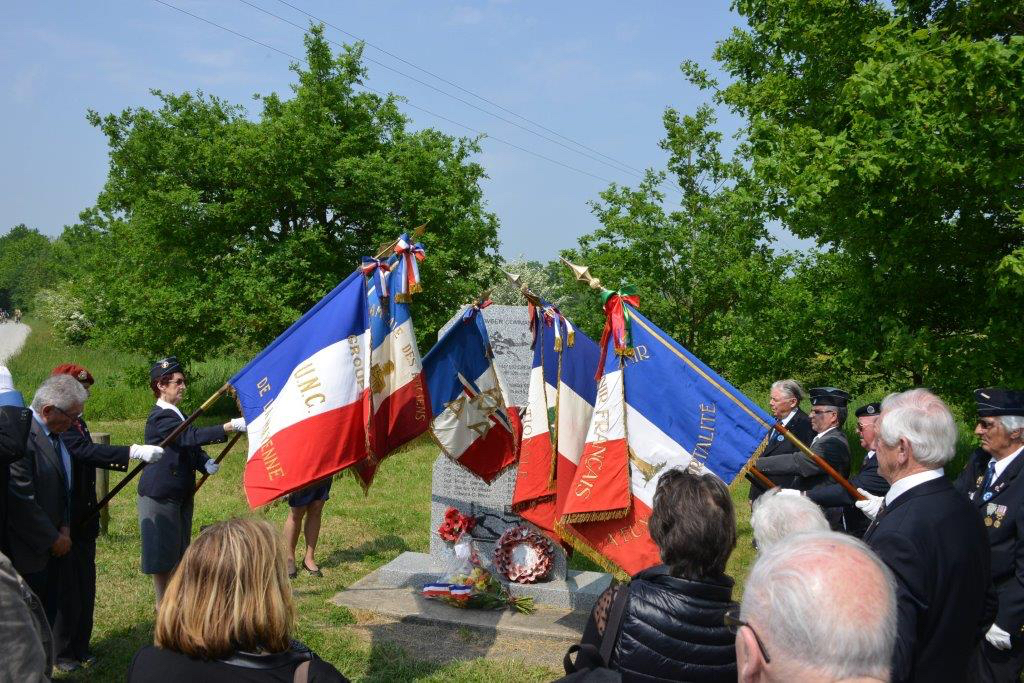
At the Valfleury Cemetery in Laval, representatives of local military and historical groups remembered VE-Day on May 8. The first photo shows the laying of wreaths and flowers before the graves of the 14 airmen in two airplanes.

The photos shown here are sent by Jean-Louis Cholet, who was one of the two people mist responsible for getting monuments erected to the crews of the two Halifax III bombers.

One plane was piloted by a Dutchman (my uncle Willem van Stockum) flying with the RAF after being trained with the RCAF.

The Laval student shown in first
photo laying flowers on the graves.
The other was piloted by an Australian (Thomas Henderson), whose son I met at the visit by the families of the airmen in 2014, during the 70th-anniversray year of D-Day. The two bombers that were downed had been on missions before and after D-Day, to remove gun emplacements and disrupt airfields and railway lines.

Every year, local students in the Laval area visit the gravesites and lay flowers on the graves of the flyers out of gratitude for the Liberation of France by the Allies.

With the placement of two monuments at the site of the crashes of the two Halifaxes, the annual memorials extend to these sites.

In 2014 I posted a memory of the coming-together of the relatives of the crews of the bombers. This was my third visit to the gravesite, but the first with my wife Alice, and with the largest number of relatives.

2018 – A wreath for the
Halifax piloted by
Tom Henderson.
It was a special pleasure also in 2014 for us to meet Dr. Rex Henderson, son of the Australian pilot of the second Halifax, and Rex's wife Deborah. Alice and I traveled with them  for several days to see the landing areas of the Normandy invasion.

Melbourne, Yorkshire, England

This year for the first time I went with my wife Alice to RAF Melbourne, the base in Yorkshire from which the planes from 10 Squadron took off.

I have written about this visit separately. In the post, I cite the statistic that 46 percent of all the crew members of the RAF Bomber Command were killed on missions. Perhaps some of the crew members believed that the statistics didn't apply to them, but the statistics don't know that.
2018 – Remembering the crew of one Halifax, piloted
by Willem van Stockum.

2018 – Honoring the crew.
Worldwide War Dead

Statistics hide the face of the human costs of war. But they are the only way to convey the magnitude of the death and destruction that Hitler generated.

Estimates of losses from WW2 sometimes differ for gruesomely competitive reasons – "We lost more people than you did." Wikipedia averages several estimates, which is not necessarily the best approach.

Below is how one source summarizes the deaths world-wide by country from World War II, ranked in order of the estimated loss.

Country
Millions Dead
1. Soviet Union (USSR)
25
2. China
15
3. Germany
8
4. Poland
5.7
5. Dutch East Indies
3.5
6. Japan
2.9
7. British India
2.1
8. French Indochina
1.6
9. Yugoslavia
1.4
10. Philippines
0.8
11. Romania
0.8
12. France
0.6
13. Greece
0.6
14. Hungary
0.6
15. Italy
0.5
16. United Kingdom
0.45
17. United States
0.42
18. Korea
0.4
19. Lithuania
0.35
20. Czechoslovakia
0.3
21. Netherlands
0.3
Total of These Countries
71.32
Source: https://www.secondworldwarhistory.com/world-war-2-statistics.asp

That's more than 71 million dead in these 21 countries. The losses weigh harder on countries that have a smaller population, and on population groups such as Jews who were targets of the Holocaust.

Thursday, June 2, 2016

BLOG VIEWS | 30K–Most-Read Posts

John Tepper Marlin in NYC. Photo
by Alice Tepper Marlin.
June 2016 – This blog, Warriors-Families, has just passed 30,000 page views. I try to post on this blog when the stories are about military or peace issues, but everything overlaps with everything else... 

Page views of my blogs on blogspot.com together are now past the  1.1 million mark.

Thank you for reading!

Here are the most-read posts for the month of May 2016. I am continuing to update the first on the list based on new information. When you see a June 2016 or later update in the subject line, it will be up to date. The Boer War post, #3, mentioning Charles Boissevain, was added only yesterday and will surely rise to #1 in a few days.

WW2 | 8. Hiding Jews in Holland–Bob Boissevain (Up...
Dec 2, 2014, 1 comment
US NAVY | Oct. 13–Navy's 240th Birthday
Oct 12, 2015
BOER WAR | May 31–Peace Treaty Signed
Jun 1, 2016
R.I.P. | Michael Intriligator, Peace and Security ...
Jul 8, 2014
FRANCE | June 10–Remembering Airmen Downed 70 Year...
Jun 13, 2014
VETS 3 | VA Loans–NYC Issues
Jun 11, 2013
VET STORY 2 | Franklin D'Olier, Founded American L...
Sep 17, 2013
WW2 | 12. Holland after the War (Updated Feb. 16, ...
Nov 2, 2014
VET STORY 8 | Edgar Jadwin, Author, "From a Milita...
Mar 5, 2016
ART BIZ | "Hope", Museum of Visionary Art - Yanni ...
Nov 6, 2015

Wednesday, June 10, 2015

BLOG VIEWS | 20K Views, Top Ten Posts

Thank you for reading and commenting. We just went past 20,000 page views.

These are the top ten posts, based on page views, since this blog was started in mid-2013:

7. Hiding Jews in Holland from the Nazis - Bob Boi... Dec 2, 2014 (Chapter 7 of a forthcoming book I am writing on the Dutch Resistance)

CHAMPS Closes Down Dec 10, 2014, 54 comments

D-Day Week 2014, 70th Anniversary Memorial for Dow... May 30, 2014

11. After the War - The Boissevain Family, Mengelb... Nov 2, 2014 (Chapter 11 of the book)

Tuesday, January 13, 2015

WW2 | 7. Escaping Nazi Holland–Hans de Beaufort (Updated Feb. 13, 2016)

The Westerbork, Holland, Concentration Camp, one of many in Holland.
Within five days of the Nazi invasion of Holland in May 1940, after the devastating bombing of Rotterdam, the Dutch Government capitulated to the Germans. Jewish residents of Holland, and many refugees from other countries, were trapped. So were others hunted by the SS, which was put in charge of Holland. (In other countries, the German Army command was a less thorough hunter.) It was difficult for those that the Nazis hunted to escape.

Ironically, Hitler used to make fun of sports hunters who used guns to kill their prey. He did not think that gave the animals a sporting chance. But in their hunt for human prey, Hitler's men were beyond ruthless.

What Happened to Jews Trapped in Holland

The Nazi invaders in Holland pursued their policy of racial cleansing in six steps:

1. The SS identified all Jewish people in Holland. This took the form of looking for lists with addresses. Unfortunately, in Holland this was an easy matter. Charities were supported by taxes, with allocations based on membership in each religion. Therefore everyone resident in the country was identified by religion. It was a simple enough matter to find these lists in official or private hands. Where these lists were found not to be complete, the SS would block off an area and search every house, as they did for their razzia recruitment raids, demanding papers for every resident.

2. It started slowly, but the Nazi occupiers in the Netherlands increasingly restricted those identified as Jewish from leading a normal life. Schools were closed to them, jobs, meeting places, transportation modes. In Amsterdam they were forced to live in ghettoes. Though many Jewish persons just waited and hoped that the war would be won by the Allies, which happened eventually, some of them tried to escape their fate.

3. They then pursued a procedure repeated in other occupied countries. I have investigated in the departmental Archives (in Laval), how Vichy France conducted their Jewish Policy in the Mayenne. Once identified, all Jews were required to make lists of all of their assets, under pain of severe penalties. Based on what I found in the Mayenne, compliance appears to have been high. Well-off people must have been misinformed about the use to which the list of assets would be put. Perhaps they were hoping that their assets would buy lenience from the authorities.

4. Once the assets were identified, the owners were required to bring in all titles, certificates, jewelry or cash for inspection. Once brought in, these assets were seized. They fueled the Nazi march as well as the energies of the SS in tracking down and deporting Jews. Doubtless some of the assets were not documented and went into the hands of the SS.

5. When all assets were accounted for, the owners were deported to concentration camps. The SS first sent them to the Westbork concentration camp in Drenthe, the Netherlands, where before the Occupation the Dutch brought Jewish refugees to be resettled. From Westbork they were taken in cattle-cars to death camps in Germany or, even more likely, Poland (most likely in Auschwitz, where between 1 and 2 million Jewish prisoners were killed; or Sobibór).  More than 100,000 Jewish people brought from Holland were gassed and cremated. It is not clear if, when they were being deported, they knew where they were going. Many were told, or expected, that they would be put to work in "labor camps". In fact most were on lists from the beginning to be exterminated.

6. In the camps, Jews were put to work (in Auschwitz, they were employed by the I. G. Farben plant). If they couldn't do the work, or were worn out, or if they caused trouble of any kind, they were sent to the Zyklon B chambers and then the ovens.

I am indebted to Charles Boissevain, who was six years old in Holland when the Nazis invaded, for information on how the Nazi procedures worked in the Netherlands, which he has described to me in emails in January 2015.

How Jews Escaped

The job of the Resistance was to intercept the procedures at some point to provide Jews with an escape route. It was not easy because the Netherlands has a total area of 16,000 square miles (41,500 sq. km.), about twice the size of New Jersey. Of this area, inland water accounts for nearly 3,000 square miles or about 7,600 square km.

Jean Michel Caubo
1. Some tried to escape the country, from the very first day of the war, usually following the Dunkirk route, escaping by boat, and then finding their way to the UK. They traveled in very small boats, even canoes, which were not meant for crossing the North Sea. Apart from the perils of the sea, German warships patrolled the waters and mines were left to blow up marine transportation. Many of those who tried to cross either were lost at sea or were captured by the Nazis. A friend of Charles Boissevain has written the stories of some of those who actually made the escape, the "Engelandvaarders" (England Sailers). His book will be published in May 2015. A monument to them was recently unveiled in Holland.

2. There are just three ways out of the Netherlands other than by air - Germany, the English Channel, or Belgium:
  • To Germany. Most of Holland's land border is with Germany. But going to Germany was like putting your head into the mouth of a crocodile.
  • Via the North Sea to the UK. Holland has a long coast to the north and west, bordering on the North Sea. The UK is close and was an attractive destination, but the trip, as mentioned, was dangerous. 
  • To Belgium. Belgium was much safer than Holland, perhaps because the Belgians spoke  French as well as English and the Nazis felt less at ease there. The famous Dutch Jewish violin player Theo Olof succeeded in surviving in Brussels. 
  • Via Belgium to Paris. The best plan was to go through Belgium to France (and preferably from there to Switzerland or Spain, which were not occupied by the Nazis). The so-called "Dutch-Paris Line" transported refugees from the Netherlands to the Gare du Nord in Paris. Altogether an estimated 1,080 people were enabled to escape from the Netherlands this way, about 800 of them Jewish. The rest were bailed-out RAF pilots who had been rescued (112) or were other Nazi targets (170), most of them being hunted because of their work with the Dutch Resistance. They all were met in the Gare du Nord by a French-residing Dutchman, Jean Michel Caubo. The French Railways cooperated with him. He gave the refugees shelter and food and then handed them over to French Resistance workers, who eventually brought them to the Swiss and the Spanish border. Caubo rescued all of the previously mentioned 800 Jewish fugitives. He was caught because of the negligence of a co-worker. He was questioned, tortured, and then brought to a Nazi concentration camp where he was killed. After the war he was posthumously awarded a UK decoration, the U.S. Medal of Freedom, the Dutch Resistance Memorial Cross, and the French Croix d'Honneur. But, so far, he is not listed in the Yad Vashem.
I was recently contacted by Charles Boisevain who summarized the available data:
During the war some 7,900 - 9,000 persons escaped the Netherlands, especially in the beginning. Official figures, published in 1995 by the Dutch Verzetsmuseum (Resistance Museum):
4,000 soldiers and other military - especially in the beginning of the war.  800 foreign pilots - some 200 of them by the socalled Dutch-Paris Line.1,700 England voyagers (Engelandvaarders) - some 170 in small boats, the rest via Belgium and France. A couple of them also by the Dutch-Paris Line.6,500 altogether, many of them via the Dutch-Paris Line.1,400 - 2,500 Jews, who were until August 1942 admitted to Switzerland, some 800 of them via the Dutch-Paris Line!7,900 - 9,000 persons altogether. Some 1200-1500 via the Dutch-Paris Line. This D-PL was the train arriving at the Gare du Nord in Paris. There they were picked up by a very brave Dutchman, Caubo, who lived in Paris for 20 years and worked around the train organisations. He brought them to others who could help them further.
Charles Boissevain has been trying to get a Yad Vashem award for Caubo:
Jean Michel Caubo saved/rescued some 800 Jews and paid for it with his life. In 1944 he was caught and died in a concentration camp. The Yad Vashem Authority in Jerusalem, which honors with a Yad Vashem Award the so-called Righteous Among the Nations, would not give the award to Caubo. In 2009 Maarten Eliasar (a Jewish physician), Dick Verkijk (a journalist now living in the USA) and I tried again. We collected some 300 signatures via the newspaper Trouw from many persons - well-known Dutch politicians and others, Dutch and Israeli rabbis etc. You can read the Appeal (in English) and half of the names on the internet. 
Was there some military or other organization that helped the soldiers or escapees? Charles says:
My father Robert Lucas Boissevain was not a member of [such an] organisation, though he may have helped some individuals. Keep in mind that he had a rule that he never informed anybody (certainly not his family, wife and children!) to protect them. [Likewise,] neither the pilots nor the England voyagers nor the escaping Jews had any organisation. So my father could not have been a member of any organisation that helped persons to save their lives abroad. However, it is possible that he helped individuals, perhaps it was likely, nobody knows. 
Helping Aviators Escape–Hans de Beaufort

Hans de Beaufort was the son of Dr. Lieven Ferdinand (Fik) de Beaufort and Catharina Josephina (Teau) Boissevain de Beaufort (1885-1922, NP 69), youngest daughter of Charles the newspaper editor. She died very young in 1922. Hans was shot by the Nazis in a Dijon prison in 1942.

He had been engaged in forging credentials for downed Allied air crew in Holland so that they could enter Switzerland. He was a competitive motorcycle racer and used his skills to transport airmen. The top prize now in Dutch motorcycle racing is now the Hans de Beaufort Cup, which is awarded on the basis not only of racing skill but also character in the form of persistence and decency.

My mother, Hilda van Stockum, was sent a copy of Hans's last letter to his father before he was executed. She translated it for me two years before she died in 2006. It is very moving. I have posted it here [click on Word doc] along with some information about the Hans de Beaufort Cup.
  
The above post is a draft of a chapter of a forthcoming book: The Boissevain Family and the Dutch Resistance, 1940-45.

To see a chapter outline and links to other chapters, go here.