Showing posts with label World War II. Show all posts

Tuesday, May 8, 2018

VE DAY | May 8, End of WWII in Europe (Updated May 10)

Canadian Troops Liberate Amsterdam, 1945.
May 8, 2018 – I returned from the Netherlands yesterday to New York City.

Today the world celebrates VE- Day, that day in 1945 when World War II hostilities ceased in Europe.

In the former Soviet Union the celebration is delayed by one day, to May 9, because fighting there continued for another day.

The Soviet Union lost a higher percentage of its population (15%) than any other Allies – led by Belarus (25%) and Poland and the Ukraine (18% each).

Overveen, The Netherlands, May 4

On Friday, May 4, I was in Holland remembering the war dead with a visit to the Honorary Cemetery (Eerebegraafplaats Bloemendaal), which is identified as being in Bloemendaal but is accessed from the town of Overveen. It was Remembrance Day (Dodenherdenking) in Holland. On that day, the Netherlands remembers those who died in combat during WWII and in subsequent combat or peace-keeping operations.

The following day, the country celebrates Liberation Day (Bevrijdingsdag), a day of festivities at the ending of World War II for the Dutch in 1945, after the long Hunger Winter of 1944-45. 

The hard-working Dutch people do not annually close their banks on either May 4 or May 5. But government workers have a holiday on May 5 and some Dutch people start their vacations on Kings' Day, since 2014 on April 27 (King Willem Alexander's birthday) and continue through May 5. 


Memorials and festivals, such as a music festival in Amsterdam (the Bevrijdingsfestival), are widespread and many schools are on vacation at that time. Liberation Day is officially a holiday for everyone only when the last two digits of the year are divisible by five. So 2020 will be the next big celebration.

Here's how Hilda van Stockum described the joy that flooded Holland on May 5, 1945, in her 1962 book, The Winged Watchman:
On the fifth of May, Holland was liberated. Canadian troops marched into the villages and cities. Women and girls threw flowers and jumped on cars and tanks. Everywhere the Dutch flag waved. Children held bunched of flowers. People danced in the streets. Bells rang.
Father and the boys set the Watchman in joy. Mother fetched flags out of her trunk, which they strung from one wing to the other, plaiting the sails through the gates in decorative patterns.
They were free!
Laval, France, May 8


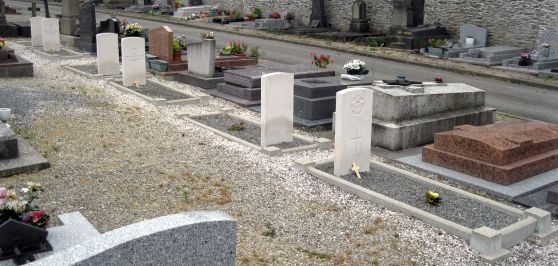
Laying of wreaths and flowers. The gravestone at
lower right is different form the others because it was
sent from the Dutch Government, not the British.
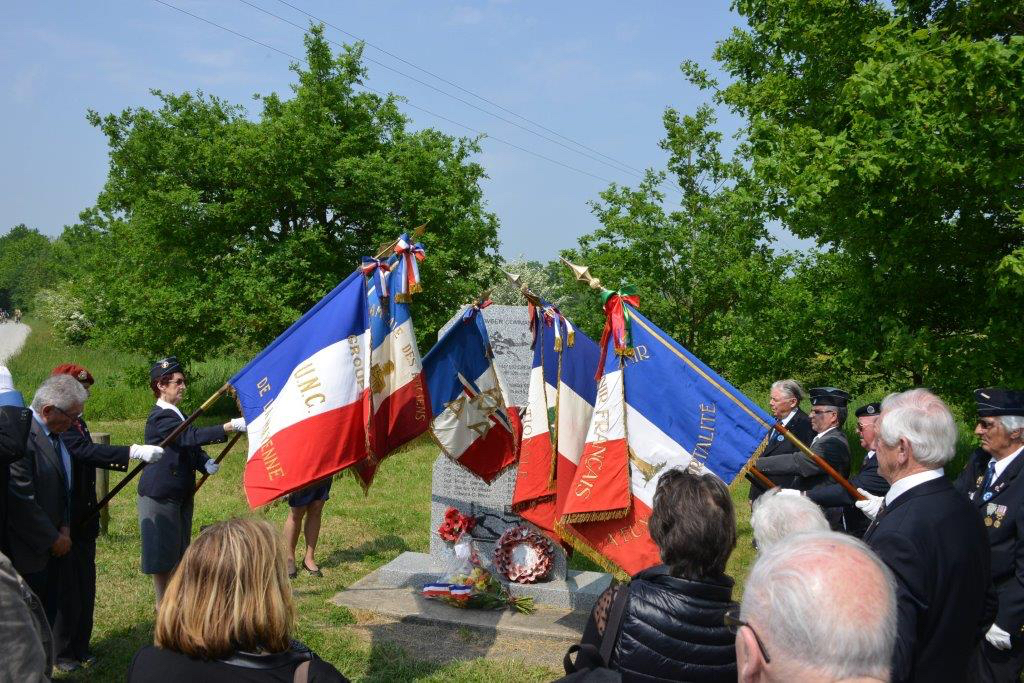
At the Valfleury Cemetery in Laval, representatives of local military and historical groups remembered VE-Day on May 8. The first photo shows the laying of wreaths and flowers before the graves of the 14 airmen in two airplanes.

The photos shown here are sent by Jean-Louis Cholet, who was one of the two people mist responsible for getting monuments erected to the crews of the two Halifax III bombers.

One plane was piloted by a Dutchman (my uncle Willem van Stockum) flying with the RAF after being trained with the RCAF.

The Laval student shown in first
photo laying flowers on the graves.
The other was piloted by an Australian (Thomas Henderson), whose son I met at the visit by the families of the airmen in 2014, during the 70th-anniversray year of D-Day. The two bombers that were downed had been on missions before and after D-Day, to remove gun emplacements and disrupt airfields and railway lines.

Every year, local students in the Laval area visit the gravesites and lay flowers on the graves of the flyers out of gratitude for the Liberation of France by the Allies.

With the placement of two monuments at the site of the crashes of the two Halifaxes, the annual memorials extend to these sites.

In 2014 I posted a memory of the coming-together of the relatives of the crews of the bombers. This was my third visit to the gravesite, but the first with my wife Alice, and with the largest number of relatives.

2018 – A wreath for the
Halifax piloted by
Tom Henderson.
It was a special pleasure also in 2014 for us to meet Dr. Rex Henderson, son of the Australian pilot of the second Halifax, and Rex's wife Deborah. Alice and I traveled with them  for several days to see the landing areas of the Normandy invasion.

Melbourne, Yorkshire, England

This year for the first time I went with my wife Alice to RAF Melbourne, the base in Yorkshire from which the planes from 10 Squadron took off.

I have written about this visit separately. In the post, I cite the statistic that 46 percent of all the crew members of the RAF Bomber Command were killed on missions. Perhaps some of the crew members believed that the statistics didn't apply to them, but the statistics don't know that.
2018 – Remembering the crew of one Halifax, piloted
by Willem van Stockum.

2018 – Honoring the crew.
Worldwide War Dead

Statistics hide the face of the human costs of war. But they are the only way to convey the magnitude of the death and destruction that Hitler generated.

Estimates of losses from WW2 sometimes differ for gruesomely competitive reasons – "We lost more people than you did." Wikipedia averages several estimates, which is not necessarily the best approach.

Below is how one source summarizes the deaths world-wide by country from World War II, ranked in order of the estimated loss.

Country
Millions Dead
1. Soviet Union (USSR)
25
2. China
15
3. Germany
8
4. Poland
5.7
5. Dutch East Indies
3.5
6. Japan
2.9
7. British India
2.1
8. French Indochina
1.6
9. Yugoslavia
1.4
10. Philippines
0.8
11. Romania
0.8
12. France
0.6
13. Greece
0.6
14. Hungary
0.6
15. Italy
0.5
16. United Kingdom
0.45
17. United States
0.42
18. Korea
0.4
19. Lithuania
0.35
20. Czechoslovakia
0.3
21. Netherlands
0.3
Total of These Countries
71.32
Source: https://www.secondworldwarhistory.com/world-war-2-statistics.asp

That's more than 71 million dead in these 21 countries. The losses weigh harder on countries that have a smaller population, and on population groups such as Jews who were targets of the Holocaust.

Sunday, July 10, 2016

WW2 | July 10–Battle of Britain Begins

RAF pilots scrambling. My uncle Willem was an
RAF pilot. He was shot down over Laval, France
 on June 10, 1944 during the week of D-Day,
and is buried there.
This day in 1940, the Germans began bombing Britain, the beginning of the "Battle of Britain" that lasted three and a half months.

It was a significant turning point of World War II, as at the end of the bombing, Germany’s Luftwaffe failed to gain air superiority over the Royal Air Force.

As Prime Minister Winston Churchill said: "Never in the field of human conflict was so much owed by so many to so few."

Britain’s decisive victory saved the country from a ground invasion and possible occupation by German forces and showed that air power alone could be used to win a major battle.

On the first day, 120 German bombers and fighters struck a British shipping convoy in the Channel, while 70 more attacked dockyards in South Wales. Britain had only 600 fighters while the Germans had 1,300. But:
  • Britain had an an effective radar system.
  • Spitfires could make tighter turns Germany’s ME109s, enabling it to elude pursuers and come up behind them. 
  • The British Hurricanes could carry 40mm cannon. These planes shot down, with American Browning machine guns, more than 1,500 Luftwaffe planes. 
  • The German single-engine fighters had limited flight radius and their bombers lacked bomb-load capacity to cause permanent damage. 
  • Britain had the advantage of a unified command, while German infighting was weakened by poor timing and intelligence. 
  • The British people were undaunted. When the government asked for all available aluminum to the brought to he Ministry of Aircraft Production to turn into airplanes, the public responded.
Many of the RAF pilots were from Commonwealth countries like Australia and Canada. My uncle Willem van Stockum was teaching mathematics at the University of Maryland when he volunteered in Canada to join the RCAF and was transferred to become a bomber pilot for 10 Squadron in Melbourne, Yorkshire. (Story is here: https://nyctimetraveler.blogspot.com/2020/07/foreign-flyers-july-10-battle-of.html

Friday, May 29, 2015

WW2 | Spies–Choices

This book about World War II offers the reader choices - a
clever way to involve readers in history.
The last three days I have been at BookExpo America - the largest annual book convention in the USA - and I picked up a book called World War II Spies by Michael Burgan, published by You Choose Books, part of Capstone Press.

The You Choose books are an ingenious way of teaching history. The choices help the reader understand that history is not something that had to happen the way it did. History happened because people made choices that affected the outcomes.

The Spies book had special meaning for me because my father worked for the American spy service, the Office of Strategic Services (O.S.S.) during World War II - first in Dublin and then in London.

The book starts with a well-written summary of how Hitler came to power and began by sending troops into countries where many Germans lived. Italy invaded North Africa and Japan invaded China. They formed what was called the Axis.

Then in 1941, Japan attacked Pearl Harbor and F.D.R. and the Congress declared war on the Axis. You, the reader, are recruited for spying work, and you are asked to make choices. It's the same approach to teaching history that is used within the Verzetsmuseum, the Resistance Museum in Amsterdam ("Your country has been occupied. Do you (1) collaborate and get favors from the occupiers, or (2) just behave as if nothing has happened, or do you (3) join the Resistance at great peril?")

The first three options are:
  • You are in Denmark and you want to help fight the Nazis.
  • You are a German and you want to join the Abwehr, the German spying service.
  • You are an American and want to join the O.S.S.
Spoiler to follow: 

The outcomes of the different paths are sometimes successes where you the reader survive.

But sometimes they end in the death of the reader. Shot by the Nazis or dead when a parachute doesn't open. But you know as you die you did something to fight evil.

The endings depend on the choices, as in real life.

At each ending, the reader is sent to the concluding section which tells how the war concluded. The idea that one could have affected the outcome of the war is not in this book. That would be Science Fiction, where alternative futures are offered by someone coming back from the future. That is the theme of, for example, Time Bomber by Robert Wack.

This book is well written and designed, and is extremely instructive. I recommend it.

I have also read another book in this series, World War II Pilots.

Monday, December 8, 2014

WW2 | 70 Years Later

Alfred Eisenstaedt's famed photo of nurse
Edith Shain and sailor celebrating VE Day. 
In 2014 there were many memorials to D-Day and to those who lost their lives in that year. The winter of 1944-45 was deadly in Holland as the Nazis diverted what food there was to their own troops. In 2015 the events will be more celebratory, as victory was achieved in Europe on V-E Day - May 8-9.

Here are two posts that look ahead to 2015:

RAF No. 10 Squadron to Celebrate Its 100th Anniversary in 2015

V-E Day May 7-8, 1945 - UN Remembrance Days

Here are my ten posts this past year that related to D-Day, the most recent ones first. If you have a comment on any of these, please post it or let me know - email me at  teppermarlin(a t)aol.com:

Monuments Unveiled to 14 Airmen (Laval, June 6)
Willem van Stockum’s Last Letter Home
Omaha Beach
Total Allied Deaths in France, World War II
Vaufleury Cemetery - Forgotten Graves in another part of the cemetery
Vaufleury Cemetery - Ceremonies, 2014
My Third Visit to My Uncle’s Grave
Memorial Visit to Normandy, Laval
70th Anniversary of “A Soldier’s Creed” 
10 It’s 70 Years After D-Day in Normandy June 6, 1944

Saturday, August 23, 2014

French Gratitude to the Allies - Hard to Track

Laval story on the monument to the MZ 684 crew. John
Tepper Marlin points to his uncle's name, F/O W.J. van
Stockum, Cpl. Pamela Turney to her great-uncle's name,
Sgt. Fred Beales.
Richard Rubin has a fine article on how the French remember, with gratitude, the U.S. entry into World War I.

He says that when the French speak about "The War" they are talking about World War I.

I think that depends on the region of France and which war had the most impact in that region.

When we were in Normandy and Mayenne in June, as the 70th anniversary of D-Day was being remembered, "The War" was World War II.

And the French there were just as grateful for the support of the Allies in World War II as they were for their support in World War I.

Just as it is hard sometimes for someone writing thank-you notes to keep track of which guest gave which gift, it is hard sometimes for the French to keep the Allies straight.

The story in the Laval, Mayenne, France newspaper about the unveiling of monument to the crews of two planes that were shot down in the week after D-Day thanks the "britannique et canadien", "British and Canadian" airmen. In fact it was more complex than that.

The Halifax MZ-684 was piloted by a Dutchman (Flying Officer W. J. van Stockum, via the R.C.A.F.) resident in the United States and awaiting U.S. citizenship. The other plane, the Halifax MZ-352, was piloted by an Australian (Flying Officer Thomas Henderson, flying for the Australian Air Force).

August 24, 2014 - Postscript

A friend writes to me saying that The New York Times story and my tributes to the sacrifices of the Allies is lovely and sentimental but how about what is going on today? Back in the days of the Black and Tans, there were people charging The Times of London with "Afghanistanism" -writing strong editorials about atrocities in Afghanistan while overlooking the atrocities in Ireland.

My answer is that it is precisely when we have crisis points in the world that we need to look back and see how we got through the crises of the past. I am aware that Forbes is tracking every omission or error in reporting on the Middle East by the The New York Times. The finances of the newspaper business have changed, and we may not be able to rely as much on only one or two sources for our information.

I am not ready to trade in The New York Times for Forbes, but maybe one result of the democratization of news gathering, news dissemination and opinion-writing is that bloggers have to think about their changing role:

  • Should bloggers only tackle topic areas where they feel less comfortable?
  • Or should they make an effort to go into topic areas where they feel less sure of themselves, but where their thinking and opinions are needed?


Wednesday, June 18, 2014

The Allies in France - September 1939-May 1945

On D-Day 2014, Queen Elizabeth II pays her respects to British
 and other Allied soldiers and airmen who died in the
Liberation of France.
The story of British and Allied action in Europe is told in the introductory pages of the French section of The War Dead of the Commonwealth, 1939-1945.

The story helps explain the burial of World War II British and other Allied war dead in the Vaufleury Cemetery in Laval, as early as 1939.

Many British Commonwealth and other Allied soldiers and airmen are buried in France as a consequence of both World Wars.

The graves from World War II were less than one-tenth the number from World War I. But often the WWII deaths came on top of those sustained in the prior war by the same families.

WW I - 530,000 graves
WW II - 45,000 graves

The War in France Started in September 1939. After Britain and France declared war on Germany on September 3, 1939, following Hitler's invasion of Poland. A British Expeditionary Force went at soon to France - landing troops at Cherbourg and supplies and vehicles at Brest, Nantes and St. Nazaire.

The French and British prepared a joint detailed plan for the defense of France. But in May 1940 the Germans attacked and drove rapidly to the south, splitting the Allied forces in half. By May 26-28, a large portion of the British army was trapped in Dunkirk. The famous evacuation saved the lives of many British and French soldiers, who as a matter of policy were evacuated in equal proportions:

211,267 fit British soldiers
13,053 British casualties
141,841 Allied troops, mostly French

On June 12, 1940, General Weygand announced that the French Army was incapable of further resistance. The Germans entered Paris on June 14. The French asked for an armistice on June 17. The last British troops were evacuated from Cherbourg on June 18, when the Germans were only three miles from the harbor.

During the next four years, commando raids were successfully conducted. A major attack in 1942 on Dieppe by the RCAF was successful at gaining information, but at a huge cost. Of 6,100 troops that embarked, 3,648 were killed, wounded, missing or captured; many are buried in Hautot-sur-Mer and Rouen.

Secret agents also were sent to France by a joint British-U.S. organization that assisted patriots in France. The value of this work, which involved loss of more than 130 Anglo-American lives, became clear after D-Day, when resistance groups guided Allied troops after the landing. The value of their help was estimated as equal to ten divisions of regular troops.

D-Day, June 6, 1944. On D-Day, the allied forces were led by General Dwight Eisenhower as Supreme Commander, with Air Chief Marshall Sir Arthur Tedder as Deputy Supreme Commander.  General Sir Bernard L. Montgomery commanded the land forces, Admiral Sir Bertram Ramsey the naval forces and Air Chief Marshal Sir Trafford Leigh-Mallory commanded the air forces.

The United States was given the western beaches (Utah and Omaha) to attack because supplies were coming directly from the United States and it was important to capture Cherbourg and ports in Brittany quickly and deliver supplies for the large numbers of troops who were landing. The British were given the remaining three beaches to the east, with the Canadian troops between two British armies.

To prepare for D-Day and the subsequent assault southward, bombing was essential to reduce German air strength and attack German essential industries and communications. Bridges over the Seine and Loire were all destroyed. Airfields within 130 miles of the battle area were attacked. Coastal artillery positions and radar installations were bombed and French and belgian railway services were disrupted.

The weather around D-Day was the worst in 20 years, but helped surprise the Germans, who did not think an attack was possible under these conditions. Casualties were fewer than expected, except on Omaha Beach and, to a lesser extent, Utah Beach.

One reason for the slaughter on Omaha Beach is that bombers who were supposed to take out machine-gun emplacements over the beach were told at the last minute to delay their bombardment by a few seconds to avoid hitting U.S. troops. This resulted in bombs being dropped beyond the target.

Because the Germans continued to believe that the real attack would come at Calais, they kept a million troops tied up there until July, by which time it was too late to stop the advancing Allied Armies. Further German efforts to stop the liberation of France were, in the large scheme of things, of a token nature.

Casualties in the Normandy area from D-Day to August 25, 1944
German losses: 240,000 killed, 210,000 captured
Allied losses: 200,000 killed, wounded and missing

V-E Day, May 8-9, 1945. It was on May 8, 1945 in western Europe, May 9 on the eastern European front. Stalin insisted that the Germans surrender to him personally, which added a day.

Saturday, June 14, 2014

WW2 | Laval Military Graves Include 20 Allies

Six additional British and Commonwealth graves in
a different part of Vaufleury Cemetery from the 14
airmen from the two Halifax bombers. One of the six
was Australian Flying Officer K. J. Trask. 
The 14 airmen from the two Halifax planes that crashed on June 10, 1944, are buried in Section E, Sub-section D, row 1, a special section of the Vaufleury communal cemetery in Laval. Photos are posted here on a Belgian site. Six additional graves are mentioned.

I wondered why there were 20 names listed in the cemetery when the number of airmen who crashed was 14 (two crews of seven men each). The number of tombstones in the cemetery in the airmen's section is 14. Where did the other six come from and where are they located?

The Belgian link provided above gives some of the answers. It cites a 55-page book on French grave sites published in 1960 by the Commonwealth War Graves Commission. I now have a copy of this book.

The six additional graves are in a different part of the Vaufleury Cemetery. The five soldiers and one Australian airman are in section A, sub-section A, row 28. 

The airman is Flying Officer Kenneth John Trask from the Royal Australian Air Force, who died November 11, 1943 at age 24, and is buried in grave #42500. He was the son of Albert Oswald Trask and Claudia Adair Trask of Camberwell, Victoria, Australia.

The five soldiers are:
- Frank Edward Clark III, age 34 (the second-oldest of the victims buried in the cemetery, two years younger than Sgt. Peake in the plane piloted by Henderson; both van Stockum and Wicks were 33 when they were killed).
- Ambrose Hunt, 
- William Morgan, 
- James Enoch Sharratt, and 
- Arthur Stokes.

Here is a complete list in the form of a table. The ages of two of the dead are missing:
LAST NAME First Names Citizen Enlisted Age, Date Died Rank, Assignment, Service Number
BEALES Fred
Canada
RCAF
20, 10-6-44
Pilot Officer (Air Gnr.), 10 (R.A.F.) Sqdn,  J/89951
BRADBURY Hugh
UK
RAF
20, 10-6-44
Sergeant (Air Bomber), Volunteer Reserve 10 Sqdn., 1425774
BROTHERTON Leslie Arthur
UK
RAF
24, 10-6-44
Sergeant (Air Gnr.) Volunteer Reserve 10 Sqdn. 1576786
CLARK Frank Edward
UK
Royal Artill.
34, 23-9-39
Warrant Officer Class III (T S M), 27 Field Regt. 1064423
DANIEL GILBERT
UK
RAF
22, 10-6-44
Flying Officer (Nav.), 10 Sqdn. 151788
ELLYATT John
UK
RAF
27, 10-6-44
Flying Officer (Flt Engr.) Royal Air Force 10 Sqdn. 51911
GAINES Philip
UK
RAF
?, 10-6-44
Sergeant (W. Op.), Volunteer Reserve 10 Sqdn. 1549492
HENDERSON Norman Random
UK
RAF
21, 10-6-44
Flying Officer (Nav.), Volunteer Reserve 10 Sqdn. 144341
HENDERSON Thomas Whyndam
Australia
RAAF
27, 10-6-44
Pilot Officer, 10 Sqdn. 415981
HUNT Ambrose
UK
Manch.Reg.
26, 27-9-39
Private, 2nd Bn. 3524489
MARSHALL Robert Keith
UK
RAF
30, 10-6-44
Flying Officer (Bomb Aimer) Volunteer Res. 10 Sqdn. 151917
MASON Albert
UK
RAF
?, 10-6-44
Sergeant (Air Gnr.) Volunteer Reserve 10 Sqdn. 2211801
MORGAN William 
UK
RoyalArmy
23, 15-5-40
Driver, Service Corps, 528 Ammunition Company. T/110288
PEAKE Stanley William
UK
RAF
36, 10-6-44
Sergeant (Flt. Engr.) Volunteer Reserve 10 Sqdn. 1606629
PERKINS Alfred Charles
UK
RAF
22. 10-6-44
Sergeant (W. Op. [Air]) Volunteer Reserve 10 Sqdn. 1461925
SHARRATT James Enoch
UK
Royal Artill.
27, 23-9-39
Warrant Officer Class II (B.S.M.) 27 Field Regt. 1070673
STOKES Arthur
UK
Royal Artill.
21, 10-10-39
Lance Bombardier, 1 Heavy Regt. 886972
TRASK Kenneth John
Australia
RAAF
24, 11-11-43
Flying Officer, 409357
VAN STOCKUM Willem Jacob
Holland
RCAF
33, 10-6-44
Flying Officer (Pilot), Volunteer Reserve 10 Sqdn., 144600
WICKS Edward Charles
UK
RAF
33, 10-6-44
Flight Sergeant (Air Gnr.) Volunteer Res. 10 Sqdn.  1376921.

For those who want to do their own research on World War II airplanes and grave sites, here are two comprehensive sources:

List of planes that crashed in France (text in French) -

Sources of information on downed airplanes anywhere in Europe in WWII (in English), showing escape routes and acknowledging help from the local Resistance -

Thursday, March 20, 2014

Survey of Veterans - Unemployment Fell in 2013

Unemployment Rate for Veterans - White House Chart. 
Here are highlights of 2013 job data on veterans, based on a special survey of veterans as well as the regular BLS sample of civilian employment. The data were released today (March 20) by the BLS:
  • Unemployment among Gulf War II veterans was down slightly to 9.0 percent in 2013.  For all veterans, it fell to 6.6 percent. The unemployment rate for all female veterans declined to 6.9 percent. The rate for male veterans fell to 6.5 percent.  Among the 722,000 unemployed veterans, 60 percent were 45 years old and over; 35 percent were 25-44, and 5 percent were 18-24. (Tables A, 2A.) 
  • Number of Veterans by Period of Service.  The country's 21.4 million veterans were 9 percent of the civilian non-institutional population 18 and over. Veterans are more likely than nonveterans to be men and to be older than nonveterans, partly because veterans who served during World War II, the Korean War, and the Vietnam era account for nearly one-half (9.8 million) of all veterans, and only men were drafted. More than one-fourth of veterans (6.1 million) served during the Gulf War era. Another one-fourth (5.5 million) served outside the designated wartime periods. (Table 1.) 
  • Variation by State. The unemployment rate of veterans varied by state from above 10 percent in Michigan and New Jersey to below 4 percent in Delaware, Iowa, North Dakota, Vermont, and Virginia. (Table 6A.) 
  • Gulf War II Veterans.  Of the nation's veterans, 2.8 million served during Gulf War era II. Of them, 20 percent were women, compared with 4 percent of veterans from World War II, the Korean War, and the Vietnam era. More than half of Gulf War II veterans were aged 25-34.  Among Gulf War II veterans, the unemployment rates for men (8.8 percent) and women (9.6 percent) were not statistically different from the prior year (9.5 percent and 12.5 percent). Among women, the unemployment rate for Gulf War II veterans (9.6 percent) was higher than the rate for nonveterans (6.8 percent).  The unemployment rate for male Gulf War II veterans (8.8 percent) was higher than the rate for male nonveterans (7.5 percent) in 2013. (Tables A,1, 2A, 2C.)
  • Unemployment by Age among Gulf War II Veterans. The unemployment rates differed by age. Male Gulf War II veterans18-24 had a higher unemployment rate, 24.3 percent, than male nonveterans of the same age group, 15.8 percent. For those 25-34, male veterans also had a higher rate, 9.2 percent, than male nonveterans, 7.5 percent. For men 35 and older, unemployment rates were little different for Gulf War II veterans and nonveterans. (Table 2B.) 
  • Occupations of Gulf War II Veterans. Veterans of Gulf War II and nonveterans had similar occupations in 2013 after accounting for gender. About one-third of the employed men in both groups worked in management and professional occupations, a higher proportion than in any other major occupational group. Among employed women, more than 40 percent of Gulf War II veterans and nonveterans worked in management and professional occupations.  A higher proportion of employed Gulf War II veterans worked in the public sector in 2013, 28 percent, than employed nonveterans, 14 percent. The federal government employed 16 percent of Gulf War II veterans, eight times the share (2 percent) of employed nonveterans. Of Gulf War II veterans, 40 percent reported serving in Iraq or Afghanistan. These veterans had an unemployment rate of 10.2 percent, little different from Gulf War II veterans who served elsewhere (10.9 percent). (Tables 4, 5, 10.) 
  • Gulf War I Veterans.  For the 3.2 million veterans who served during Gulf War I (August 1990 to August 2001), the proportion that were women (19 percent) was similar to that of Gulf War II veterans. Almost all Gulf War I veterans were age 35 and over (91 percent) in 2013, compared with 41 percent of Gulf War II veterans. In 2013, the unemployment rates for male and female Gulf War I veterans were 5.7 percent and 5.3 percent, respectively, lower than the rates for their Gulf War II veteran counterparts (8.8 percent and 9.6 percent, respectively). These differences in the unemployment rates reflect, at least in part, the older age profile of veterans who served during Gulf War I. Younger workers, veterans or nonveterans, are more likely to be unemployed than older workers. Unemployment rates of Gulf War I veterans were little different from their nonveteran counterparts of the same age and gender groups. (Tables 1, 2A, 2B, 2C.) 
  • Veterans of World War II, the Korean War, and the Vietnam Era.  Of all veterans, 9.8 million served during World War II, the Korean War, or the Vietnam era. All of them were at least 55 years old, and more than 70 percent were at least 65 years old. Nearly all (96 percent) of these veterans were men. In 2013, 30.0 percent of male veterans of these wartime periods were in the labor force, and their unemployment rate was 6.5 percent. Male veterans of these wartime periods had lower labor force participation rates than did male nonveterans in the same age categories. (Tables 1, 2B.) 
  • Veterans of Other (Non-War) Service Periods.  A total of 5.5 million veterans served on active duty during "other service periods," mainly between the Korean War and the Vietnam era, and between the Vietnam era and Gulf War I. This group is concentrated in two age ranges - 38 percent were 45-54 and another 38 percent were 65 years and over, for a total of 76 percent. Men account for 9 in 10 veterans of "other service periods". Among most age groups, male veterans of service periods between the designated wartime periods had unemployment rates that were little different than those of male nonveterans. (Tables 1, 2A, 2B.)
  • Disabled Veterans. About 3.2 million veterans, or 15 percent,  reported a service-connected disability. The rate was nearly twice the overall rate, 29 percent, for Gulf War II veterans. Veterans with a service-connected disability had an unemployment rate of 6.2 percent, little different from the rate for veterans with no disability (6.6 percent). One in three employed veterans with a service-connected disability worked in the public sector, a higher share than veterans with no disability, for whom the ratio was one in five. Regardless of period of service, 31 percent of employed veterans with a disability worked in federal, state, or local government, much higher than the 19 percent of veterans with no disability and 13 percent of nonveterans. The federal government employed 19 percent of veterans with a disability, nearly three times the rate, 7 percent, of veterans with no disability, and 2 percent of employed nonveterans. (Tables 7, 8.) 
  • Disabled Veterans by Severity of Disability.  Veterans with a service-connected disability are assigned a disability rating from 0 to 100 percent, in increments of 10 percentage points, depending on the severity of the condition. Among veterans with a service-connected disability, 35 percent reported a disability rating below 30 percent, while about 3 in 10 had a rating of 60 percent or higher. Veterans with a service-connected disability rating below 30 percent (i.e., 56 percent of all veterans) were nearly twice as likely to be in the labor force as those with a rating of 60 percent or higher (i.e., 28.9 percent of veterans). 
  • Employment and Unemployment among Disabled Veterans. Of Gulf War II veterans with a service-connected disability, 70.5 percent were in the labor force, lower than the labor force participation rate of 85.4 percent for veterans from this period with no service-connected disability. Among Gulf War II veterans, the unemployment rate of those with a disability was 8.6 percent, not statistically different from those with no disability (11.1 percent). Nearly 20 percent (589,000) of veterans who served during Gulf War I reported a service-connected disability. Their labor force participation rate (71.3 percent) was lower than the rate for veterans from the era who did not have a disability (86.8 percent). Unemployment rates for Gulf War I veterans with service-connected disabilities, 4.1 percent, was not  statistically different from that of those without, 6.5 percent. Among the 1.3 million veterans with a service-connected disability from World War II, the Korean War, and the Vietnam eras, 16.8 percent were in the labor force, compared with 30.3 percent of veterans from these periods without. The unemployment rate of veterans with a disability from these wartime periods was 7.6 percent, not statistically different from their counterparts with no disability (5.3 percent). Veterans with a service-connected disability from other service periods had a labor force participation rate of 55.5 percent, below the 56.2 percent for veterans with no disability from these periods. Among veterans from other service periods, the unemployment rates of those with service-connected disabilities was 2.7 percent, not statistically different from the 5.3 percent for other veterans. (Tables 7, 8.)
  • Unemployment among Reserve or National Guard Members. Nearly 30 percent of Gulf War veterans were reported to be current or past members of the Reserve or National Guard. Unemployment rates were similar for those veterans compared with other veterans. Among Gulf War II veterans, those who were current or past members of the Reserve or National Guard had an 85.4 labor force participation rate, higher than the 77.4 percent rate for those who had never been members. For veterans of Gulf War I, labor force participation rates were similar for members and nonmembers. (Table 9.)
For links to all the original data by table, with full definitions and sources, go here.