|
| On D-Day 2014, Queen Elizabeth II pays her respects to British and other Allied soldiers and airmen who died in the Liberation of France. |
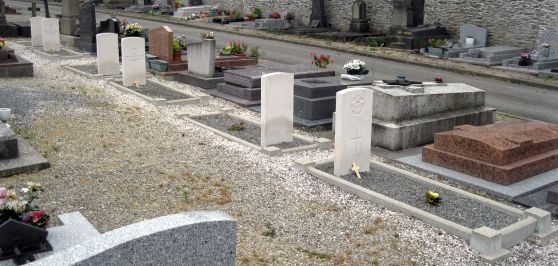
The story helps explain the burial of World War II British and other Allied war dead in the Vaufleury Cemetery in Laval, as early as 1939.
Many British Commonwealth and other Allied soldiers and airmen are buried in France as a consequence of both World Wars.
The graves from World War II were less than one-tenth the number from World War I. But often the WWII deaths came on top of those sustained in the prior war by the same families.
WW I - 530,000 graves
WW II - 45,000 graves
The War in France Started in September 1939. After Britain and France declared war on Germany on September 3, 1939, following Hitler's invasion of Poland. A British Expeditionary Force went at soon to France - landing troops at Cherbourg and supplies and vehicles at Brest, Nantes and St. Nazaire.
The French and British prepared a joint detailed plan for the defense of France. But in May 1940 the Germans attacked and drove rapidly to the south, splitting the Allied forces in half. By May 26-28, a large portion of the British army was trapped in Dunkirk. The famous evacuation saved the lives of many British and French soldiers, who as a matter of policy were evacuated in equal proportions:
211,267 fit British soldiers
13,053 British casualties
141,841 Allied troops, mostly French
On June 12, 1940, General Weygand announced that the French Army was incapable of further resistance. The Germans entered Paris on June 14. The French asked for an armistice on June 17. The last British troops were evacuated from Cherbourg on June 18, when the Germans were only three miles from the harbor.
During the next four years, commando raids were successfully conducted. A major attack in 1942 on Dieppe by the RCAF was successful at gaining information, but at a huge cost. Of 6,100 troops that embarked, 3,648 were killed, wounded, missing or captured; many are buried in Hautot-sur-Mer and Rouen.
Secret agents also were sent to France by a joint British-U.S. organization that assisted patriots in France. The value of this work, which involved loss of more than 130 Anglo-American lives, became clear after D-Day, when resistance groups guided Allied troops after the landing. The value of their help was estimated as equal to ten divisions of regular troops.
D-Day, June 6, 1944. On D-Day, the allied forces were led by General Dwight Eisenhower as Supreme Commander, with Air Chief Marshall Sir Arthur Tedder as Deputy Supreme Commander. General Sir Bernard L. Montgomery commanded the land forces, Admiral Sir Bertram Ramsey the naval forces and Air Chief Marshal Sir Trafford Leigh-Mallory commanded the air forces.
The United States was given the western beaches (Utah and Omaha) to attack because supplies were coming directly from the United States and it was important to capture Cherbourg and ports in Brittany quickly and deliver supplies for the large numbers of troops who were landing. The British were given the remaining three beaches to the east, with the Canadian troops between two British armies.
To prepare for D-Day and the subsequent assault southward, bombing was essential to reduce German air strength and attack German essential industries and communications. Bridges over the Seine and Loire were all destroyed. Airfields within 130 miles of the battle area were attacked. Coastal artillery positions and radar installations were bombed and French and belgian railway services were disrupted.
The weather around D-Day was the worst in 20 years, but helped surprise the Germans, who did not think an attack was possible under these conditions. Casualties were fewer than expected, except on Omaha Beach and, to a lesser extent, Utah Beach.
One reason for the slaughter on Omaha Beach is that bombers who were supposed to take out machine-gun emplacements over the beach were told at the last minute to delay their bombardment by a few seconds to avoid hitting U.S. troops. This resulted in bombs being dropped beyond the target.
Because the Germans continued to believe that the real attack would come at Calais, they kept a million troops tied up there until July, by which time it was too late to stop the advancing Allied Armies. Further German efforts to stop the liberation of France were, in the large scheme of things, of a token nature.
Casualties in the Normandy area from D-Day to August 25, 1944
German losses: 240,000 killed, 210,000 captured
Allied losses: 200,000 killed, wounded and missing
V-E Day, May 8-9, 1945. It was on May 8, 1945 in western Europe, May 9 on the eastern European front. Stalin insisted that the Germans surrender to him personally, which added a day.