Wednesday, June 18, 2014

The Allies in France - September 1939-May 1945

On D-Day 2014, Queen Elizabeth II pays her respects to British
 and other Allied soldiers and airmen who died in the
Liberation of France.
The story of British and Allied action in Europe is told in the introductory pages of the French section of The War Dead of the Commonwealth, 1939-1945.

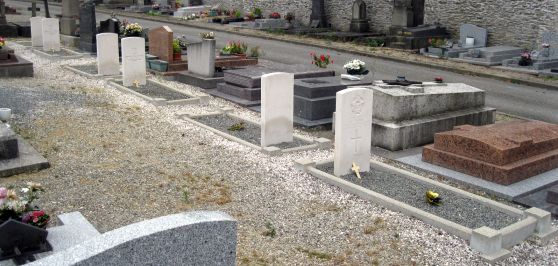
The story helps explain the burial of World War II British and other Allied war dead in the Vaufleury Cemetery in Laval, as early as 1939.

Many British Commonwealth and other Allied soldiers and airmen are buried in France as a consequence of both World Wars.

The graves from World War II were less than one-tenth the number from World War I. But often the WWII deaths came on top of those sustained in the prior war by the same families.

WW I - 530,000 graves
WW II - 45,000 graves

The War in France Started in September 1939. After Britain and France declared war on Germany on September 3, 1939, following Hitler's invasion of Poland. A British Expeditionary Force went at soon to France - landing troops at Cherbourg and supplies and vehicles at Brest, Nantes and St. Nazaire.

The French and British prepared a joint detailed plan for the defense of France. But in May 1940 the Germans attacked and drove rapidly to the south, splitting the Allied forces in half. By May 26-28, a large portion of the British army was trapped in Dunkirk. The famous evacuation saved the lives of many British and French soldiers, who as a matter of policy were evacuated in equal proportions:

211,267 fit British soldiers
13,053 British casualties
141,841 Allied troops, mostly French

On June 12, 1940, General Weygand announced that the French Army was incapable of further resistance. The Germans entered Paris on June 14. The French asked for an armistice on June 17. The last British troops were evacuated from Cherbourg on June 18, when the Germans were only three miles from the harbor.

During the next four years, commando raids were successfully conducted. A major attack in 1942 on Dieppe by the RCAF was successful at gaining information, but at a huge cost. Of 6,100 troops that embarked, 3,648 were killed, wounded, missing or captured; many are buried in Hautot-sur-Mer and Rouen.

Secret agents also were sent to France by a joint British-U.S. organization that assisted patriots in France. The value of this work, which involved loss of more than 130 Anglo-American lives, became clear after D-Day, when resistance groups guided Allied troops after the landing. The value of their help was estimated as equal to ten divisions of regular troops.

D-Day, June 6, 1944. On D-Day, the allied forces were led by General Dwight Eisenhower as Supreme Commander, with Air Chief Marshall Sir Arthur Tedder as Deputy Supreme Commander.  General Sir Bernard L. Montgomery commanded the land forces, Admiral Sir Bertram Ramsey the naval forces and Air Chief Marshal Sir Trafford Leigh-Mallory commanded the air forces.

The United States was given the western beaches (Utah and Omaha) to attack because supplies were coming directly from the United States and it was important to capture Cherbourg and ports in Brittany quickly and deliver supplies for the large numbers of troops who were landing. The British were given the remaining three beaches to the east, with the Canadian troops between two British armies.

To prepare for D-Day and the subsequent assault southward, bombing was essential to reduce German air strength and attack German essential industries and communications. Bridges over the Seine and Loire were all destroyed. Airfields within 130 miles of the battle area were attacked. Coastal artillery positions and radar installations were bombed and French and belgian railway services were disrupted.

The weather around D-Day was the worst in 20 years, but helped surprise the Germans, who did not think an attack was possible under these conditions. Casualties were fewer than expected, except on Omaha Beach and, to a lesser extent, Utah Beach.

One reason for the slaughter on Omaha Beach is that bombers who were supposed to take out machine-gun emplacements over the beach were told at the last minute to delay their bombardment by a few seconds to avoid hitting U.S. troops. This resulted in bombs being dropped beyond the target.

Because the Germans continued to believe that the real attack would come at Calais, they kept a million troops tied up there until July, by which time it was too late to stop the advancing Allied Armies. Further German efforts to stop the liberation of France were, in the large scheme of things, of a token nature.

Casualties in the Normandy area from D-Day to August 25, 1944
German losses: 240,000 killed, 210,000 captured
Allied losses: 200,000 killed, wounded and missing

V-E Day, May 8-9, 1945. It was on May 8, 1945 in western Europe, May 9 on the eastern European front. Stalin insisted that the Germans surrender to him personally, which added a day.

Saturday, June 14, 2014

WW2 | Laval Military Graves Include 20 Allies

Six additional British and Commonwealth graves in
a different part of Vaufleury Cemetery from the 14
airmen from the two Halifax bombers. One of the six
was Australian Flying Officer K. J. Trask. 
The 14 airmen from the two Halifax planes that crashed on June 10, 1944, are buried in Section E, Sub-section D, row 1, a special section of the Vaufleury communal cemetery in Laval. Photos are posted here on a Belgian site. Six additional graves are mentioned.

I wondered why there were 20 names listed in the cemetery when the number of airmen who crashed was 14 (two crews of seven men each). The number of tombstones in the cemetery in the airmen's section is 14. Where did the other six come from and where are they located?

The Belgian link provided above gives some of the answers. It cites a 55-page book on French grave sites published in 1960 by the Commonwealth War Graves Commission. I now have a copy of this book.

The six additional graves are in a different part of the Vaufleury Cemetery. The five soldiers and one Australian airman are in section A, sub-section A, row 28. 

The airman is Flying Officer Kenneth John Trask from the Royal Australian Air Force, who died November 11, 1943 at age 24, and is buried in grave #42500. He was the son of Albert Oswald Trask and Claudia Adair Trask of Camberwell, Victoria, Australia.

The five soldiers are:
- Frank Edward Clark III, age 34 (the second-oldest of the victims buried in the cemetery, two years younger than Sgt. Peake in the plane piloted by Henderson; both van Stockum and Wicks were 33 when they were killed).
- Ambrose Hunt, 
- William Morgan, 
- James Enoch Sharratt, and 
- Arthur Stokes.

Here is a complete list in the form of a table. The ages of two of the dead are missing:
LAST NAME First Names Citizen Enlisted Age, Date Died Rank, Assignment, Service Number
BEALES Fred
Canada
RCAF
20, 10-6-44
Pilot Officer (Air Gnr.), 10 (R.A.F.) Sqdn,  J/89951
BRADBURY Hugh
UK
RAF
20, 10-6-44
Sergeant (Air Bomber), Volunteer Reserve 10 Sqdn., 1425774
BROTHERTON Leslie Arthur
UK
RAF
24, 10-6-44
Sergeant (Air Gnr.) Volunteer Reserve 10 Sqdn. 1576786
CLARK Frank Edward
UK
Royal Artill.
34, 23-9-39
Warrant Officer Class III (T S M), 27 Field Regt. 1064423
DANIEL GILBERT
UK
RAF
22, 10-6-44
Flying Officer (Nav.), 10 Sqdn. 151788
ELLYATT John
UK
RAF
27, 10-6-44
Flying Officer (Flt Engr.) Royal Air Force 10 Sqdn. 51911
GAINES Philip
UK
RAF
?, 10-6-44
Sergeant (W. Op.), Volunteer Reserve 10 Sqdn. 1549492
HENDERSON Norman Random
UK
RAF
21, 10-6-44
Flying Officer (Nav.), Volunteer Reserve 10 Sqdn. 144341
HENDERSON Thomas Whyndam
Australia
RAAF
27, 10-6-44
Pilot Officer, 10 Sqdn. 415981
HUNT Ambrose
UK
Manch.Reg.
26, 27-9-39
Private, 2nd Bn. 3524489
MARSHALL Robert Keith
UK
RAF
30, 10-6-44
Flying Officer (Bomb Aimer) Volunteer Res. 10 Sqdn. 151917
MASON Albert
UK
RAF
?, 10-6-44
Sergeant (Air Gnr.) Volunteer Reserve 10 Sqdn. 2211801
MORGAN William 
UK
RoyalArmy
23, 15-5-40
Driver, Service Corps, 528 Ammunition Company. T/110288
PEAKE Stanley William
UK
RAF
36, 10-6-44
Sergeant (Flt. Engr.) Volunteer Reserve 10 Sqdn. 1606629
PERKINS Alfred Charles
UK
RAF
22. 10-6-44
Sergeant (W. Op. [Air]) Volunteer Reserve 10 Sqdn. 1461925
SHARRATT James Enoch
UK
Royal Artill.
27, 23-9-39
Warrant Officer Class II (B.S.M.) 27 Field Regt. 1070673
STOKES Arthur
UK
Royal Artill.
21, 10-10-39
Lance Bombardier, 1 Heavy Regt. 886972
TRASK Kenneth John
Australia
RAAF
24, 11-11-43
Flying Officer, 409357
VAN STOCKUM Willem Jacob
Holland
RCAF
33, 10-6-44
Flying Officer (Pilot), Volunteer Reserve 10 Sqdn., 144600
WICKS Edward Charles
UK
RAF
33, 10-6-44
Flight Sergeant (Air Gnr.) Volunteer Res. 10 Sqdn.  1376921.

For those who want to do their own research on World War II airplanes and grave sites, here are two comprehensive sources:

List of planes that crashed in France (text in French) -

Sources of information on downed airplanes anywhere in Europe in WWII (in English), showing escape routes and acknowledging help from the local Resistance -

Friday, June 13, 2014

June 14 - Thoughts for Flag Day on the Origins of the Stars and Stripes

The Stars in the Stars and Stripes are more of a puzzle to
explain than the Stripes. Why five points on the Stars?
Today is Flag Day in the United States. The stars and stripes flag was adopted in 1777 by resolution of the Second Continental Congress. Two years earlier, the U.S. Army was born on the same day. In 1916, President Woodrow Wilson proclaimed June 14 as Flag Day and in August 1949, an Act of Congress made it statutory.

On Flag Day it is appropriate to consider the origins of the Stars and Stripes and their connection with the coat of arms of America's first president, George Washington. The various occurrences of the Washington coat of arms are readily found, but their influence on the American stars and stripes is denied. I would like to restate the case against the connection and then why I believe the case against the connection is biased and unproven.

The Case against the Connection
  • In a 1914 letter to the NY Times, a self-certified heraldry expert considers the connection unproven, based on a trip around England looking for evidence of a connection between the coat of arms and the flag. 
  • The American Heraldry Society website features an article written in 2006 by Joseph McMillan, Director of Research for the Society, who says: "there is not a shred of evidence that the one [coat of arms of George Washington] had anything to do with the other [U.S. stars and stripes flag]."
  • The five-pointed star on the American flag is an invention of Betsy Ross - unrelated to the fact that the Washington coat of arms morphed from six-pointed to five-pointed stars (originally pierced mullets, later unpierced mullets or stars in Scottish heraldry).
  • The 1876 play by UK poet Martin Farquhar Tupper features Benjamin Franklin explaining that friends of George Washington were behind the stars and stripes, is said to have been based on a excess of imagination to give greater importance to the stars and stripes.
  • George Washington was a modest man who professed disdain for the trappings of office.
The Case for the Connection
  • The "shred of evidence" for the connection between the flag and the Washington coat of arms is that both have stars (or mullets) and stripes (or bars) in them, and George Washington was leader of the country when the flag was created. Whether the influence came from Washington or his many supporters, the visual resonance is satisfying.
  • The opponents of the connection may have a bias against the connection with the Washington family coat of arms because of its English origins, or its basis in aristocratic English heraldry, or in their distaste for the personalization of the American Revolution.
  • The 1914 letter may have been written by someone wishing to keep the United States out of the War in Europe by minimizing the historical ties between the United States and Britain.
  • Evidence of the attachment of George Washington to his family coat of arms is that he includes it on his correspondence and on silver items used in the house.
  • Gilbert Stuart's 1796 "Lansdowne" portrait of George Washington, for example, has an inkwell below his right hand with the family coat of arms on it. It did not imply that a family was in the nobility, just that it owned property and was thereby entitled to a coat of arms. English heraldry wasn't regulated until centuries later.
  • Whatever Washington said about the trappings of office, he used his coat of arms a great deal, certainly more than any later president. He actively incorporated changes in the coat of arms - substituting a griffin for the traditional raven. Article 1, Sections 9-10 eschews titles, but says nothing about use of coats of arms.
  • The two red stripes on the Washington coat of arms are alleged to represent the English king's honoring of a soldier who slew a great Dane in battle, by dipping two fingers into a wound on the Dane, and drawing two lines across the shield of the soldier. That became the soldier's coat of arms. (I could not verify the story, but it is so appealing I leave it for future research.)
  • A more plausible explanation than the Betsy Ross story is that George Washington's family was attached to the five-pointed pierced mullets, which over time lost their pierce (and thereby became stars in Scottish heraldic terms). 
  • The Washington family once had a stars-and-stripes coat of arms with six-pointed pierced mullets (star-like spurs), based on records from County Durham that I have seen in the British Library on two separate visits. The change to five points may have been a matter of family pride, since it has prevailed and distinguishes British from French heraldry.

Veteran's Story 4 - Steve Robinson, Prudential, R.I.P.

Stephen Robinson, Prudential - died
on Thursday, June 12.
Stephen Robinson, himself a veteran of 20 years of army service, became a formidable advocate for Veterans.

From 2010 to his death on June 12, 2014 he was vice president for External Veteran Affairs at Prudential Financial, where he focused on Veteran employment. His role was to advise the Prudential leadership on policies toward Veterans, expand programs, create partnerships and liaise with relevant agencies to improve access of Veterans to job opportunities.

He expanded Prudential's external network for Veteran initiatives by meeting with industry leaders in both the public and private sector, such as Veteran service organizations and legislators. He maintained Prudential as a leader in promoting education, training and employment for returning Veterans, in the tradition of Franklin D'Olier.

From 2001 to 2010, he was a retired Army officer and an independent advocate for Veterans and their families, working with several nonprofits to support service members and families. He served on the Department of Veterans Affairs Research Advisory Committee on Gulf War Illnesses and was a special advisor on chemical and biological weapons exposures to Vietnam and Gulf War Veterans. Robinson was regularly called before Congressional committees to speak about military suicide, the mental health of Veterans, PTSD and the resiliency of the Armed Forces.

Previous to 2001, he had 20 years of service in conventional and Special Operations assignments including the 1/75th Ranger Battalion, 24th Infantry Division, 1/10th Special Forces, 8th Infantry Division, Ranger Instructor, 6th Ranger Training Brigade, Long Range Surveillance Detachment Team Leader in Korea, ROTC Instructor, and the Office of the Secretary of Defense, as briefer and analyst on health effects that arose out of the 1991 Persian Gulf war.  


From 1995 to 1998 he was at the University of West Florida. He prepared for college at Milton High School in Milton, Florida. Robinson also served on the board of directors for USO Metro Washington and as a military and veteran advisor for the Rockstar Energy Drink Mayhem Festival, and as a member of the board of advisers for the Call of Duty Endowment.

FRANCE | June 10–Remembering Airmen Downed 70 Years Ago

At the Air Force band concert on
June 9, the two crews, of the MZ 532
and the MZ 684, were displayed
on the screen above the musicians.
L to R: Deborah and Dr. Rex
Henderson by the grave of Rex's
father Tom, pilot of the MZ 532.
This and all following photos by
JT Marlin.
The memorials in honor of the 14 downed airmen at Vaufleury Cemetery on May 8, 2011 were more elaborate than this year.

That is because they were part of a larger celebration of V-E Day, the end of hostilities in Europe in 1945, and the Town of Laval turned out in large numbers.

But this year's memorial on June 10 was unquestionably more special for the family members who came. (Missing from 2011 were Nicola and Robin Sumner; Robin is the nephew of Daniel Gilbert.
2011 -  L to R: Nicola and Robin Sumner (nephew of Daniel Gilbert), Cpl Pamela Turney (great-niece of Fred Beales), Luke Shergold (son of Suzanne), Michael Hayes (Beryl's husband), Beryl Hayes (daughter of Edward Wicks), Martin Clegg (Suzanne's husband), Suzanne Clegg (Beryl's daughter), Ashley Shergold (Suzanne's son), John Tepper Marlin (nephew of Willem van Stockum), Silvia and John Ellyatt (son of John Elyatt).


Crew members of the MZ 532 as
shown on the monument (stele) at
St. Berthevin.
One reason is that in 2014 the memorial has been entirely focused on the airmen who crashed on that date in 1944. Those who were at the cemetery were there for one reason, to honor the two crews of the Halifax bombers that were shot down nearby on June 10, 1944.

Another reason this year was special is that the families of six crew members were represented by their families - one more crew member than in 2011. Also, 20 family members showed up to pay their respects, eight more than in 2011.

This year, three crew members from each plane were represented by family.

In 2011, from the St. Berthevin-crash plane, MZ 532, only Sgt. Edward C. ("Eddy") Wicks had family there.

Representatives of the families of Sgt.Wicks (on left) and Sgt.
Brotherton (on right), whose younger brother and three
more generations attended in 2014 for the first time.
This year, the pilot of the MZ 532, Australian P/O Thomas W. (Tom) Henderson was also represented by his son, Dr. Rex Henderson and Rex's wife Deborah, who came from Australia for the occasion. Sgt. Leslie Brotherton was represented by four generations - his younger brother, daughter and other family members.

From the plane that crashed in Entrammes, the MZ 684, three crew members were represented again, as they were in 2011 - the pilot, Dr. Willem J. van Stockum, F/O John Ellyatt by his son, and Sgt. Fred Beales by his great-niece Cpl. Pamela Turney, who was in the uniform of the Canadian Forces Air Command.

Crew members of the plane that
crashed in Entrammes, the MZ 684.
John Tepper Marlin, nephew of F/O
Dr. Willem J. van Stockum (pilot of
the MZ 684), and wife Alice Tepper
Marlin.  Photo w JTM camera.
The MZ 684 crew is of interest for a number of reasons. The plane included four Flying Officers, which in the anglophone military is equivalent to an army rank of Lieutenant. A Pilot Officer is equivalent to a 2nd Lieutenant.

The MZ 532, by contrast, had two Pilot Officers, the rest being Sergeants. In other words, the MZ 684 had twice as many officers aboard.

Cpl. Pamela Turney next to
the marker of her great-uncle,
Sgt. Fred Beales.
My uncle Willem van Stockum's grave site is marked as both Canadian and Dutch. Dutch, because he was a citizen of Holland (his grave marker is different from the other 13 because it was provided after the others were in place, by the Dutch Government). Canadian, because he was seconded from the RCAF, where he had been an instructor in flying the Halifax bomber. He is also variously identified in those who have written about him as Scottish (his Ph.D. in physics was from Edinburgh), Irish (graduate of Trinity College, Dublin, where he met my mother and father), and American (he was teaching mathematics at the University of Maryland when World War II broke out and was previously a fellow at the ).

Van Stockum's work as a mathematician, utilizing Einstein's equations, has earned him a place in the history of time travel and the father of scientific approaches to the subject. Dr. Robert Wack, an Army Major and pediatrician, has written a science-fiction novel, Time Bomber, centered on van Stockum's life and death.

View of gravesite looking away from the
flag - the MZ 684 end of the site. At left
is M. Cousineau of the Canadian Embassy
 in Paris, who attended with his wife.
At the ceremonies on June 10, representatives of the embassies of Australia and Canada were in attendance. Each embassy has several military attaches who travel to pay respects to nationals of their countries who died in prior wars and are buried in France.

Comment

If someone from the Dutch Government ever attends an event at Vaufleury, it would be good for them to know that when they asked my mother what she wanted on the tombstone, her answer was: "Greater love hath no man..."

It would be nice if this request were some day honored, especially since the Dutch Government wrote to my mother to ask what she wanted inscribed. The minister who officiated at the ceremony on June 10 cited that exact quote...

For those unfamiliar with Anglophone military ranks, the following guide may be helpful:
NaviesArmiesAir forces
Officers
Admiral of
the fleet
Marshal or
Field marshal
Marshal of
the air force
AdmiralGeneralAir chief marshal
Vice admiralLieutenant generalAir marshal
Rear admiralMajor generalAir vice-marshal
CommodoreBrigadierAir commodore
CaptainColonelGroup captain
CommanderLieutenant colonelWing commander
Lieutenant
commander
Major or
Commandant
Squadron leader
LieutenantCaptainFlight lieutenant
Sub-lieutenantLieutenantFlying officer
EnsignSecond
lieutenant
Pilot officer


Seamen, soldiers and airmen
Warrant officerSergeant major
Warrant officer
Warrant officer
Petty officerSergeantSergeant
Leading seamanCorporalCorporal
SeamanPrivateAircraft man

Wednesday, June 11, 2014

WILLEM VAN STOCKUM | Visit #3 to My Uncle Willem's Gravesite

My uncle Willem van Stockum and 13 other crew members on two Halifax bombers are buried in the Vaufleury Cemetery in Laval. This is my third visit to Laval to visit and honor the grave site:

1. December 1954. On my first visit in 1954, I was one of eight members of our family to visit my uncle's grave; his plane came down in Entrammes, on the east side of Laval. We found that the 13 other grave sites had tombstone markers from the RAF and my uncle's did not. The explanation given to my parents was that Willem was a Dutch citizen. My parents followed up to have a tombstone made for Willem by the Dutch Government, which is what happened. (The RCAF and Australian Air Force did the tombstones for Beales and Henderson apparently without any need to follow up.)

Detail of monument to the crew of the plane that crashed at
the pear farm in Entrammes. Pilot Willem van Stockum is in
 the front row, middle, in the only photo we have of him with
crew. It does not seem to correspond to all the members of the
crew actually on the MZ 684 when it crashed in 1944.
2. May 2011. On the second visit in 2011, on V-E Day (May 8), a dozen representatives of five fallen airmen were there to pay their respects, through the good sleuthing of Jean-Louis Cholet of Souvenir Francais of the Mayenne, Jean-Luc Peslier of the AMAA and RCAF Cpl Pamela Turney (great-niece of Sgt. Fred Beales). Four of the airmen represented were from the Entrammes plane, and one large family came to pay their respects to Eddy Wicks from the St. Berthevin plane - his daughter Beryl Wicks and her husband Mike Hayes and their children and grandchildren.

3. June 2014. This year, on the 70th anniversary of the downing of the two planes four days after D-Day - on their fifth mission in the space of ten days - 20 people from the families of six airmen attended, representing six of the airmen, three from the Entrammes plane my uncle was piloting, and three from the St. Berthevin plane.

Detail of monument (stele) to the crew that crashed in a field
 in St. Berthevin, NW of Laval, from the monument. The
pilot, Australian Pilot-Officer Tom Henderson, is mid-group.
Two new airmen were represented in 2014 - (1) the Australian pilot Tom Henderson by his son Rex Henderson and Rex's wife Deb, and (2) Leslie Brotherton by his younger brother Cyril and by his children Carol and Brian Thornley and their grandchildren Richard, Nick and Steve, and Leslie's  great-grandchildren, the two children of Steve and Rachel - Jonah and Isabella.

This year, two well-designed monuments were installed and unveiled at the two crash sites. The families and local children and officials left flowers in front of the graves at the Vaufleury Cemetery and also at the monuments at the crash sites.

All of the families of the airmen are grateful to the French people in Laval for showing this respect to the airmen on the 70th anniversary of the two crashes. We are especially grateful to Jean-Louis Cholet of the organization Souvenir France (France Remembers) and Jean-Luc Peslier, President of AMAA (Amicale Mayenne de l'Armee de l'Air). Three other hosts from the AMAA were Michael Guegan, who told me he has a daughter in San Francisco; Michael Fontaine; and Georges Mezieres.

Saturday, May 31, 2014

Why Daddy Serves His Country

A great book for military
families, except for one thing.
At the BookExpo America yesterday I saw this coloring book for kids and thought it would be great for military families. Why Daddy Serves His Country is patriotic and provides valuable historical information on wars in which American soldiers were in harm's way.

The illustrations by Scott Novzen are appropriate and appear to be easy to color.

The book includes cute stories that bring home the difficulties that veterans come back from war having to face. My personal favorite story is about ancestors of the book's author, Major R. Scott ("Scotty") Price, Retired, who served from 1978 to 1992 in the field artillery and other branches of the U.S. Army:
Brothers Edward and John Reese fought on opposite sides: one for the North and the other for the South. ... Both brothers survived the four years of war but each lost a leg, Edward his right one and John his left. After the war they became very close again and, as luck would have it, they both had the same shoe size. So each year they would take the train to Richmond together and buy a pair of shoes. 
I think the book is charming and very suitable for military families...

Along with the coloring books for kids, this is for sale.
Funny?
However, I have a problem. The last page of the book advertises four other coloring books, "Machine Gun Inventors," "Machine Guns of World War I", "Machine Guns of World War II", and "Famous People with Their Firearms". This is understandable, since the coloring books are all published by a business that caters to gun enthusiasts, which also produces gun magazines like the Small Arms Review.

For me, the issue is whether the coloring books, especially as a group of four, create the idea that guns are the way to solve problems.

If your reaction is that I must be crazy in thinking this, take a look at the T shirt that is being sold on the website and think about the number of young people who have in recent years decided that their social problems are best dealt with by killing a bunch of innocent people in a classroom or a restaurant or somewhere else in their community.

So there you are. A good book for kids, unless you are concerned that the source of the book advertises a T shirt that promotes the idea that having a gun nearby is a good way to solve problems that come up. What is the impact on kids of this message?