Showing posts with label World War I. Show all posts

Tuesday, September 9, 2014

WW1 | Tower of London Memorial

"Blood Swept Lands and Seas of Red", an installation by Paul Cummins
and a team of volunteers to remember British soldiers who fell in the
Great War.
The British have set the standard for remembering their dead.

A London art installation features a Red Sea of 888,246 ceramic poppies - one for every British and Commonwealth soldier who died during World War I. It is shown at left.

The poppy became a symbol of World War I dead and Armistice Day because of "In Flanders Fields", the great poem by the Canadian John McCrae who was a battlefield physician in Belgium in 1915.  An excellent video with readings from War Poets appears here.

Most of the poppies were laid in the moat of the Tower of London throughout the summer by the artist Paul Cummins and more than 100 volunteer assistants.

The installation was opened in August, 100 years after the first hostilities of World War I. The last flower will be planted on November 11, Armistice Day, 1918. 

Saturday, August 23, 2014

French Gratitude to the Allies - Hard to Track

Laval story on the monument to the MZ 684 crew. John
Tepper Marlin points to his uncle's name, F/O W.J. van
Stockum, Cpl. Pamela Turney to her great-uncle's name,
Sgt. Fred Beales.
Richard Rubin has a fine article on how the French remember, with gratitude, the U.S. entry into World War I.

He says that when the French speak about "The War" they are talking about World War I.

I think that depends on the region of France and which war had the most impact in that region.

When we were in Normandy and Mayenne in June, as the 70th anniversary of D-Day was being remembered, "The War" was World War II.

And the French there were just as grateful for the support of the Allies in World War II as they were for their support in World War I.

Just as it is hard sometimes for someone writing thank-you notes to keep track of which guest gave which gift, it is hard sometimes for the French to keep the Allies straight.

The story in the Laval, Mayenne, France newspaper about the unveiling of monument to the crews of two planes that were shot down in the week after D-Day thanks the "britannique et canadien", "British and Canadian" airmen. In fact it was more complex than that.

The Halifax MZ-684 was piloted by a Dutchman (Flying Officer W. J. van Stockum, via the R.C.A.F.) resident in the United States and awaiting U.S. citizenship. The other plane, the Halifax MZ-352, was piloted by an Australian (Flying Officer Thomas Henderson, flying for the Australian Air Force).

August 24, 2014 - Postscript

A friend writes to me saying that The New York Times story and my tributes to the sacrifices of the Allies is lovely and sentimental but how about what is going on today? Back in the days of the Black and Tans, there were people charging The Times of London with "Afghanistanism" -writing strong editorials about atrocities in Afghanistan while overlooking the atrocities in Ireland.

My answer is that it is precisely when we have crisis points in the world that we need to look back and see how we got through the crises of the past. I am aware that Forbes is tracking every omission or error in reporting on the Middle East by the The New York Times. The finances of the newspaper business have changed, and we may not be able to rely as much on only one or two sources for our information.

I am not ready to trade in The New York Times for Forbes, but maybe one result of the democratization of news gathering, news dissemination and opinion-writing is that bloggers have to think about their changing role:

  • Should bloggers only tackle topic areas where they feel less comfortable?
  • Or should they make an effort to go into topic areas where they feel less sure of themselves, but where their thinking and opinions are needed?


Wednesday, November 6, 2013

November 11 - Veterans Day

2008-11-11-4604814inflandersfields1.jpg
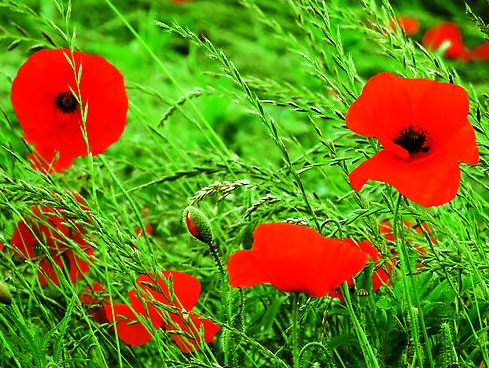
In Flanders Field, the poppies blow...
On Veterans Day we salute those who have served -- in the U.S. Army, Navy, Air Force, Marines, and Coast Guard. 

The poppy became a symbol of World War I dead and Armistice Day because of In Flanders Fields, the great poem by the Canadian John McCrae who was a battlefield physician in Belgium in 1915.

The day was originally called Armistice Day, because it marked the ending of hostilities in Europe, on November 11, 1918. 


In the British Commonwealth, the day became known as Remembrance Day. In the United States, it is the day set aside for honoring of veterans.

Our honoring of Veterans Day in November suffers by comparison with Memorial Day, which has a similar purpose and is more widely observed as a holiday because it starts the U.S. summer season. Memorial Day also dates back further, to 1866 when a memorial was first held in Waterloo, NY to honor dead Union soldiers.

Our honoring of November 11 as the end of the "Great War" is also not as poignant as it is in Europe, where an entire generation of young men was cut down by machine guns in the tragedy of World War I trench warfare started by an assassination and then moving ahead inexorably as treaty after treaty came into effect and no one was able to halt the death march.
The memory of so many young men having been killed senselessly is evoked by The Green Fields of France, a poignant song about the fallen soldier Willy McBride. Some 250,000 Americans died in Europe in World War I, but as was the case in World War II the impact on the United States was much less devastating than on Europe, where losses were much greater over a longer period, out of smaller populations. My friend Tim Sullivan sent me the inspiring story of Alan Seeger, a Yank who volunteered to join the French and British forces after the Kaiser invaded Belgium and France in 1914. But Seeger was a rarity. The United States didn't join in the war until 1917 and it was soon over.
Ironically, America's longest war, although not the deadliest, is the one that we are still in, what is called the Gulf War, parts I and II, with Part II beginning on September 11, 2001. The longest war in our history, but the smallest percentage of our population is involved in fighting the war. 
So - let us pay proper tribute to the day by saluting all those who have fought for their country - and the families of those who have had to cope with their warrior not returning, or returning with injuries - and all other innocent victims of wars.