Showing posts with label Laval. Show all posts

Tuesday, May 8, 2018

VE DAY | May 8, End of WWII in Europe (Updated May 10)

Canadian Troops Liberate Amsterdam, 1945.
May 8, 2018 – I returned from the Netherlands yesterday to New York City.

Today the world celebrates VE- Day, that day in 1945 when World War II hostilities ceased in Europe.

In the former Soviet Union the celebration is delayed by one day, to May 9, because fighting there continued for another day.

The Soviet Union lost a higher percentage of its population (15%) than any other Allies – led by Belarus (25%) and Poland and the Ukraine (18% each).

Overveen, The Netherlands, May 4

On Friday, May 4, I was in Holland remembering the war dead with a visit to the Honorary Cemetery (Eerebegraafplaats Bloemendaal), which is identified as being in Bloemendaal but is accessed from the town of Overveen. It was Remembrance Day (Dodenherdenking) in Holland. On that day, the Netherlands remembers those who died in combat during WWII and in subsequent combat or peace-keeping operations.

The following day, the country celebrates Liberation Day (Bevrijdingsdag), a day of festivities at the ending of World War II for the Dutch in 1945, after the long Hunger Winter of 1944-45. 

The hard-working Dutch people do not annually close their banks on either May 4 or May 5. But government workers have a holiday on May 5 and some Dutch people start their vacations on Kings' Day, since 2014 on April 27 (King Willem Alexander's birthday) and continue through May 5. 


Memorials and festivals, such as a music festival in Amsterdam (the Bevrijdingsfestival), are widespread and many schools are on vacation at that time. Liberation Day is officially a holiday for everyone only when the last two digits of the year are divisible by five. So 2020 will be the next big celebration.

Here's how Hilda van Stockum described the joy that flooded Holland on May 5, 1945, in her 1962 book, The Winged Watchman:
On the fifth of May, Holland was liberated. Canadian troops marched into the villages and cities. Women and girls threw flowers and jumped on cars and tanks. Everywhere the Dutch flag waved. Children held bunched of flowers. People danced in the streets. Bells rang.
Father and the boys set the Watchman in joy. Mother fetched flags out of her trunk, which they strung from one wing to the other, plaiting the sails through the gates in decorative patterns.
They were free!
Laval, France, May 8


Laying of wreaths and flowers. The gravestone at
lower right is different form the others because it was
sent from the Dutch Government, not the British.
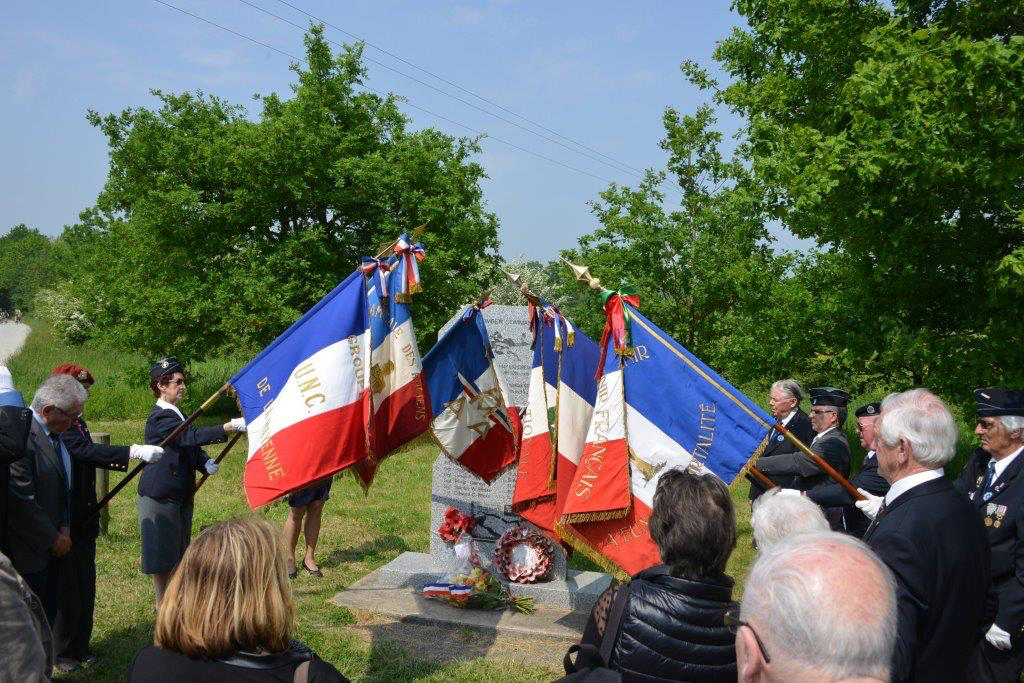
At the Valfleury Cemetery in Laval, representatives of local military and historical groups remembered VE-Day on May 8. The first photo shows the laying of wreaths and flowers before the graves of the 14 airmen in two airplanes.

The photos shown here are sent by Jean-Louis Cholet, who was one of the two people mist responsible for getting monuments erected to the crews of the two Halifax III bombers.

One plane was piloted by a Dutchman (my uncle Willem van Stockum) flying with the RAF after being trained with the RCAF.

The Laval student shown in first
photo laying flowers on the graves.
The other was piloted by an Australian (Thomas Henderson), whose son I met at the visit by the families of the airmen in 2014, during the 70th-anniversray year of D-Day. The two bombers that were downed had been on missions before and after D-Day, to remove gun emplacements and disrupt airfields and railway lines.

Every year, local students in the Laval area visit the gravesites and lay flowers on the graves of the flyers out of gratitude for the Liberation of France by the Allies.

With the placement of two monuments at the site of the crashes of the two Halifaxes, the annual memorials extend to these sites.

In 2014 I posted a memory of the coming-together of the relatives of the crews of the bombers. This was my third visit to the gravesite, but the first with my wife Alice, and with the largest number of relatives.

2018 – A wreath for the
Halifax piloted by
Tom Henderson.
It was a special pleasure also in 2014 for us to meet Dr. Rex Henderson, son of the Australian pilot of the second Halifax, and Rex's wife Deborah. Alice and I traveled with them  for several days to see the landing areas of the Normandy invasion.

Melbourne, Yorkshire, England

This year for the first time I went with my wife Alice to RAF Melbourne, the base in Yorkshire from which the planes from 10 Squadron took off.

I have written about this visit separately. In the post, I cite the statistic that 46 percent of all the crew members of the RAF Bomber Command were killed on missions. Perhaps some of the crew members believed that the statistics didn't apply to them, but the statistics don't know that.
2018 – Remembering the crew of one Halifax, piloted
by Willem van Stockum.

2018 – Honoring the crew.
Worldwide War Dead

Statistics hide the face of the human costs of war. But they are the only way to convey the magnitude of the death and destruction that Hitler generated.

Estimates of losses from WW2 sometimes differ for gruesomely competitive reasons – "We lost more people than you did." Wikipedia averages several estimates, which is not necessarily the best approach.

Below is how one source summarizes the deaths world-wide by country from World War II, ranked in order of the estimated loss.

Country
Millions Dead
1. Soviet Union (USSR)
25
2. China
15
3. Germany
8
4. Poland
5.7
5. Dutch East Indies
3.5
6. Japan
2.9
7. British India
2.1
8. French Indochina
1.6
9. Yugoslavia
1.4
10. Philippines
0.8
11. Romania
0.8
12. France
0.6
13. Greece
0.6
14. Hungary
0.6
15. Italy
0.5
16. United Kingdom
0.45
17. United States
0.42
18. Korea
0.4
19. Lithuania
0.35
20. Czechoslovakia
0.3
21. Netherlands
0.3
Total of These Countries
71.32
Source: https://www.secondworldwarhistory.com/world-war-2-statistics.asp

That's more than 71 million dead in these 21 countries. The losses weigh harder on countries that have a smaller population, and on population groups such as Jews who were targets of the Holocaust.

Saturday, April 21, 2018

RAF100 | Visit to RAF Melbourne, Yorkshire, April 20

At Betty's. L to R: Alice, Susanne Pescott and I in York,
England. During WW2, Betty's Shop had a bar favored by
airmen from many countries.
Edinburgh, Scotland, April 21, 2018 – As noted a few weeks ago, I have been eagerly anticipating my first visit to the base from which my uncle Willem van Stockum flew six missions for RAF 10 Squadron during the ten days surrounding D-Day, 1944.

The sixth mission, on June 9/10, 1944 took his life and that of the other six crew members on their Halifax Mark III bomber. (Willem trained on the Mark II bomber.)

They had completed their mission when they were shot down. An eye witness (who was then a small child) said that the plane was in flames but steered away from the French farmer's home and into the pear orchard.

I've been three times to Laval, France where the 14 crew members of the two RAF planes hit that night are buried. But this was my first visit to the site from which the planes left.

Scratched on the Mirror. V/C Poulin, at
bottom right, scrawls "Canada"...
Two More Names. Sgt. Alex Trench from 
Glen Cove, N.Y, USA and Sgt. Redlin
from Edmonton, Alberta, Canada.
Another. J. N. Fletcher, Royal Canadian Air
Force, from Vancouver.
Alice and I took the train from Oxford (we should have taken a faster and cheaper train from London) to York, and there met Susanne Pescott, a dedicated volunteer from the 10 Squadron Association, for lunch at Betty's.

The Mirrors at Betty's Bar

Susanne showed us the mirrors in Betty's Betty's, where during World War II was a popular bar for airmen from all over the world – Canada especially, but also the United States and New Zealand.

The crew members scratched their names in the mirror – 600 of them according to a notice at the location. Unfortunately, no one so far has written down the names and indexed them alphabetically. It would be helpful if someone did that, so that the place could become even more of a destination for families of the airmen. I couldn't find my uncle's name anywhere; the lighting is difficult.

What these young men may not have known, or had time enough to even think about, is that the killed-in-action rate of the Bomber Command was 46 percent. For every 400 men who showed up to fly, 46 died.

For every ten airmen scratching their names in the mirror, five would never come home...

...And many of those who  counted as survivors came back wounded or were taken as prisoners of war by the Germans and were delayed returning...

My uncle Willem was a mathematician and he knew about probability. This was also clear from his letters to his mother. He was at peace with his decision to fight for his occupied native country (Holland), but he warned his mother that it was unlikely he would ever see his mother again. The knock on the door at 3728 Northampton Street in Washington, D.C. came for her and my mother in June 1944, when U.S. military officials came to report that Willem and the rest of the crew were missing.

In front of the door that Uncle Willem went through
 in 1943 or 1944 when he reported for duty at RAF
Melbourne.
Checking In

Here at the right is the doorway where the flight crews, who would have had their basic pilot, navigation or gunnery training elsewhere, would show up for their assignments.

My uncle Willem wrote to his mother about the satisfaction he had about being chosen by crew members as their pilot. The Time Bomber book by Robert Wack devotes a lot of attention to Willem's time as a pilot trainee, and the paces he had to go through (at 32 years of age, which was old for a pilot).

The door knocker has the badge of the 10 Squadron on it.

The motto at the bottom of the badge is "Rem Acu Tangere," which has nothing to do with Tangerines. It means "To touch the thing with a needle,"  "Hit the target precisely" or "Hit the nail on the head".

Prime Minister Margaret ("Iron Lady") Thatcher had her own version in her presentation of a new standard to 10 Squadron at Brize Norton:
Over nearly ten years as Prime Minister I have come to know many of the Squadron's members and their aircraft. We have flown together to the most far-flung lands and continents. You have brought me safely to my destinations through ice and fog and sand-storms, with unfailing punctuality. Indeed I am living proof of your Squadron motto, Rem acu tangere, which might be loosely translated as “we land even when the Prime Minister can't see the runway”.
Why Were So Many Bases in Yorkshire?

To reach Germany and Occupied Europe, the RAF bases needed to be on the Eastern half of the country. Yorkshire is a likely place just because it takes up so much space on the East Coast. It has some hills that are called "peaks" such as "Three Peaks" in northern Yorkshire, but these "peaks" are more like foothills, averaging 700 meters in height. Roseberry Topping is called "Yorkshire's Matterhorn" because it looks a bit like the original, but it is only one-thirteenth of the height of the real Matterhorn (4,500 meters) on the Swiss-Italian border.

By the standards of England's 48 counties, Yorkshire is enormous. Its 11,900 sq km area constitutes 9.1 percent of England's total 130,000 sq km. Even after Yorkshire was split into four separate counties in 1974, the North Yorkshire component was still England's largest county. The wide-open spaces in Yorkshire offered the RAF a chance to spread out its personnel and keep the equipment away from civilian residences. The county is relatively underpopulated, with only 7.5 percent of the English population in 9 percent of the area, and the countryside was under no building pressure.

When the RAF was requisitioning farmland to create runways for military aircraft, Yorkshire had other advantages over, say, Norfolk, which was the site of RAF Hethel. The Vale of York offered not only ample flat agricultural fields and plateaus, but easy access from the central railway hub of York. So that is where the RAF concentrated its intensive training programs for flight crews.

Here are 38 sites of former air bases in Yorkshire. They include the one from which my uncle set off six times and returned to five times, Melbourne. His sixth flight took him and his crew to Laval, France where they still rest.

What Was at the Melbourne Air Base?


RAF Melbourne, view from the air. To support the heavily
loaded Halifax bombers, the runways were made of concrete.
They remain, to be used occasionally for drag races.
The main feature of the air bases was a runway for take-off and landing, a "tower" (usually a two-story building) and living quarters for the flight crews and other staff.

At the beginning of the war, grass runways were common, but heavily loaded bombers required concrete and asphalt strips.

To allow for variation in wind direction, airports typically have a triangular configuration. They are therefore easy to spot from above.

Besides the control tower and barracks, an airbase would  include a briefing room for crews heading, and hangars for repairs.

The lengths of the runways at RAF Melbourne were (see numbers on photo):
01-19 1,350 yards
06-24 1,900 yards
15-33 1,400 yards

Camp sites for base personnel were dispersed to the north. The base accommodated 1,901 men and 382 women. Women were deployed on communications and reporting functions as well as food and housing tasks.

The Halifax III Crews and Their Motivation
Willem van Stockum, Captain, front center, with six other 
members of the crew of the Halifax III. They are all buried 
in Laval, France.

While awaiting duty, the Halifax III crews would practice their takeoffs and landings.

They were anticipating action at the end of 1943 and the beginning of 1944. Willem writes to his mother that they crews are eager to go into action.

He reacts with disbelief when Dorothy Thompson, a popular news columnist, wrote that American soldiers needed postwar goal to fight for, a vision of a new society after the war.

He wrote a response to his mother that was eventually published as "A Soldier's Creed". It was written in June 1944 and was published in The Horn Book in its Christmas issue and reprinted at the end of Time Bomber, by Robert Wack.
A SOLDIER'S CREED By A BOMBER PILOT
I didn't join the war to improve the Universe; in fact, I am sick and tired of the eternal sermons on the better world we are going to build when this war is over. I hate the disloyalty to the past twenty years. Apparently people think that life in those twenty years, which cover most of my conscious existence, was so terrible that no-one can be expected to fight for it. We must attempt to dazzle people with some brilliant schemes leading, probably, to some horrible Utopia, before we can ask them to fight. 
I detest that point of view. I hate the idea of people throwing their lives away for slum-clearance projects or forty-hour weeks or security and exchange commissions. It is a grotesque and horrible thought. There are so many better ways of achieving this than diving into enemy guns. Lives are precious things and are of a different order and entail a different scale of values than social systems, political theories, or art. 
"Why are we not given a cause?" some people ask. I do not understand this question. It seems so plain to me. There are millions and millions of people who are shot, persecuted and tortured daily in Europe. The assault on so many of our fellow human beings makes some of us tingle with anger and gives us an urge to do something about it. That, and that alone, makes some of us feel strongly about the war. All the rest is vapid rationalization. All this talk about philosophy, the degeneration of art and literature, the poisoning of Nazi youth, which the Nazi system entails, and which we all rightly condemn, is still not the reason why we fight and why we are willing to risk our lives. 
Here, let us say, is a soldier. He asks himself, "Why should I die?" You would tell him: "To preserve our civilization." When the soldier replies: "To Hell with your civilization; I never thought it so hot," you take him up wrongly when you sit down and say to yourself: "Well, after all, maybe it wasn't so hot," and then brightly tap him on the shoulder and say: "Well, I've thought of a better idea. I know this civilization wasn't so hot, but you go and die anyway and we'll fix up a really good one after the war." I say you take him up wrong because his remark: "To Hell with your civilization" doesn't really mean that he is not seriously concerned about our civilization. He is simply revolted by the idea of dying for ANY civilization. 
Civilization simply isn't the kind of thing you ever want to die for. It is something to enjoy and something to help build up because it's fun, and that is that, and that is all. 
When a man jumps into the fire to save his wife he doesn't justify himself by saying that his wife was so civilized that it was worth the risk! There is only one reason why a man will throw himself into mortal combat and that is because there is nothing else to do and doing nothing is more intolerable than the fear of death. I could stand idly by and see every painting by Rembrandt, Leonardo da Vinci and Michelangelo thrown into a bonfire and feel no more than a deep regret, but throw one small, insignificant Polish urchin on the same bonfire and, by God, I'd pull him out or else. I fight quite simply for that and I cannot see what other reasons there are. At least, I can see there are reasons, but they are not the reasons that motivate me. 
During the first two years of the war when I was an instructor at an American University in close contact with American youth and in close contact with the vital isolationist question in the States, I often felt that there was much insincerity, conscious or unconscious, on our, the Interventionist, side of the argument. We had strong views on the danger of isolationism for the United States. We thought, rightly, that for the sake of self-interest and self-preservation the United States should take every step to ensure the defeat of the Nazi criminals. But however sound our arguments, our own motives and intensity of feeling did not spring from those arguments but from an intense passion for common righteousness and decency. 
Suppose it could have been proved to us at that time that the participation of the United States in the stamping out of organized murder, rape and torture in Europe could only take place at great cost to the United States, while not doing so would in no way impair her security. Would we not still have prayed that our country might do something? And would we not have been proud to see her do something? 
There is an appalling timidity and false shame among intellectuals. The common man in the last war went to fight quite simply as a crusader. I am not talking about politics now, I am not either asserting or denying that England declared war from purely generous and noble considerations, but I am asserting that the common man went and fought with the rape of Belgium foremost in his mind and saw himself as an avenger of wrong. 
After the war the common man went quietly back to his home. The intellectuals, however, upon coming back, ashamed of their one lapse of finding themselves in agreement with every Tom, Dick and Harry, must turn around and deride the things they were ready to give their lives for. As they were the only vocal group, the opinion became firmly established that the last war was a grave mistake and that anyone who got killed in it was a sucker. 
And now, in this war, these intellectuals are hoist with their own petard. They lack the nerve and honesty to represent the American doughboy to himself for what he is. They do not give him the one picture in his mind which would stimulate his imagination and which would make him see beyond the fatigues, the mud, the boredom and the fear. The picture is there for anyone to paint who has a gift for words. It is a simple picture and a true picture and no one who has ever sat as a small child and listened with awe to a fairy story can fail to understand. The intellectuals, however, have made fun of the picture and so they won't use It.
But some day an American doughboy in an American tank will come lurching into some small Polish, Czech or French village and it may fall to his lot to shoot the torturers and open the gates of the village jail. And then he will understand. 
There is a lot of talk among our intellectuals about our youth. Our youth is supposed to want a change, a new order, a revolution or what not. But it is my conviction that that is emphatically NOT what our youth wants. Have you ever been in a picture house on a Saturday afternoon, when it is filled with children and some old Western movie is ending in a race of time between the hero and the villain? Have you seen the rapt attention, the glowing faces, the clenched fists? What our young men really want is to be able to give that same concentrated attention and emotional participation, this time to reality, and this time as heroes and not as spectators, that they were able to give to unsubstantial shadows, before long words and cliches had killed their imaginations. Killed them so dead that they can no longer see even reality itself imaginatively. 
It is up to the intellectuals to rekindle the thing they have tried to destroy. It is as simple as St. George and the Dragon. Why not have the courage to point out that St. George fought the dragon because he wanted to liberate a captive and not because he wanted to lead a better life afterwards? Some day, sometime, my picture of an American doughboy in a Polish village will become true. Wouldn't it be better for him then to have the cross of St. George on his banner than a long rigmarole about a better world? 
As long as our intellectuals and leaders do not have the courage to risk being thought sentimental and out-of-date and are not willing to stress that nations as well as individuals are entitled to their acts of heroism and chivalry, they will never be able to give our youth what it needs. 
It is true that every fairy story ends with the words: "and they lived happily ever after." How irritating a child would be, though, if it interrupted its mother at every sentence to ask: "But, Mummy, will they live happily ever afterwards?" It simply isn't the point of the fairy story and it isn't the point of this war. 
Presumably we won't live happily ever after this war. But just as a fairy story helps to increase a child's awareness and wonder at the world, so this war may make us more aware of one another. Perhaps we shall learn, and perhaps some things will be better organized. I hope so. I believe so. But only if we engage in this war with our hearts as well as our minds. 
The windmill was a landmark for flyers returning to the
RAF Melbourne base. Source: Excerpt from unidentified
RAF reference book on air bases in WW2, 208-209.
For goodness' sake let us stop this empty political theorizing according to which a man would have to have a University degree in social science before he could see what he was fighting for. It is all so simple, really, that a child can understand it.

After the war, the arms of the windmill were removed.
The Record of 10 Squadron at RAF Melbourne

The only bomber squadron based at Melbourne was 10 Squadron.

While in residence, 10 Squadron lost 128 Halifaxes in 300 raids.

This is what I saw. The base of the windmill is still there.
Photo by JT Marlin.
That would be 896 crew members. It began its work in early 1944 and its last sorties were on April 25, 1945.

What Happened to the RAF Bases after WWII?

Some of the RAF air bases were retained for postwar military needs. The Cold War with the Soviet Union was still on, and the US Air Force needed some bases to implement its participation in NATO and U.S.-British agreements. Many air bases were converted to industrial or other civilian uses. Some just fell into disuse.

Most of the air bases that had been agricultural land were returned to this use. That was the case with RAF Melbourne. Some buildings were converted to farm use. Others were left as they were at the end of the war, and have been opened up once a year on Remembrance Day, November 11 with the cooperation of the 10 Squadron Association, which is membership-based.

Besides farming and occasional drag racing on the runways, part of the base is used for private flying. There is interest in establishing a museum at the base. A memorial to 10 Squadron has been placed near the wartime entrance to the Melbourne air base.

Remembrances in France

The two crews that were downed on June 10, 1944 are remembered in France. A French website on the RAF effort includes details on the crew of the Halifax plane that Willem van Stockum piloted:

Flying Officer (Pilot). VAN STOCKUM, WILLEM JACOB, 33 ans. 10 Sqdn. Royal Air Force Volunteer Reserve. E. Sub-Sec. D. Row 1. Joint grave 42944. LAVAL (VALFLEURY) COMMUNAL CEMETERY.

Flying Officer (Bomb Aimer).MARSHALL, ROBERT KEITH, 30 ans. 10 Sqdn. Royal Air Force Volunteer Reserve. E. Sub-Sec. D. Row 1. Joint grave 42949. LAVAL (VALFLEURY) COMMUNAL CEMETERY.

Sergeant (Wireless Operator). PERKINS, ALFRED CHARLES, 22 ans. 10 Sqdn. Royal Air Force Volunteer Reserve. E. Sub-Sec. D. Row 1. Joint grave 42945-42946. LAVAL (VALFLEURY) COMMUNAL CEMETERY.

Flying Officer (Flight Engineer). ELLYATT, JOHN, 27 ans. 10 Sqdn. Royal Air Force. E. Sub-Sec. D. Row 1. Joint grave 42943. LAVAL (VALFLEURY) COMMUNAL CEMETERY.

Flying Officer (Navigator). DANIEL, GILBERT, 22 ans. 10 Sqdn. Royal Air Force. E. Sub-Sec. D. Row 1. Joint grave 42947. LAVAL (VALFLEURY) COMMUNAL CEMETERY.


Pilot Officer (Air Gunner). BEALES, FRED, 20 ans. 10 (R.A.F.) Sqdn Royal Canadian Air Force. E. Sub-Sec. D. Row 1. Joint grave 42945-42946. LAVAL (VALFLEURY) COMMUNAL CEMETERY.

Sergeant (Air Gunner). MASON, ALBERT. 10 Sqdn. Royal Air Force Volunteer Reserve. E. Sub-Sec. D. Row 1. Joint grave 42948. LAVAL (VALFLEURY) COMMUNAL CEMETERY.

The Dutch Ministry of Defense knew who van Stockum was. They identify the pilot as Prof. Dr. Willem Jacob van Stockum.

Postscript – Poem

A 10 Squadron veteran returned to Melbourne and wrote the poem at right.

See Related Posts: RAF Centenary and 10 Squadron

Thursday, June 2, 2016

BLOG VIEWS | 30K–Most-Read Posts

John Tepper Marlin in NYC. Photo
by Alice Tepper Marlin.
June 2016 – This blog, Warriors-Families, has just passed 30,000 page views. I try to post on this blog when the stories are about military or peace issues, but everything overlaps with everything else... 

Page views of my blogs on blogspot.com together are now past the  1.1 million mark.

Thank you for reading!

Here are the most-read posts for the month of May 2016. I am continuing to update the first on the list based on new information. When you see a June 2016 or later update in the subject line, it will be up to date. The Boer War post, #3, mentioning Charles Boissevain, was added only yesterday and will surely rise to #1 in a few days.

WW2 | 8. Hiding Jews in Holland–Bob Boissevain (Up...
Dec 2, 2014, 1 comment
US NAVY | Oct. 13–Navy's 240th Birthday
Oct 12, 2015
BOER WAR | May 31–Peace Treaty Signed
Jun 1, 2016
R.I.P. | Michael Intriligator, Peace and Security ...
Jul 8, 2014
FRANCE | June 10–Remembering Airmen Downed 70 Year...
Jun 13, 2014
VETS 3 | VA Loans–NYC Issues
Jun 11, 2013
VET STORY 2 | Franklin D'Olier, Founded American L...
Sep 17, 2013
WW2 | 12. Holland after the War (Updated Feb. 16, ...
Nov 2, 2014
VET STORY 8 | Edgar Jadwin, Author, "From a Milita...
Mar 5, 2016
ART BIZ | "Hope", Museum of Visionary Art - Yanni ...
Nov 6, 2015

Wednesday, November 25, 2015

WW2 | Mark II Halifax Bomber

A Mark II Series 1 Halifax bomber operating out of the 10th
Squadron in Melbourne, Yorks., UK.
My mother's brother Willem van Stockum died during the week of D-day, June 1944,  in a crash of a Handley-Page Halifax Mark II bomber. 

He was one of seven crew members on the plane, and it was one of two planes that crashed the same night.

Uncle Willem knew the plane well because he had been a flight instructor for this plane for the Royal Canadian Air Force (RCAF) before he became a pilot.

Naturally I have been curious about the   plane he flew in and how it fared during the war:
  • Was this a good plane? Where did it rank in the hierarchy of the air? 
  • How many sorties were made in this plane?
  • What was the experience of 10th RAF Squadron, flying out of Melbourne, Yorkshire?
  • What was the experience of all of the RAF Halifaxes during June 1944?
I have some answers to these questions. Some of these answers come from my own counting and are therefore new.

The Halifax Bomber

The Lancaster bomber had a somewhat better reputation, but in June 1944 the Halifax was second only to it. It was a plane of preference. That is, the Mark II version did. The Mark I version had a dangerous tendency to go into an uncontrollable tailspin occasionally under extreme conditions. The tail was improved and the Mark II shook this problem.

The Bomber Command Museum of Canada, provides excellent data on Halifax Sorties and Losses in WWII (1941-1945). It reports that of those who flew for the bomber command at the beginning of WWII, only 10 percent survived. Willem van Stockum, as a mathematician and a flight instructor, would have been intimately familiar with these numbers, as is pointed out in Robert Wack's Time Bomber. Here is what the Museum says about the Halifax  bomber crews:

Of every 100 airmen who joined Bomber Command, 45 were killed, 6 were seriously wounded, 8 became Prisoners of War, and only 41 escaped unscathed (at least physically). Of the 120,000 who served, 55,573 were killed, including more than 10,000 Canadians. 

Of those flying at the beginning of the war, only ten percent survived. It is a loss rate comparable only to the worst slaughter of the First World War trenches. Only the Nazi U-Boat force suffered a higher casualty rate. 

On a single night (the night that Willem van Stockum was downed, June 10, 1944), Bomber Command suffered more losses than did Fighter Command during the entire Battle of Britain. 

The loss rate varied greatly as the war progressed and was considerably lower as the end of the war approached in late 1944 and early 1945. For most of the war, the majority of those who entered Bomber Command did not survive. During the RCAF's Halifax operations between March 1943 and February 1944, the average loss rate was 6 percent, producing a mere 16 percent survival rate for a tour of 30 operations.
Yet despite the chilling odds, the flow of volunteers never faltered. The price was known to be enormous, but it was a price which continued to be paid with unquestioning courage. If today it represents a debt which can never be repaid, it is at least a debt which must never be forgotten.
Canadian pilot and author Murray Peden said:
The crews faced formidable odds, odds seldom appreciated outside the Command. At times in the great offensives of 1943 and 1944 the short-term statistics foretold that fewer  than 25 out of each 100 crews would survive their first tour of 30 operations. [...] Yet the crews buckled on their chutes and set out with unshakeable resolution night after night. They fell prey to the hazards of icing, lightning, storm and structural failure, and they perished amidst the bursting shells of the flak batteries. But by far the greater number died in desperately unequal combat under the overwhelming firepower of the tenacious German night fighter defenders. [Emphasis added.]
More Data on Sorties

Dates are based on what the date was at 12:01 a.m. So the night of June 1-2 would be recorded as June 2.


Data on Halifax Bomber Losses, June 1944

Night and Losses
June 2 - 1 down
3 - 15 down out of 105 out (Trappes); none were lost on 119 sorties to coastal batteries
6 - 2 down out of 412 attacking Normandy batteries
7 - 1 down out of 418 attacking French roads and rail
8 - 11 down out of 195 attacking French roads and rail (as Willem predicted, the Germans got wise and were more prepared the next night)
10 - 2 down out of 175 attacking French airfields (the two were shot down over Laval in Mayenne). 
Total of 32 down in ten days. For the whole month of June it would be 105 planes down.
105 lost in 5095 sorties was a 2.06 percent loss rate
Since each plane had a crew of 7, that meant 735 dead 

Loss Rates for Halifax vs. Other Planes


Lancaster losses can be found here, Halifax losses can be found here. The record of losses for both planes was tragic, but the Halifax seems to have done slightly better than the Lancaster. 
For example, in June 1944 the loss rates were:
Mossie (Mosquito) - 7 lost in 1487 sorties for a 0.47% loss rate
Lancaster - 182 lost in 8614 sorties for a 2.11 percent loss rate
Halifax - 105 lost in 5095 sorties for a 2.06 percent loss rate

Since the Lancaster was considered a superior plane, it may have taken more risks...

It would be interesting to have the numbers for the U.S. B-25. We do have:
American heavy bomber, ETO - 520 lost in 28,925 sorties for a loss rate 1.8 percent (ref AAFSD) 

Monday, December 8, 2014

WW2 | 70 Years Later

Alfred Eisenstaedt's famed photo of nurse
Edith Shain and sailor celebrating VE Day. 
In 2014 there were many memorials to D-Day and to those who lost their lives in that year. The winter of 1944-45 was deadly in Holland as the Nazis diverted what food there was to their own troops. In 2015 the events will be more celebratory, as victory was achieved in Europe on V-E Day - May 8-9.

Here are two posts that look ahead to 2015:

RAF No. 10 Squadron to Celebrate Its 100th Anniversary in 2015

V-E Day May 7-8, 1945 - UN Remembrance Days

Here are my ten posts this past year that related to D-Day, the most recent ones first. If you have a comment on any of these, please post it or let me know - email me at  teppermarlin(a t)aol.com:

1 Monuments Unveiled to 14 Airmen (Laval, June 6)
2 Willem van Stockum’s Last Letter Home
3 Omaha Beach
4 Total Allied Deaths in France, World War II
5 Vaufleury Cemetery - Forgotten Graves in another part of the cemetery
6 Vaufleury Cemetery - Ceremonies, 2014
7 My Third Visit to My Uncle’s Grave
8 Memorial Visit to Normandy, Laval
9 70th Anniversary of “A Soldier’s Creed” 
10 It’s 70 Years After D-Day in Normandy June 6, 1944

Saturday, August 23, 2014

French Gratitude to the Allies - Hard to Track

Laval story on the monument to the MZ 684 crew. John
Tepper Marlin points to his uncle's name, F/O W.J. van
Stockum, Cpl. Pamela Turney to her great-uncle's name,
Sgt. Fred Beales.
Richard Rubin has a fine article on how the French remember, with gratitude, the U.S. entry into World War I.

He says that when the French speak about "The War" they are talking about World War I.

I think that depends on the region of France and which war had the most impact in that region.

When we were in Normandy and Mayenne in June, as the 70th anniversary of D-Day was being remembered, "The War" was World War II.

And the French there were just as grateful for the support of the Allies in World War II as they were for their support in World War I.

Just as it is hard sometimes for someone writing thank-you notes to keep track of which guest gave which gift, it is hard sometimes for the French to keep the Allies straight.

The story in the Laval, Mayenne, France newspaper about the unveiling of monument to the crews of two planes that were shot down in the week after D-Day thanks the "britannique et canadien", "British and Canadian" airmen. In fact it was more complex than that.

The Halifax MZ-684 was piloted by a Dutchman (Flying Officer W. J. van Stockum, via the R.C.A.F.) resident in the United States and awaiting U.S. citizenship. The other plane, the Halifax MZ-352, was piloted by an Australian (Flying Officer Thomas Henderson, flying for the Australian Air Force).

August 24, 2014 - Postscript

A friend writes to me saying that The New York Times story and my tributes to the sacrifices of the Allies is lovely and sentimental but how about what is going on today? Back in the days of the Black and Tans, there were people charging The Times of London with "Afghanistanism" -writing strong editorials about atrocities in Afghanistan while overlooking the atrocities in Ireland.

My answer is that it is precisely when we have crisis points in the world that we need to look back and see how we got through the crises of the past. I am aware that Forbes is tracking every omission or error in reporting on the Middle East by the The New York Times. The finances of the newspaper business have changed, and we may not be able to rely as much on only one or two sources for our information.

I am not ready to trade in The New York Times for Forbes, but maybe one result of the democratization of news gathering, news dissemination and opinion-writing is that bloggers have to think about their changing role:

  • Should bloggers only tackle topic areas where they feel less comfortable?
  • Or should they make an effort to go into topic areas where they feel less sure of themselves, but where their thinking and opinions are needed?


Wednesday, July 9, 2014

VETS 6 | Monuments to 14 Downed Airmen

L to R: John Ellyatt, John Tepper Marlin and Cpl. Pamela Turney,
pointing  to the crew members to whom they are related.
A fine new monument was unveiled on the 70th Anniversary of the downing of the MZ 684 Halifax bomber, at Entrammes, near Laval, Mayenne, France.

Three of the seven crew members were represented by their families at the unveiling: John Ellyatt's son John Ellyatt, Willem van Stockum's nephew John Tepper Marlin and Fred Beales's great-niece Cpl. Pamela Turney.

In 2011, four of the seven crew members were represented by family at the Vaufleury Cemetery. The additional family member was Robin  Sumner (nephew of Gilbert Daniel).

The seven crew members listed on the monument are:
Flying Officer Willem Jacob Van Stockum, Pilot (hero of Time Bomber–see below)
Flying Officer John Ellyatt, Flight Engineer
Flying Officer Gilbert Daniel, Navigator
Flying Officer Robert Keith Marshall, Bomb Aimer
Sergeant Alfred Charles Perkins, Wireless Operator AG
Pilot Officer Fred Beales RCAF, Upper Gunner
Sergeant Albert Mason, Rear Gunner

Top photo shows two of the relatives of the crew of the MZ 684, JT Marlin (your
blogger), nephew of Willem van Stockum, and Pamela Turney, great-niece of Fred
Beales. The newly unveiled monument to the 70-year-old crash is in Entrammes.
Two monuments were unveiled on June 10 in memory of the two planes downed that early morning on a mission in the Laval area.

One was at a pear farm in Entrammes, Mayenne. It was dedicated to the MZ 684 Halifax bomber and its crew. The pilot was Willem J. van Stockum, my uncle.

The other was at Saint-Berthevin, dedicated to the MZ 532 Halifax bomber and its crew.

Comment

Uncle Willem was the person who brought my parents together. He roomed with my father at Trinity College, Dublin in 1929-32. When my father discovered that Willem had a sister, he set about wooing her.

They were married in 1932, had their first child in 1934 (my sister Olga will be 80 this year), and ten years after they were married they got me (#5 out of 6 children).

When Uncle Willem died in 1944, a light went out in the lives of my parents. It was unspeakably tragic for them and for my Granny who lived with us.

"Time Bomber", by Robert
Wack, centered on the life
of W. J. van Stockum.
When we came to visit the graves in 1954, the 13 RAF-administered British and Commonwealth graves had tombstones. My uncle's grave just had a simple wooden cross. I remember my mother burst into tears because she couldn't understand why her brother was singled out for not having a tombstone. It turns out it was because Willem was still a Dutch citizen (he was seconded from the Royal Canadian Air Force but he had been working in the United States on what is now called a "green card" and had applied for American citizenship). The Dutch Government had asked my mother what she wanted to have on the tombstone and she said: "Greater love hath no man..." The tombstone arrived in due course, but my mother never came back to see it. My brother Randal and I have been back several times. The Dutch tombstone is very impressive, but it does not have on it the epitaph that my mother requested.

On the other hand, my uncle is the only one so far of the 14 members of the crew to have a book written about him - Time Bomber, written by a U.S. Army Major and pediatrician, Dr. Robert Wack. I recommend the book for three groups of people: (1) those interested in the European theater of World War II, (2) those interested in the scientists who have examined time travel, and (3) those who are interested in the motivation and challenges of a soldier's and airman's life.  The story is based mainly on factual material about my uncle and the life he led until it was ended. The additional elements that have been added to the story, what we could call the sci-fi meta-story, make several important points that are hard to discuss any other way.