Sunday, October 25, 2015

UN MEETUP | Aerospace Conversion, 1992

Conference on Conversion of the Aerospace Complex,
Moscow, November 1992.
I was employed by the City of New York as Chief Economist in the NY City Comptroller's Office.

However, I was permitted at the time of my hiring the month before - because it had been a prior arrangement - to attend a conference on Aerospace Complex Conversion in Moscow in November 1992.

We went on a tour of the ancient Russian
Orthodox capital of Zagorsk.
Having slogged through two years' worth of Russian-language courses at Harvard and about to settle down to focus on a single American city, it was important for me to take advantage of the opportunity to put my Russian to some use.

The theme of the conference was "Swords to Ploughshares".  I am posting these photos from the conference as memorabilia of a time when the "Peace Dividend" was on everyone's mind.

Some defense enterprises were opened
to westerners for the first time in 1990.
A quick summary of what happened to much of the aerospace research labs is that they ran out of money and they closed down. The plans for an orderly reuse of these facilities came to nothing. What was largely missing from the situation was the cadre of entrepreneurs who are called "developers" in New York City.

L to R: John Tepper Marlin, Mrs. Franklin and Lewis
R. Franklin of TRW Space & Defense.
The following year, I went to Kharkiv to offer advice under USIA auspices to officials there on what to do with their obsolete airfields and tank factories. I told them they were in a good position to turn their airfields and tank factories to peaceful use by becoming a distribution center for high-value goods like pharmaceuticals or books.

The local Chamber of Commerce - which met at the Army Club -  asked me what the next step was and I said: "Bring in a developer." The generals who were running the conversion effort in Kharkiv asked me: "Chto eto, devyeloper?" They just didn't have any idea what sort of person would do that kind of abstract work, thinking up uses of land without direction from a higher authority.

Jurgen Brauer.
I found out that Kharkiv did what I had suggested, and the publisher Bertelsmann made Kharkiv a center of its Eastern European distribution network. It was a success story.

The U.N. conference attempted to bring together people who might have ideas for using the space and military research centers with the officials in Moscow who were trying reuse them.

My Russian language skills were put to the test. That is me
on the Far Right.
What was already happening is that detailed plans for conversion - with orderly transfer of equipment and personnel - were being replaced with death by financial starvation. With no money coming in, payrolls were not met. The employees went home with equipment in lieu of payment. Eventually the research facilities were stripped of equipment and people. They started their own independent research centers and figured out who might buy from them.

The conversion happened as soon as the money stopped. Instead of a marching band proceeding in an orderly way to a new formation, a gun went off (no money) and everyone scrambled.
L to R: Academician V. Avduesky, Jurgen Brauer.

The difference between a marching band and the conversion that happened is that a marching band is told where to go next. In the case of the Russian defense workers, they had to figure out for themselves what to do next.

The U.N. conference was the last one of several that took place during the exciting years 1990-1992, when the Soviet Union imploded and the peace dividend seemed to promise a new era of prosperity for all except the military establishment. Some of the people at the U.N. conference had attended one sponsored by the Council on Economic Priorities two years earlier, in Moscow and Leningrad.
Greg Bischak, at the end of
conference, going home.

Russian Othodox guide tells us about Zagorsk.
Lew Franklin was one of the people who attended both events. Academician V. Avduesky was another; he was the chairman of the Soviet Conversion Committee and prepared a paper for the 1990 event.


Saturday, October 24, 2015

UN OPENS | My Dad Joins ICAO (Comment)

The two-month, April 25-June 26 Conference in San Fran-
cisco. My Dad was sent by FDR's Budget Bureau, but it
became Truman's when FDR died on April 12.
October 24–This day in 1945, the United Nations Charter came into effect.

It had been adopted and signed four months earlier, on June 26, 1945.

The U.N. was intended to be an improved version of League of Nations. The principles of the U.N. Charter originated in the San Francisco Conference, presided over by the Yalta powers - the United States, Britain and the Soviet Union.

It was attended by a huge international assembly -3,500 representatives of 50 nations, including nine continental European states, 21 North, Central, and South American republics, seven Middle Eastern states, five British Commonwealth nations, two Soviet republics in addition to the USSR, two East Asian nations, and three African states.

The conferees were determined to create a better organization than the League of Nations. The goal was create something to
save succeeding generations from the scourge of war,…to reaffirm faith in fundamental human rights,…to establish conditions under which justice and respect for the obligations arising from treaties and other sources of international law can be maintained, and to promote social progress and better standards of life in larger freedom.
A feeling for the meeting is given by the BBC World Service,  which interviews Steve Schlesinger and others on the founding of the U.N. Negotiating and maintaining the peace was the practical responsibility of the new U.N. Security Council, composed of the United States, Great Britain, France, the Soviet Union, and China. Each would have veto power over the other.

One of the specialized agencies of the U.N. was the International Civil Aviation Organization, ICAO (properly pronounced ee-KAY-oh, says my brother Randal). My Dad, E. R. Marlin, became Director of Technical Assistance and by the mid-1960s of the 1,700 employees of ICAO, about 1,500 worked for the bureau that he headed.

Service cover sent by the UN Technical Assistance Board to E. R. Marlin,
Director, ICAO Technical Assistance Bureau. Postmark dated May 11, 1954.
ICAO’s Technical Co-operation Bureau was created to provide in-depth technological assistance to States with their aviation projects.

It supports ICAO’s Strategic Objectives - Aviation Safety, Air Navigation Capacity and Efficiency, Security and Facilitation, Environmental Protection, Sustainable and Economic Development of Air Transport.

It also contributes to the global and uniform implementation the International Standards and Recommended Practices (SARPs).

The ICAO Technical Co-operation Program has been in operation since 1951. It has made valuable contributions to international civil aviation safety and growth and remains a permanent priority activity of ICAO.

Since its establishment in 1952, the Technical Assistance Bureau has implemented civil aviation projects with an accumulated value in excess of $2 billion. With an average annual progra size of more than $120 million, it is involved in approximately 250 projects each year with individual project budgets ranging from less than $20 ,000 to more than $120 million. To date, TCB has provided assistance to more than 115 countries, deploying annually approximately 1200 international and national experts.

E. R. ("Spike") Marlin was a Member of the Secretariat at the Conference on International Civil Aviation held in Chicago in 1944. He was one of the first Members of the PICAO Secretariat, and served with the Organization for 17 years. The first years of this period saw Marlin successively as Administrative Officer, Liaison Officer and External Relations Officer for ICAO. When the Expanded Program of Technical Assistance of the United Nations and the Specialized Agencies began, Marlin was assigned to direct ICAO's participation; he became the first Director of the Technical Assistance Bureau when this Office was created in November 1952.

Comment by Randal Marlin, My Brother (October 24, 2015)

The location of ICAO in Montreal was Dad's idea. I asked him once about this and he stated clearly stated this was so. He was internationalist in spirit [he wrote a League of Nations column for the Irish Times] and wanted the organization to work in at least a bilingual region. Dad understood the historical arrival of decolonization and wanted to prepare for it by training aviation personnel in less developed areas so that they would operate safe airports and aircraft. This was quite against the spirit of American exceptionalism and world domination that we find today among neoconservatives.

In Canada, we just had an election whereby a neoconservative government was replaced by a Liberal one. Most people are probably not aware that Canada was in danger of losing the headquarters of ICAO to some other country as a result of Prime Minister Stephen Harper's unwavering and uncritical support of the Israeli government of Netanyahu, despite its actions in the West Bank and Gaza. Arab and Muslim nations were looking for some way of showing their displeasure with Canada's policy and this was one possibility that was suggested.

Monday, October 12, 2015

US NAVY | Oct. 13–Navy's 240th Birthday

Proudly 240 Years Old Today.
This day in 1775, the Continental Congress created the American Navy.

The Navy did not come out of thin air:
  • American naval prowess was built on the large number of sailors, captains and shipbuilders who made their living from trade and passenger travel in the colonial era. 
  • On June 12, 1775 Rhode Island's assembly commissioned a navy, which fought back against British ships.
  • Massachusetts and Connecticut also had their own navies and in due course eight other colonies had their own navies during the Revolutionary War, notably Pennsylvania, Virginia and South Carolina. 
The establishment of a national navy was a contentious issue in the Second Continental Congress.

Supporters argued that a navy would protect shipping, defend the coast, and make it more likely that other countries would come to the aid of the colonies.

But others considered it foolhardy to challenge Britain's Royal Navy, then the world's preeminent naval power.

However, after the Battle of Lexington in April, the British Government sent a fleet to suppress the rebel colonies. Something had to be done. While debate over a Navy dragged on, the Commander-in-Chief of the Continental Army (founded June 10, 1775),  General George Washington, decided he couldn't wait and he commissioned seven ocean-going cruisers, starting with the schooner USS Hannah, to interdict British supply ships, and reported captures of British ships to the Congress.

Washington said: "[W]ithout a decisive naval force we can do nothing definitive, and with it, everything honorable and glorious."

On October 13,  the Continental Congress decided to establish the Continental Navy, and this is the Navy-recognized birthday of the service, predating the Stars and Stripes flag, which was established the following year.

On December 22, Esek Hopkins was appointed as the first commander in chief of the Continental Navy, with four captains reporting to him - Nicholas Biddle, John Burrows Hopkins, Dudley Saltonstall, and Abraham Whipple.

The Continental fleet then consisted of eight ships - the 24-gun frigates Alfred and Columbus, the 14-gun brigs Andrew Doria and Cabot, and three schooners, the Hornet, the Wasp and the Fly.

Thirteen lieutenants were commissioned - five first lieutenants, including future American hero John Paul Jones, five second lieutenants and three third lieutenants.

Esek Hopkins was called "Admiral" Hopkins and was sent to find out whether it would be feasible to attack the British fleet in Chesapeake Bay. He decided it would not be feasible and instead attacked the British port of Nassau in the Bahamas. For this he was relieved of his command upon return.

The Continental Navy achieved mixed results. It successfully preyed upon British merchant shipping and won some encounters with British war ships. But it lost 24 of its vessels to the Royal Navy and at one point was down to two vessels in active service.

After the Revolutionary War, the Navy was disbanded for nearly a decade, leaving merchant ships open to pirate attacks. In 1790-97, only the U.S. Revenue Cutter Service (USRCS) had a fleet. This fleet evolved into the U.S. Coast Guard.

Not until the Naval Act of 1794 did Congress establish a permanent standing navy. The Naval Act ordered the construction and manning of six frigates. Three were in service by 1797 - the USS Constellation, USS Constitution and USS United States - and the U.S. Navy Department as we know it today was in place by April 1798.

The original stars and stripes
(The Constellation got its name from the stars in the canton of the Stars and Stripes, the flag that was adopted in 1776. After the Battle of Lexington in April, the Founding Fathers were determined to drop the Union Jack in the Grand Union Flag used in 1775. George Washington in 1776 presented to Congress a flag that replaced the Union Jack with 13 white stars on a dark blue field, which he referred to as representing "a new constellation". The U.S. military in due course flew the stars and stripes. The "star-spangled banner" that flew over at Fort McHenry in 1814 had 15 stars and 15 stripes.)

Thomas Jefferson (President, 1801-1809) did not favor a strong navy, arguing that small gunboats in the major harbors were all that the nation needed to defend itself. But the gunboats showed themselves to be inadequate when the United States was in conflict first with France and then again with Britain.

Saturday, October 10, 2015

US NAVY | Oct. 10, Naval Academy Founded, 1845–170 Years Old

This day in 1845 was established the U.S. Naval Academy (also known as USNA, Annapolis, or simply Navy), a four-year coeducational federal service academy located in Annapolis, Md.

Created by Navy Secretary George Bancroft, it is the second-oldest of the five U.S. service academies, after West Point. It educates officers for commissioning primarily into the U.S. Navy and U.S. Marine Corps.

The U.S. Navy was born during the American Revolution when the need for a naval force to match the Royal Navy became clear. But during the period immediately following the Revolution, the Continental Navy was demobilized in 1785 by an economy-minded Congress.

However, a subsequent mutiny in the Navy showed how a lack of discipline had developed, and was evidence of the need for a naval academy. During the 1838-45 period the program was located at the Philadelphia Naval Asylum.

The Academy started with 50 students and seven professors, moving from Philadelphia in 1845 to Annapolis. Today it spreads out over 338 acres on the former grounds of Fort Severn, where the Severn River flows into Chesapeake Bay, 26 miles southeast of Baltimore. The campus is a National Historic Landmark and home to many historic sites, buildings, and monuments.

Related Posts: West Point Betrayed

Tuesday, July 14, 2015

WW2 | Willem van Stockum Bench at Trinity College, Dublin

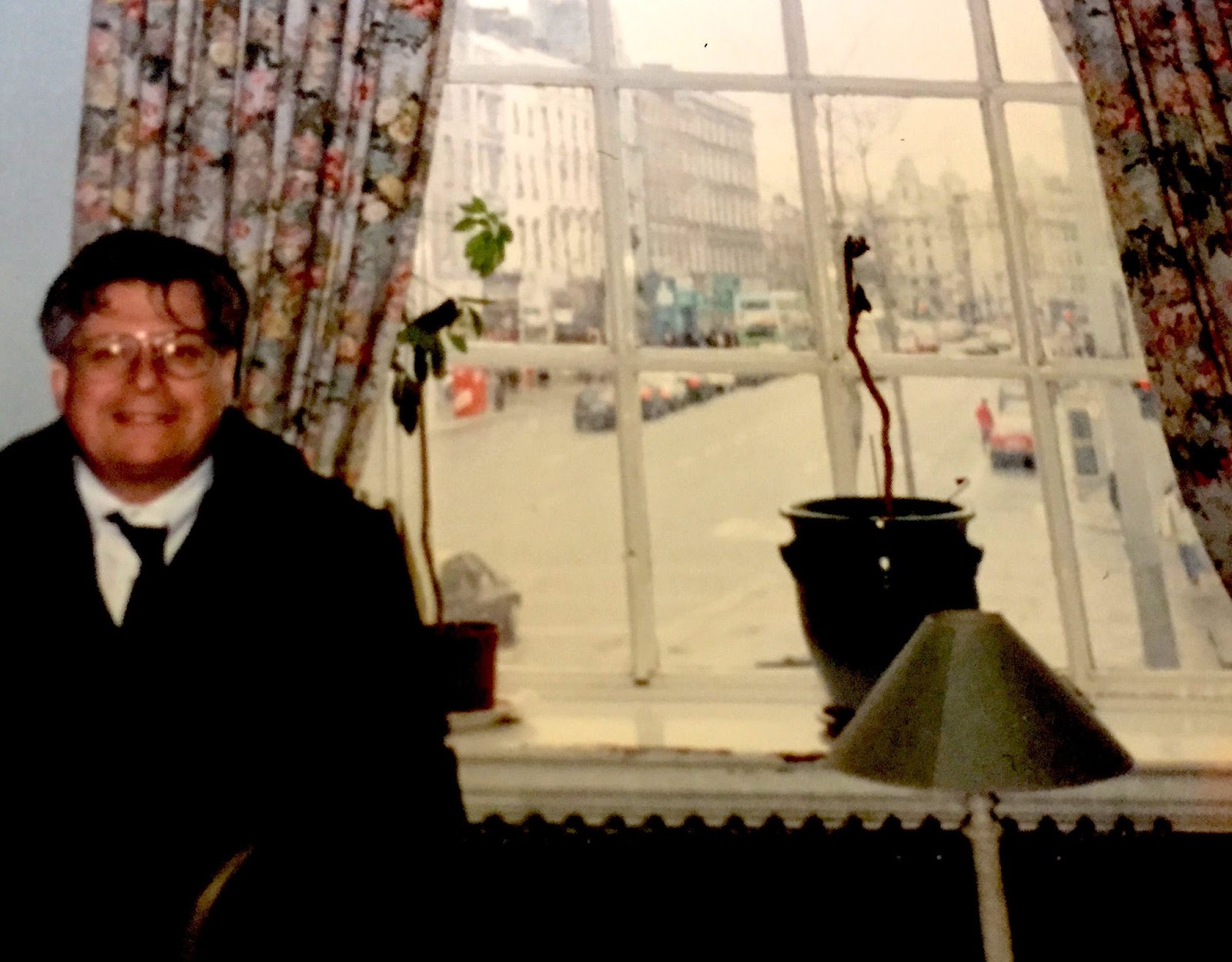
Visiting Randal's office at Trinity College,
Dublin, Feb. 12, 1994. The view is of
O'Connell Street. Photo by R Marlin.
My brother Randal most of his life has been a philosophy professor at Carleton University in Ottawa, Canada.

In 1993-1994 he took a sabbatical year and used it to bring his family to Dublin. He had an appointment at Trinity College, Dublin with a fine view of O'Connell Street.

I visited in February 1994, during the 50th anniversary year of the D-Day assault on Normandy. I got to see the memorial that my parents chose to honor my uncle Willem van Stockum after the war. He was shot down on June 10, 1944 while on a mission for the RAF.

A memorial was erected in France last year, on the 70th anniversary, to each of the two crews that were downed that night.

Randal on the Memorial Bench. Photo by JT Marlin.
The Irish memorial is simply a bench with the inscription: "To the Memory of Willem van Stockum / 30 November 1910-10 June 1944 by His Sister."

Spike Marlin and Willem van Stockum were roommates at Trinity. When Spike learned that Willem had a sister, he decided then and there that he was interested in marrying her, so fond he was of her brother Willem.

My Dad died in December 1994. Mom lived another 12 years.

My turn on the Bench. Photo by R Marlin.
Another member of the group was David Grene, a classicist who went on to be a co-founder of  the University of Chicago's Committee on Social Thought. He died after my father and before my mother, in 2002.

When my Dad died we made a gift to Trinity College, Dublin of another bench, named for my father, and we had the one for Willem renovated. They were placed on opposite sides of the entrance to the Book of Kells.

Friday, June 12, 2015

CIVIL WAR | June 12–Jeb Stuart's Cavalry Circles the Union Army

Jeb Stuart
This day in 1862 Confederate General James Ewell Brown ("Jeb") Stuart and 1,200 troops began a four-day ride from Richmond around the Army of the Potomac. Robert E. Lee sent him to scout out Union positions. Stuart's posse rode around the entire Yankee army of 105,000 troops, collecting prisoners and information.

General George McClellan had spent the entire spring of 1862 preparing his huge Union army for a campaign against Richmond, inching forward toward the Confederate capital.

On May 31, after Joseph Johnston was wounded, Confederate General Robert E. Lee assumed command of the Army of Northern Virginia. He dispatched Stuart, his cavalry leader, to investigate the position of McClellan’s right flank.

Stuart discovered that McClellan had no topological protection from his posse, so he risked court-martial by exceeding his orders and continuing to ride around the rest of the Union army.

His troops took prisoners and harassed Federal supply lines. They rode altogether 100 miles, pursued by Union cavalry that were commanded by Stuart’s father-in-law, Philip St. George Cooke.

The Southern horses outran their Yankee chasers, and Stuart assumed the status of a legend for his bravery and calculated risk-taking when he got back to Richmond on June 15. The information Stuart obtained helped Lee drive McClellan back from his slow attack on Richmond.

The Stuart Tank

The World War II Stuart tank, the American-made middle-sized and fast tank, was wryly named by the British after Jeb Stuart. The Stuart tank came in three editions - M2, M3 and M5. The Stuart M4 was skipped to avoid confusion with the Sherman (named after Union General William Tecumseh Sherman) M4 tank.

Both the Sherman and the Stuart were produced by ACF, which at one time was so big that it was part of the Dow-Jone Industrial Average. The Sherman was produced by the American Locomotive Company, a division of ACF. The Stuart was produced mostly in Berwick, Pa. during World War II.
  • The Stuart was the first U.S. tank designed to operate independently, with a top speed of 35 mph. Previously, tanks were designed to support infantry troops, and had a maximum speed of 10 mph. The German Panzer [Panther] III and IV tanks had a top speed of 26 mph.
  • The M2A4 was the first U.S. tank built on an assembly line and the Berwick plant was the only one in the USA with its own ballistics testing range. It was also the first tank included in the Lend-Lease program.
  • The Stuart tank was used by all of the Allied armies in all the major war theaters - Europe, North Africa, Asia and Pacific Ocean (including Alaska and Antarctica).
From 1940 through April 17, 1944, ACF produced 15,225 Stuart Light Tanks for the U.S. Army, the Marines, and the lend-Lease program for the Allies.  Of these, 1,496 tanks were produced in St. Charles, Mo. The rest were produced in Berwick. The model numbers and quantities produced (all in Berwick except where indicated) were:

1940-41: 365 M2A4 tanks
1941-43: 4,526 M3 tanks in Berwick, 1,285 in St. Charles
1942-43: 4,410 M3A1 tanks in Berwick, 211 in St. Charles
1942-43: 3,427 M3A3 tanks
1943-44: 1,000 M5A1 tanks

Field Marshal Montgomery praised the tank in its use in North Africa. The Stuart was noted for its great reliability, which was essential in the desert. The weaknesses of the Stuart were its limited range, its small gun (half the diameter of the 75 mm. guns on the Sherman M4 and Panzer III and IV) and the limited protection of its armor plate. It was most useful as a reconnaissance vehicle and as troop support. It was weakest in tank-to-tank confrontations with larger-gunned and better-protected tanks.

Brigadier G. M. Ross at the British Army Staff in Detroit wrote to ACF Berwick to pass along praise from military staff in Burma:
[T]he first tank to cross the Irrawaddy west of Mandalay was "The Curse of Scotland". This gallant old Stuart was the only one belonging to the 7th Armored Brigade, which got back across the Chindwin during the retreat from Burma in 1942. ... It is now the CO's Command Tank and has participated in the advance from Imphal. ... Recent advances have enabled us to regain a number of M3A1s ... lost during the retreat. These tanks have been in Japanese hands for more than 2.5 years and exposed to three monsoons and two winter periods. ... [A]lthough there was a certain amount of rust and peeling of paint, there were no signs of exceptional deterioration.
Berwick is seeking the funds to bring a Stuart tank back to the town.

Wednesday, June 10, 2015

BLOG VIEWS | 20K Views, Top Ten Posts

Thank you for reading and commenting. We just went past 20,000 page views.

These are the top ten posts, based on page views, since this blog was started in mid-2013:

7. Hiding Jews in Holland from the Nazis - Bob Boi... Dec 2, 2014 (Chapter 7 of a forthcoming book I am writing on the Dutch Resistance)

CHAMPS Closes Down Dec 10, 2014, 54 comments

D-Day Week 2014, 70th Anniversary Memorial for Dow... May 30, 2014

11. After the War - The Boissevain Family, Mengelb... Nov 2, 2014 (Chapter 11 of the book)