Showing posts with label Melbourne. Show all posts

Tuesday, May 8, 2018

VE DAY | May 8, End of WWII in Europe (Updated May 10)

Canadian Troops Liberate Amsterdam, 1945.
May 8, 2018 – I returned from the Netherlands yesterday to New York City.

Today the world celebrates VE- Day, that day in 1945 when World War II hostilities ceased in Europe.

In the former Soviet Union the celebration is delayed by one day, to May 9, because fighting there continued for another day.

The Soviet Union lost a higher percentage of its population (15%) than any other Allies – led by Belarus (25%) and Poland and the Ukraine (18% each).

Overveen, The Netherlands, May 4

On Friday, May 4, I was in Holland remembering the war dead with a visit to the Honorary Cemetery (Eerebegraafplaats Bloemendaal), which is identified as being in Bloemendaal but is accessed from the town of Overveen. It was Remembrance Day (Dodenherdenking) in Holland. On that day, the Netherlands remembers those who died in combat during WWII and in subsequent combat or peace-keeping operations.

The following day, the country celebrates Liberation Day (Bevrijdingsdag), a day of festivities at the ending of World War II for the Dutch in 1945, after the long Hunger Winter of 1944-45. 

The hard-working Dutch people do not annually close their banks on either May 4 or May 5. But government workers have a holiday on May 5 and some Dutch people start their vacations on Kings' Day, since 2014 on April 27 (King Willem Alexander's birthday) and continue through May 5. 


Memorials and festivals, such as a music festival in Amsterdam (the Bevrijdingsfestival), are widespread and many schools are on vacation at that time. Liberation Day is officially a holiday for everyone only when the last two digits of the year are divisible by five. So 2020 will be the next big celebration.

Here's how Hilda van Stockum described the joy that flooded Holland on May 5, 1945, in her 1962 book, The Winged Watchman:
On the fifth of May, Holland was liberated. Canadian troops marched into the villages and cities. Women and girls threw flowers and jumped on cars and tanks. Everywhere the Dutch flag waved. Children held bunched of flowers. People danced in the streets. Bells rang.
Father and the boys set the Watchman in joy. Mother fetched flags out of her trunk, which they strung from one wing to the other, plaiting the sails through the gates in decorative patterns.
They were free!
Laval, France, May 8


Laying of wreaths and flowers. The gravestone at
lower right is different form the others because it was
sent from the Dutch Government, not the British.
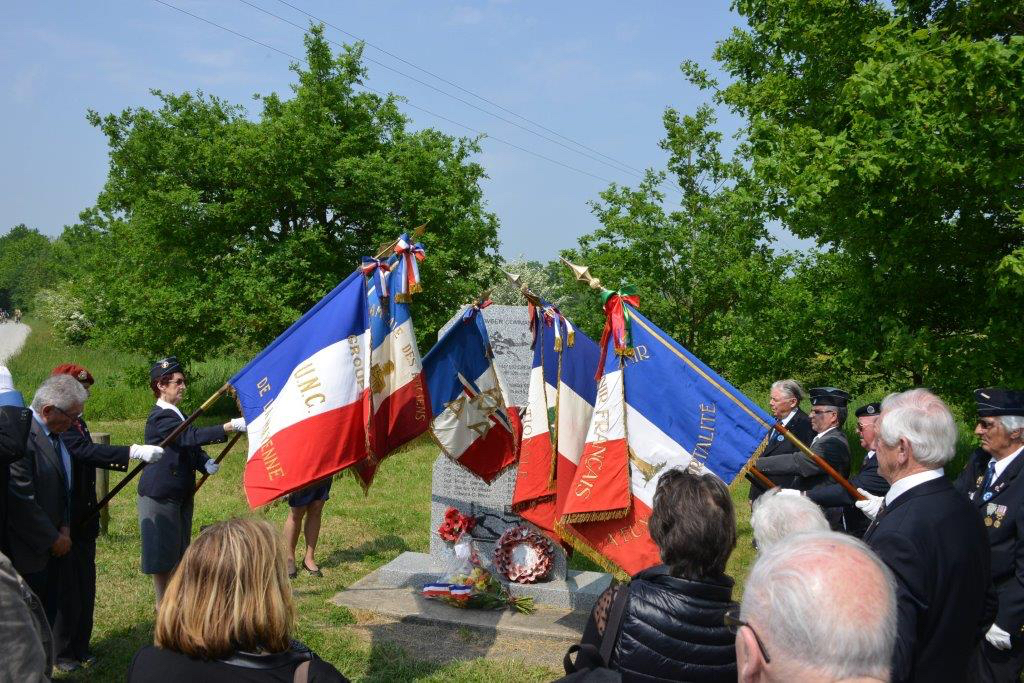
At the Valfleury Cemetery in Laval, representatives of local military and historical groups remembered VE-Day on May 8. The first photo shows the laying of wreaths and flowers before the graves of the 14 airmen in two airplanes.

The photos shown here are sent by Jean-Louis Cholet, who was one of the two people mist responsible for getting monuments erected to the crews of the two Halifax III bombers.

One plane was piloted by a Dutchman (my uncle Willem van Stockum) flying with the RAF after being trained with the RCAF.

The Laval student shown in first
photo laying flowers on the graves.
The other was piloted by an Australian (Thomas Henderson), whose son I met at the visit by the families of the airmen in 2014, during the 70th-anniversray year of D-Day. The two bombers that were downed had been on missions before and after D-Day, to remove gun emplacements and disrupt airfields and railway lines.

Every year, local students in the Laval area visit the gravesites and lay flowers on the graves of the flyers out of gratitude for the Liberation of France by the Allies.

With the placement of two monuments at the site of the crashes of the two Halifaxes, the annual memorials extend to these sites.

In 2014 I posted a memory of the coming-together of the relatives of the crews of the bombers. This was my third visit to the gravesite, but the first with my wife Alice, and with the largest number of relatives.

2018 – A wreath for the
Halifax piloted by
Tom Henderson.
It was a special pleasure also in 2014 for us to meet Dr. Rex Henderson, son of the Australian pilot of the second Halifax, and Rex's wife Deborah. Alice and I traveled with them  for several days to see the landing areas of the Normandy invasion.

Melbourne, Yorkshire, England

This year for the first time I went with my wife Alice to RAF Melbourne, the base in Yorkshire from which the planes from 10 Squadron took off.

I have written about this visit separately. In the post, I cite the statistic that 46 percent of all the crew members of the RAF Bomber Command were killed on missions. Perhaps some of the crew members believed that the statistics didn't apply to them, but the statistics don't know that.
2018 – Remembering the crew of one Halifax, piloted
by Willem van Stockum.

2018 – Honoring the crew.
Worldwide War Dead

Statistics hide the face of the human costs of war. But they are the only way to convey the magnitude of the death and destruction that Hitler generated.

Estimates of losses from WW2 sometimes differ for gruesomely competitive reasons – "We lost more people than you did." Wikipedia averages several estimates, which is not necessarily the best approach.

Below is how one source summarizes the deaths world-wide by country from World War II, ranked in order of the estimated loss.

Country
Millions Dead
1. Soviet Union (USSR)
25
2. China
15
3. Germany
8
4. Poland
5.7
5. Dutch East Indies
3.5
6. Japan
2.9
7. British India
2.1
8. French Indochina
1.6
9. Yugoslavia
1.4
10. Philippines
0.8
11. Romania
0.8
12. France
0.6
13. Greece
0.6
14. Hungary
0.6
15. Italy
0.5
16. United Kingdom
0.45
17. United States
0.42
18. Korea
0.4
19. Lithuania
0.35
20. Czechoslovakia
0.3
21. Netherlands
0.3
Total of These Countries
71.32
Source: https://www.secondworldwarhistory.com/world-war-2-statistics.asp

That's more than 71 million dead in these 21 countries. The losses weigh harder on countries that have a smaller population, and on population groups such as Jews who were targets of the Holocaust.

Saturday, April 21, 2018

RAF100 | Visit to RAF Melbourne, Yorkshire, April 20

At Betty's. L to R: Alice, Susanne Pescott and I in York,
England. During WW2, Betty's Shop had a bar favored by
airmen from many countries.
Edinburgh, Scotland, April 21, 2018 – As noted a few weeks ago, I have been eagerly anticipating my first visit to the base from which my uncle Willem van Stockum flew six missions for RAF 10 Squadron during the ten days surrounding D-Day, 1944.

The sixth mission, on June 9/10, 1944 took his life and that of the other six crew members on their Halifax Mark III bomber. (Willem trained on the Mark II bomber.)

They had completed their mission when they were shot down. An eye witness (who was then a small child) said that the plane was in flames but steered away from the French farmer's home and into the pear orchard.

I've been three times to Laval, France where the 14 crew members of the two RAF planes hit that night are buried. But this was my first visit to the site from which the planes left.

Scratched on the Mirror. V/C Poulin, at
bottom right, scrawls "Canada"...
Two More Names. Sgt. Alex Trench from 
Glen Cove, N.Y, USA and Sgt. Redlin
from Edmonton, Alberta, Canada.
Another. J. N. Fletcher, Royal Canadian Air
Force, from Vancouver.
Alice and I took the train from Oxford (we should have taken a faster and cheaper train from London) to York, and there met Susanne Pescott, a dedicated volunteer from the 10 Squadron Association, for lunch at Betty's.

The Mirrors at Betty's Bar

Susanne showed us the mirrors in Betty's Betty's, where during World War II was a popular bar for airmen from all over the world – Canada especially, but also the United States and New Zealand.

The crew members scratched their names in the mirror – 600 of them according to a notice at the location. Unfortunately, no one so far has written down the names and indexed them alphabetically. It would be helpful if someone did that, so that the place could become even more of a destination for families of the airmen. I couldn't find my uncle's name anywhere; the lighting is difficult.

What these young men may not have known, or had time enough to even think about, is that the killed-in-action rate of the Bomber Command was 46 percent. For every 400 men who showed up to fly, 46 died.

For every ten airmen scratching their names in the mirror, five would never come home...

...And many of those who  counted as survivors came back wounded or were taken as prisoners of war by the Germans and were delayed returning...

My uncle Willem was a mathematician and he knew about probability. This was also clear from his letters to his mother. He was at peace with his decision to fight for his occupied native country (Holland), but he warned his mother that it was unlikely he would ever see his mother again. The knock on the door at 3728 Northampton Street in Washington, D.C. came for her and my mother in June 1944, when U.S. military officials came to report that Willem and the rest of the crew were missing.

In front of the door that Uncle Willem went through
 in 1943 or 1944 when he reported for duty at RAF
Melbourne.
Checking In

Here at the right is the doorway where the flight crews, who would have had their basic pilot, navigation or gunnery training elsewhere, would show up for their assignments.

My uncle Willem wrote to his mother about the satisfaction he had about being chosen by crew members as their pilot. The Time Bomber book by Robert Wack devotes a lot of attention to Willem's time as a pilot trainee, and the paces he had to go through (at 32 years of age, which was old for a pilot).

The door knocker has the badge of the 10 Squadron on it.

The motto at the bottom of the badge is "Rem Acu Tangere," which has nothing to do with Tangerines. It means "To touch the thing with a needle,"  "Hit the target precisely" or "Hit the nail on the head".

Prime Minister Margaret ("Iron Lady") Thatcher had her own version in her presentation of a new standard to 10 Squadron at Brize Norton:
Over nearly ten years as Prime Minister I have come to know many of the Squadron's members and their aircraft. We have flown together to the most far-flung lands and continents. You have brought me safely to my destinations through ice and fog and sand-storms, with unfailing punctuality. Indeed I am living proof of your Squadron motto, Rem acu tangere, which might be loosely translated as “we land even when the Prime Minister can't see the runway”.
Why Were So Many Bases in Yorkshire?

To reach Germany and Occupied Europe, the RAF bases needed to be on the Eastern half of the country. Yorkshire is a likely place just because it takes up so much space on the East Coast. It has some hills that are called "peaks" such as "Three Peaks" in northern Yorkshire, but these "peaks" are more like foothills, averaging 700 meters in height. Roseberry Topping is called "Yorkshire's Matterhorn" because it looks a bit like the original, but it is only one-thirteenth of the height of the real Matterhorn (4,500 meters) on the Swiss-Italian border.

By the standards of England's 48 counties, Yorkshire is enormous. Its 11,900 sq km area constitutes 9.1 percent of England's total 130,000 sq km. Even after Yorkshire was split into four separate counties in 1974, the North Yorkshire component was still England's largest county. The wide-open spaces in Yorkshire offered the RAF a chance to spread out its personnel and keep the equipment away from civilian residences. The county is relatively underpopulated, with only 7.5 percent of the English population in 9 percent of the area, and the countryside was under no building pressure.

When the RAF was requisitioning farmland to create runways for military aircraft, Yorkshire had other advantages over, say, Norfolk, which was the site of RAF Hethel. The Vale of York offered not only ample flat agricultural fields and plateaus, but easy access from the central railway hub of York. So that is where the RAF concentrated its intensive training programs for flight crews.

Here are 38 sites of former air bases in Yorkshire. They include the one from which my uncle set off six times and returned to five times, Melbourne. His sixth flight took him and his crew to Laval, France where they still rest.

What Was at the Melbourne Air Base?


RAF Melbourne, view from the air. To support the heavily
loaded Halifax bombers, the runways were made of concrete.
They remain, to be used occasionally for drag races.
The main feature of the air bases was a runway for take-off and landing, a "tower" (usually a two-story building) and living quarters for the flight crews and other staff.

At the beginning of the war, grass runways were common, but heavily loaded bombers required concrete and asphalt strips.

To allow for variation in wind direction, airports typically have a triangular configuration. They are therefore easy to spot from above.

Besides the control tower and barracks, an airbase would  include a briefing room for crews heading, and hangars for repairs.

The lengths of the runways at RAF Melbourne were (see numbers on photo):
01-19 1,350 yards
06-24 1,900 yards
15-33 1,400 yards

Camp sites for base personnel were dispersed to the north. The base accommodated 1,901 men and 382 women. Women were deployed on communications and reporting functions as well as food and housing tasks.

The Halifax III Crews and Their Motivation
Willem van Stockum, Captain, front center, with six other 
members of the crew of the Halifax III. They are all buried 
in Laval, France.

While awaiting duty, the Halifax III crews would practice their takeoffs and landings.

They were anticipating action at the end of 1943 and the beginning of 1944. Willem writes to his mother that they crews are eager to go into action.

He reacts with disbelief when Dorothy Thompson, a popular news columnist, wrote that American soldiers needed postwar goal to fight for, a vision of a new society after the war.

He wrote a response to his mother that was eventually published as "A Soldier's Creed". It was written in June 1944 and was published in The Horn Book in its Christmas issue and reprinted at the end of Time Bomber, by Robert Wack.
A SOLDIER'S CREED By A BOMBER PILOT
I didn't join the war to improve the Universe; in fact, I am sick and tired of the eternal sermons on the better world we are going to build when this war is over. I hate the disloyalty to the past twenty years. Apparently people think that life in those twenty years, which cover most of my conscious existence, was so terrible that no-one can be expected to fight for it. We must attempt to dazzle people with some brilliant schemes leading, probably, to some horrible Utopia, before we can ask them to fight. 
I detest that point of view. I hate the idea of people throwing their lives away for slum-clearance projects or forty-hour weeks or security and exchange commissions. It is a grotesque and horrible thought. There are so many better ways of achieving this than diving into enemy guns. Lives are precious things and are of a different order and entail a different scale of values than social systems, political theories, or art. 
"Why are we not given a cause?" some people ask. I do not understand this question. It seems so plain to me. There are millions and millions of people who are shot, persecuted and tortured daily in Europe. The assault on so many of our fellow human beings makes some of us tingle with anger and gives us an urge to do something about it. That, and that alone, makes some of us feel strongly about the war. All the rest is vapid rationalization. All this talk about philosophy, the degeneration of art and literature, the poisoning of Nazi youth, which the Nazi system entails, and which we all rightly condemn, is still not the reason why we fight and why we are willing to risk our lives. 
Here, let us say, is a soldier. He asks himself, "Why should I die?" You would tell him: "To preserve our civilization." When the soldier replies: "To Hell with your civilization; I never thought it so hot," you take him up wrongly when you sit down and say to yourself: "Well, after all, maybe it wasn't so hot," and then brightly tap him on the shoulder and say: "Well, I've thought of a better idea. I know this civilization wasn't so hot, but you go and die anyway and we'll fix up a really good one after the war." I say you take him up wrong because his remark: "To Hell with your civilization" doesn't really mean that he is not seriously concerned about our civilization. He is simply revolted by the idea of dying for ANY civilization. 
Civilization simply isn't the kind of thing you ever want to die for. It is something to enjoy and something to help build up because it's fun, and that is that, and that is all. 
When a man jumps into the fire to save his wife he doesn't justify himself by saying that his wife was so civilized that it was worth the risk! There is only one reason why a man will throw himself into mortal combat and that is because there is nothing else to do and doing nothing is more intolerable than the fear of death. I could stand idly by and see every painting by Rembrandt, Leonardo da Vinci and Michelangelo thrown into a bonfire and feel no more than a deep regret, but throw one small, insignificant Polish urchin on the same bonfire and, by God, I'd pull him out or else. I fight quite simply for that and I cannot see what other reasons there are. At least, I can see there are reasons, but they are not the reasons that motivate me. 
During the first two years of the war when I was an instructor at an American University in close contact with American youth and in close contact with the vital isolationist question in the States, I often felt that there was much insincerity, conscious or unconscious, on our, the Interventionist, side of the argument. We had strong views on the danger of isolationism for the United States. We thought, rightly, that for the sake of self-interest and self-preservation the United States should take every step to ensure the defeat of the Nazi criminals. But however sound our arguments, our own motives and intensity of feeling did not spring from those arguments but from an intense passion for common righteousness and decency. 
Suppose it could have been proved to us at that time that the participation of the United States in the stamping out of organized murder, rape and torture in Europe could only take place at great cost to the United States, while not doing so would in no way impair her security. Would we not still have prayed that our country might do something? And would we not have been proud to see her do something? 
There is an appalling timidity and false shame among intellectuals. The common man in the last war went to fight quite simply as a crusader. I am not talking about politics now, I am not either asserting or denying that England declared war from purely generous and noble considerations, but I am asserting that the common man went and fought with the rape of Belgium foremost in his mind and saw himself as an avenger of wrong. 
After the war the common man went quietly back to his home. The intellectuals, however, upon coming back, ashamed of their one lapse of finding themselves in agreement with every Tom, Dick and Harry, must turn around and deride the things they were ready to give their lives for. As they were the only vocal group, the opinion became firmly established that the last war was a grave mistake and that anyone who got killed in it was a sucker. 
And now, in this war, these intellectuals are hoist with their own petard. They lack the nerve and honesty to represent the American doughboy to himself for what he is. They do not give him the one picture in his mind which would stimulate his imagination and which would make him see beyond the fatigues, the mud, the boredom and the fear. The picture is there for anyone to paint who has a gift for words. It is a simple picture and a true picture and no one who has ever sat as a small child and listened with awe to a fairy story can fail to understand. The intellectuals, however, have made fun of the picture and so they won't use It.
But some day an American doughboy in an American tank will come lurching into some small Polish, Czech or French village and it may fall to his lot to shoot the torturers and open the gates of the village jail. And then he will understand. 
There is a lot of talk among our intellectuals about our youth. Our youth is supposed to want a change, a new order, a revolution or what not. But it is my conviction that that is emphatically NOT what our youth wants. Have you ever been in a picture house on a Saturday afternoon, when it is filled with children and some old Western movie is ending in a race of time between the hero and the villain? Have you seen the rapt attention, the glowing faces, the clenched fists? What our young men really want is to be able to give that same concentrated attention and emotional participation, this time to reality, and this time as heroes and not as spectators, that they were able to give to unsubstantial shadows, before long words and cliches had killed their imaginations. Killed them so dead that they can no longer see even reality itself imaginatively. 
It is up to the intellectuals to rekindle the thing they have tried to destroy. It is as simple as St. George and the Dragon. Why not have the courage to point out that St. George fought the dragon because he wanted to liberate a captive and not because he wanted to lead a better life afterwards? Some day, sometime, my picture of an American doughboy in a Polish village will become true. Wouldn't it be better for him then to have the cross of St. George on his banner than a long rigmarole about a better world? 
As long as our intellectuals and leaders do not have the courage to risk being thought sentimental and out-of-date and are not willing to stress that nations as well as individuals are entitled to their acts of heroism and chivalry, they will never be able to give our youth what it needs. 
It is true that every fairy story ends with the words: "and they lived happily ever after." How irritating a child would be, though, if it interrupted its mother at every sentence to ask: "But, Mummy, will they live happily ever afterwards?" It simply isn't the point of the fairy story and it isn't the point of this war. 
Presumably we won't live happily ever after this war. But just as a fairy story helps to increase a child's awareness and wonder at the world, so this war may make us more aware of one another. Perhaps we shall learn, and perhaps some things will be better organized. I hope so. I believe so. But only if we engage in this war with our hearts as well as our minds. 
The windmill was a landmark for flyers returning to the
RAF Melbourne base. Source: Excerpt from unidentified
RAF reference book on air bases in WW2, 208-209.
For goodness' sake let us stop this empty political theorizing according to which a man would have to have a University degree in social science before he could see what he was fighting for. It is all so simple, really, that a child can understand it.

After the war, the arms of the windmill were removed.
The Record of 10 Squadron at RAF Melbourne

The only bomber squadron based at Melbourne was 10 Squadron.

While in residence, 10 Squadron lost 128 Halifaxes in 300 raids.

This is what I saw. The base of the windmill is still there.
Photo by JT Marlin.
That would be 896 crew members. It began its work in early 1944 and its last sorties were on April 25, 1945.

What Happened to the RAF Bases after WWII?

Some of the RAF air bases were retained for postwar military needs. The Cold War with the Soviet Union was still on, and the US Air Force needed some bases to implement its participation in NATO and U.S.-British agreements. Many air bases were converted to industrial or other civilian uses. Some just fell into disuse.

Most of the air bases that had been agricultural land were returned to this use. That was the case with RAF Melbourne. Some buildings were converted to farm use. Others were left as they were at the end of the war, and have been opened up once a year on Remembrance Day, November 11 with the cooperation of the 10 Squadron Association, which is membership-based.

Besides farming and occasional drag racing on the runways, part of the base is used for private flying. There is interest in establishing a museum at the base. A memorial to 10 Squadron has been placed near the wartime entrance to the Melbourne air base.

Remembrances in France

The two crews that were downed on June 10, 1944 are remembered in France. A French website on the RAF effort includes details on the crew of the Halifax plane that Willem van Stockum piloted:

Flying Officer (Pilot). VAN STOCKUM, WILLEM JACOB, 33 ans. 10 Sqdn. Royal Air Force Volunteer Reserve. E. Sub-Sec. D. Row 1. Joint grave 42944. LAVAL (VALFLEURY) COMMUNAL CEMETERY.

Flying Officer (Bomb Aimer).MARSHALL, ROBERT KEITH, 30 ans. 10 Sqdn. Royal Air Force Volunteer Reserve. E. Sub-Sec. D. Row 1. Joint grave 42949. LAVAL (VALFLEURY) COMMUNAL CEMETERY.

Sergeant (Wireless Operator). PERKINS, ALFRED CHARLES, 22 ans. 10 Sqdn. Royal Air Force Volunteer Reserve. E. Sub-Sec. D. Row 1. Joint grave 42945-42946. LAVAL (VALFLEURY) COMMUNAL CEMETERY.

Flying Officer (Flight Engineer). ELLYATT, JOHN, 27 ans. 10 Sqdn. Royal Air Force. E. Sub-Sec. D. Row 1. Joint grave 42943. LAVAL (VALFLEURY) COMMUNAL CEMETERY.

Flying Officer (Navigator). DANIEL, GILBERT, 22 ans. 10 Sqdn. Royal Air Force. E. Sub-Sec. D. Row 1. Joint grave 42947. LAVAL (VALFLEURY) COMMUNAL CEMETERY.


Pilot Officer (Air Gunner). BEALES, FRED, 20 ans. 10 (R.A.F.) Sqdn Royal Canadian Air Force. E. Sub-Sec. D. Row 1. Joint grave 42945-42946. LAVAL (VALFLEURY) COMMUNAL CEMETERY.

Sergeant (Air Gunner). MASON, ALBERT. 10 Sqdn. Royal Air Force Volunteer Reserve. E. Sub-Sec. D. Row 1. Joint grave 42948. LAVAL (VALFLEURY) COMMUNAL CEMETERY.

The Dutch Ministry of Defense knew who van Stockum was. They identify the pilot as Prof. Dr. Willem Jacob van Stockum.

Postscript – Poem

A 10 Squadron veteran returned to Melbourne and wrote the poem at right.

See Related Posts: RAF Centenary and 10 Squadron

Saturday, March 31, 2018

RAF100 | The RAF Centenary, 10 Squadron (Updated April 4, 2018)

This Handley Page Halifax B III was flown in 1944-45,
a high-performing plane, as good as the Lancaster.
April 1, 2018 (Updated April 4, 2018 with Postscript below) – The Royal Air Force (RAF) celebrates its 100th Anniversary starting this month.

A public event will be held at Buckingham Palace on July 10.

The RAF was formed on April 1, 1918 by the amalgamation of the Royal Flying Corps (RFC) and the Royal Naval Air Service (RNAS), so that it stood as a coequal branch of the armed forces.

The Women’s Royal Air Force (WRAF) was created at the same time to provide female mechanics to free up men for service in World War I. An unexpectedly large number of women volunteered. WRAF ended in 1920 and was recreated in 1949 as the new name of the Women's Auxiliary Air Force, founded in 1939. As more women joined the RAF staff, WRAF formally merged into the RAF in 1994.

Successes of the RAF's Predecessors in WWI

In April 1911, an air battalion of the British army’s Royal Engineers was formed at Larkhill in Wiltshire, including aircraft, airship, balloon, and man-carrying kite companies. It was less than a decade after Wilbur and Orville Wright made the first flight of a self-propelled, heavier-than-air aircraft, at Kitty Hawk, on North Carolina's Outer Banks.

The predecessor Halifax B II Bomber was deployed until 1944
by RAF's 10 Squadron, from Melbourne, Yorkshire. This
shows the inside of the plane. A model is on display at the
Yorkshire Air Museum. Note rounder tail fins than on the III.
In December 1911, the British navy formed its Flying School at Eastchurch, Kent.

The following May, the army's air battalion and the navy's flying school were absorbed into the newly created RFC, which established a new flying school at Upavon, Wiltshire, and formed new airplane squadrons.

In July 1914, navy needs led to the creation of RNAS. A month later, on August 4, Britain declared war on Germany and entered World War I. At the time, the RFC had 84 aircraft, and the RNAS had 71 aircraft and seven airships. Four RFC squadrons were deployed to France to support the British Expeditionary Force.

Germany dominated the air at first, with superior weapons like the manually directable machine gun. Britain suffered from bombing on the ground and defeat in the skies against German flying aces such as Manfred von Richthofen, “The Red Baron.” The British military responded with a separate air ministry, committed to retaliate against Germany with strategic bombing.

By war’s end, November 1918, the newly created RAF had gained air superiority on the western front, with nearly 300,000 officers and airmen, and more than 22,000 aircraft.

The RAF in WWII

In September 1939, RAF strength had fallen to about 2,000 aircraft, when Hitler shocked the world by invading Poland. World War II was on.

On May 10, 1940, Hitler invaded Holland, despite having promised to allow it to remain neutral. After he carpet-bombed Rotterdam, the Netherlands surrendered and was occupied by the Wehrmacht and (much worse) the SS police, as the Nazis continued their advance through Belgium to France.

In June 1940, Britain was alone in Europe in its resistance to Nazi Germany. Hitler planned to invade Britain and prepared maps of British cities and factory centers showing strategic sites. In July 1940 he ordered his air force, the Luftwaffe, to soften up Britain by destroying their ports, as he did in Holland. However, this time the outnumbered RAF fliers put up a fierce resistance in the Battle of Britain.

Luftwaffe commanders then made it their priority to destroy the British air fleet. The Germans intended to wipe out the RAF during the summer, and invade Britain in the autumn. During the next three months, however, the RAF resisted the massive German air attacks, relying on radar technology, more maneuverable aircraft, and sheer, exceptional bravery. For every British plane shot down, two Luftwaffe planes were destroyed.

In October, Hitler postponed the planned invasion. In May 1941 he opted to save his planes for the Eastern Front, and the invasion was off the table. The Battle of Britain ended. British Prime Minister Winston Churchill said of the RAF pilots: “Never in the field of human conflict was so much owed by so many to so few.” I was required had to write out this sentence many, many times when pronounced guilty of an infraction against school rules as a pupil in Gilling Castle and Junior House, the younger classes of Ampleforth College near York.

By war’s end in 1945, the RAF employed a staff of nearly one million. After the war, as in the United States, British military personnel strength was drastically reduced and RAF staff stabilized at about 150,000 men and women.

The RAF's 10 Squadron

My uncle, Willem van Stockum, was a pilot for the 10 Squadron of the RAF in World War II. He piloted a 10 Squadron Halifax bomber on six missions during the ten days surrounding D-Day. Leaving from Melbourne, Yorkshire, his plane was downed over Laval, France.

A Dutchman, born to a Dutch Navy Captain (Abraham van Stockum) who married one of the six daughters of the publisher of the main newspaper (the Algemeen Handelsblad) in Amsterdam, Willem earned a B.A. and M.A. in mathematics from Trinity College, Dublin, winning a large gold medal. He went on to obtain a doctorate in mathematics from Edinburgh University. He won a position at Einstein's Institute for Advanced Studies in Princeton, NJ and was the first person to write in English about the potential for time travel suggested by the "time-like curves" implicit in Einstein's equations for Special Relativity. (His "van Stockum dust" theory is considered the beginning of scientific time-travel speculation.) He was teaching mathematics at the University of Maryland when Hitler invaded Holland.

Outraged by the invasion of his native country, van Stockum went to Canada to volunteer to fight Hitler. For months he taught navigation and the physical principles of flight to pilot trainees in the Royal Canadian Air Force. Then he asked to be sent to the RAF to fly bombers. He qualified as a flying officer himself, although older than most pilots, and went on six missions during the ten days around D-Day. On June 10, ten RAF Halifax B III planes went out from Melbourne. Eight returned. The missing two were downed by German anti-aircraft fire.

Dutchman Willem van Stockum piloted one of these planes. A book has been written about him by US army major Dr Robert Wack, Time Bomber. Six other crew members killed in the crash of the plane in a pear orchard in Entrammes, near Laval in the Mayenne.

The other was piloted by an Australian and crashed nearby. The son of this pilot, Rex Henderson, visited Laval at the same time as I did and on the 70th anniversary of V-E Day we drove together through Normandy with my wife Alice and his wife Deborah.

Two memorials were erected by a local French group at the ceremony that we attended, organized by Souvenir Français representative Jean-Louis Cholet. Details on the mission are here: http://aircrewremembered.com/stockum-willem-jacob-van.html

My wife Alice and I are visiting York on April 20-21, 2018 and intend to visit what is left of the base in Melbourne and speaking with anyone with a shared interest in No. 10 Squadron in WW2. If we have time, we would like to see the Halifax bomber on display, and the War Museum. I have sent a note to the 10 Squadron Association (10sqnass.co.uk). Willem's 10 Squadron, part of No 4 Group in December 1941, moved from its original location in Leeming in August 1942 to Melbourne. In 1942-1944 it deployed the Handley Page Halifax B II bomber; starting March 1944 through August 6, 1945 (when disbanded) it used the Handley Page Halifax B III.

A book by Jon Lake, Halifax Squadrons of World War II covers its role as a front line bomber, and other topics.

For more, see http://www.historyofwar.org/air/units/RAF/10_wwII.html and
http://aircrewremembered.com/stockum-willem-jacob-van.html

Postscript, April 4, 2018

I received the following email this morning from the man who started, in 1988, the annual commemoration on V-E Day (May 8) of the sacrifice of the crews of the two planes that were downed in the Laval area, Jean-Louis Cholet. He gives credit for the monuments or steles to Jean-Luc Peslier, a French Air Force veteran.
Dear American friend,  
Thank you for your message and documents attached. You know how much I am attached to the memory of your uncle and his comrades. I am not alone in the realization of the steles recalling the fall of the Halifax bombers. The realization of the steles was possible only thanks to the work of Mr. Jean-Luc Peslier president at the time of the Amicale Mayennaise of the Ancients [Veterans] of the French Air Force. Without him, nothing could have happened. We will think a lot about you and them on May 8th. 
Very cordially,
Jean Louis Cholet

Wednesday, November 25, 2015

WW2 | Mark II Halifax Bomber

A Mark II Series 1 Halifax bomber operating out of the 10th
Squadron in Melbourne, Yorks., UK.
My mother's brother Willem van Stockum died during the week of D-day, June 1944,  in a crash of a Handley-Page Halifax Mark II bomber. 

He was one of seven crew members on the plane, and it was one of two planes that crashed the same night.

Uncle Willem knew the plane well because he had been a flight instructor for this plane for the Royal Canadian Air Force (RCAF) before he became a pilot.

Naturally I have been curious about the   plane he flew in and how it fared during the war:
  • Was this a good plane? Where did it rank in the hierarchy of the air? 
  • How many sorties were made in this plane?
  • What was the experience of 10th RAF Squadron, flying out of Melbourne, Yorkshire?
  • What was the experience of all of the RAF Halifaxes during June 1944?
I have some answers to these questions. Some of these answers come from my own counting and are therefore new.

The Halifax Bomber

The Lancaster bomber had a somewhat better reputation, but in June 1944 the Halifax was second only to it. It was a plane of preference. That is, the Mark II version did. The Mark I version had a dangerous tendency to go into an uncontrollable tailspin occasionally under extreme conditions. The tail was improved and the Mark II shook this problem.

The Bomber Command Museum of Canada, provides excellent data on Halifax Sorties and Losses in WWII (1941-1945). It reports that of those who flew for the bomber command at the beginning of WWII, only 10 percent survived. Willem van Stockum, as a mathematician and a flight instructor, would have been intimately familiar with these numbers, as is pointed out in Robert Wack's Time Bomber. Here is what the Museum says about the Halifax  bomber crews:

Of every 100 airmen who joined Bomber Command, 45 were killed, 6 were seriously wounded, 8 became Prisoners of War, and only 41 escaped unscathed (at least physically). Of the 120,000 who served, 55,573 were killed, including more than 10,000 Canadians. 

Of those flying at the beginning of the war, only ten percent survived. It is a loss rate comparable only to the worst slaughter of the First World War trenches. Only the Nazi U-Boat force suffered a higher casualty rate. 

On a single night (the night that Willem van Stockum was downed, June 10, 1944), Bomber Command suffered more losses than did Fighter Command during the entire Battle of Britain. 

The loss rate varied greatly as the war progressed and was considerably lower as the end of the war approached in late 1944 and early 1945. For most of the war, the majority of those who entered Bomber Command did not survive. During the RCAF's Halifax operations between March 1943 and February 1944, the average loss rate was 6 percent, producing a mere 16 percent survival rate for a tour of 30 operations.
Yet despite the chilling odds, the flow of volunteers never faltered. The price was known to be enormous, but it was a price which continued to be paid with unquestioning courage. If today it represents a debt which can never be repaid, it is at least a debt which must never be forgotten.
Canadian pilot and author Murray Peden said:
The crews faced formidable odds, odds seldom appreciated outside the Command. At times in the great offensives of 1943 and 1944 the short-term statistics foretold that fewer  than 25 out of each 100 crews would survive their first tour of 30 operations. [...] Yet the crews buckled on their chutes and set out with unshakeable resolution night after night. They fell prey to the hazards of icing, lightning, storm and structural failure, and they perished amidst the bursting shells of the flak batteries. But by far the greater number died in desperately unequal combat under the overwhelming firepower of the tenacious German night fighter defenders. [Emphasis added.]
More Data on Sorties

Dates are based on what the date was at 12:01 a.m. So the night of June 1-2 would be recorded as June 2.


Data on Halifax Bomber Losses, June 1944

Night and Losses
June 2 - 1 down
3 - 15 down out of 105 out (Trappes); none were lost on 119 sorties to coastal batteries
6 - 2 down out of 412 attacking Normandy batteries
7 - 1 down out of 418 attacking French roads and rail
8 - 11 down out of 195 attacking French roads and rail (as Willem predicted, the Germans got wise and were more prepared the next night)
10 - 2 down out of 175 attacking French airfields (the two were shot down over Laval in Mayenne). 
Total of 32 down in ten days. For the whole month of June it would be 105 planes down.
105 lost in 5095 sorties was a 2.06 percent loss rate
Since each plane had a crew of 7, that meant 735 dead 

Loss Rates for Halifax vs. Other Planes


Lancaster losses can be found here, Halifax losses can be found here. The record of losses for both planes was tragic, but the Halifax seems to have done slightly better than the Lancaster. 
For example, in June 1944 the loss rates were:
Mossie (Mosquito) - 7 lost in 1487 sorties for a 0.47% loss rate
Lancaster - 182 lost in 8614 sorties for a 2.11 percent loss rate
Halifax - 105 lost in 5095 sorties for a 2.06 percent loss rate

Since the Lancaster was considered a superior plane, it may have taken more risks...

It would be interesting to have the numbers for the U.S. B-25. We do have:
American heavy bomber, ETO - 520 lost in 28,925 sorties for a loss rate 1.8 percent (ref AAFSD) 

Friday, May 30, 2014

WW2 | D-Day Gravesites, 70 Years On

Map 1. Normandy Invasion. Utah-Omaha Beaches, where U.S.
troops took heavy losses. Also shows Bayeux, Caen, Honfleur.
In the week of D-Day (June 6) 1944, every available pilot was put to use.

So many RAF pilots were killed by anti-aircraft fire in their missions over France that every available pilot was put to use.

They were needed to destroy railways, bridges and roads so as to prevent Nazi troops from the south to prevent them from joining in the battles in Normandy.

My mother's younger brother, Willem van Stockum, was given a Halifax bomber to fly with six in crew.

He was an experienced pilot, with a Ph.D. in mathematics and months spent as an instructor to other pilots, way overqualified. He was 33 years old and ordinarily would have been given light duty. He was an instructor with the RCAF in Canada when he volunteered to fly for the RAF. He was posted to 10th Squadron in Melbourne. He flew six missions in the days before and after D-Day.

Monument to the crew of the plane piloted by Willem
van Stockum from the RCAF, shot down over
Entrammes, near Laval.
In a second plane  on the same mission of ten bombers was another pilot who was older than average, Thomas Henderson. He was also a Commonwealth volunteer, an Australian, Thomas Henderson. His plane and van Stockum's were shot down on June 10, 1944.

On June 7-8 2014, just prior to the 70th anniversary of D-Day, Alice and I had the pleasure of visiting memorial sites in and near Normandy, with Thomas Henderson's son Rex and his wife Deb Henderson.

It was a poignant week. We came from the United States and the Hendersons came from Australia. We were all there because  the citizens of Laval, to the south of Normandy, were about to unveil a monument to RAF airmen at Entrammes and St. Berthevin.

Monument to Thomas Henderson, the Australian pilot
of the second plane that was shot down in the early hours
of June 10, 1944, over Berthevin.
We drove north from Laval through Normandy, using routes E401 and E46. On Saturday, June 7 we went via Caen and Bayeux to Honfleur, stopping at Bayeux to see the tapestry. Honfleur is an historic gem of a port village; we stayed at la Closerie. Sunday, June 8 we went to the Normandy beaches, WW2 museum and cemetery at Omaha Beach.

June 9-10, Laval Area

Led by Jean-Louis Cholet of "Souvenir Francais" (in the Mayenne branch, the department to the south that includes Laval), Jean-Luc Peslier of the Association of the Mayenne Airmen (AMAA) and other hosts from the Town of Laval and other groups, the families of the 14 downed airmen were escorted to key spots.

The airmen were flying two Handley-Page Halifax bombers (MZ 684 and MZ 532) out of the 10th Squadron RAF station in Melbourne, Yorkshire, and were shot down over Entrammes and St. Berthevin, southeast and west of Laval, on June 10, 1944.

They are buried in a special section of the communal cemetery in Laval - photos are posted here.

(I wondered why there were 20 names listed in the cemetery, six more than the number of airmen who crashed and the number of tombstones in the cemetery in the airmen's section - Section E, Sub-section D, row 1. The answer is that five soldiers and one airman from the British Commonwealth are buried in a different part of the cemetery - in section A, sub-section A, row 28. The airman is Flying Officer Kenneth John Trask from the Royal Australian Air Force, who died November 11, 1943; grave #42500. The five soldiers are named Clark, Hunt, Morgan, Sharratt, and Stokes.)

For me it was important closure. When my mother first came to the gravesite of her brother Willem in 1954 she found that all of the other 13 airmen had gravestones. Her brother only had a wooden marker. She was deeply upset. She told me that one possible explanation was that her brother was an atheist and therefore wasn't allowed to have a Christian marker.

That, of course, was highly improbable, but my mother was a convert to Catholicism (her parents were agnostic although born to religious Dutch Reform families) and it surely reflected her state of mind. The family trip around Europe was billed as pilgrimage and we deliberately stopped at places like Lourdes and Santiago de Compostela (the end of the Camino Santiago).

In fact, the problem was that her brother died a Dutch citizen, although he was in the process of applying for U.S. citizenship - he was a young faculty member in mathematics at the University of Maryland when the war broke out. The Dutch, with many other challenges on their hands, had not yet delivered the special Dutch tombstone for Willem, whereas the RAF had managed by 1954 to get the 13 other gravestones in place.

Monday, June 9, 2014
Map 2. Normandy and Pays-de-la-Loire. Shows Laval,
Le Mans, Caen, Honfleur
10 am - Brunch in Laval at the Brasserie Chez Marcel, impasse Barbé; before the roundabout route to Le Mans on 57 RD from Laval.
12 Noon - Lunch at Le Parc Gourmand in Conlie.
1:30 pm - Visit to the WW2 Museum, guided by Mr. Roger Bellon, a self-taught wood-carver who accompanied his relics of the war with depictions of what happened.
Map 3. Shows Laval, Ernée, Entrammes, St. Berthevin.
6:30 pm - Ernée, dinner with the musicians of the Army Air Force, at Grand Cerf.
7:50 pm - Clair de Lune Hall by car or on foot. Seating in the concert hall reserved for family, AMAA and VIPs.
8:45 pm - Concert by the brass band, Music of the Paris Air Force.
10:30 pm - Drinks with the conductor and musicians.

Tuesday, June 10, 2014

9 am - Laval, RV esplanade "Ch Nine" for guided tour in English of Old Laval, starting with the old castle. Guide is Helene.
Map 4. Shows Laval, Conlie, Ernée
10:30 am - Laval, Vaufleury Cemetery - Graveside Ceremony at the Airmen's Square with a brief ecumenical service, speeches, RAF Anthem and wreath-laying.
11:30 am - Laval, Official reception at City Hall.
12:30 pm -  Laval, Lunch at Relais Champetre ("Country Stage Stop"), near the Airport.

2:30 pm - Entrammes, Pear Farm (outside the village on the road to Maisoncelles ), ceremony following unveiling of the monument to Halifax bomber MZ 684. Laying of wreaths/flowers in the presence of the Mayor of Entrammes and other local officials, with anthem and flag bearers. This is the plane that was piloted by flying officer van Stockum, about whom a science-fiction novel called Time Bomber was published in 2014.
3:15 p.m. - On to the Lycée Agricole, "Chateau Blancherie", remembrance of MZ 532 with testimony and comments on the mission. For a photo of the MZ 532 crew and a British presentation in 2013 in honor of the 10th Squadron based in Melbourne, Yorks., go here: Halifax Crew MZ 532.

4:45 pm - St. Berthevin, in Pont-Alain. Unveiling of the monument to Halifax bomber MZ 532 with wreath-laying in presence of the Mayor of Berthevin and other officials, and flag-bearers.
5:45 pm - Meeting Centre of the City of St. Berthevin, northwest of Laval. Welcome and toasts in memory of the downed airmen.
7 pm - Welcome by staff of the AMAA, restaurant "Maine".
7:45 p.m. - Farewell dinner, presentation of mission maps for the nights of June 9-10, 1944 (Melbourne/Laval) and gift souvenir of the monument for families.