Showing posts with label Willem van Stockum. Show all posts

Wednesday, June 6, 2018

WARRIORS FAMILIES | 80K VIEWS

June 6, 2018 – Today was D-Day in 1944. 

This blog today just passed 80,000 page views.

Thank you for reading.

Here are the most-viewed posts on this blog site since it was begun. The first one has 54 comments.


FAMILIES | CHAMPS Closes Down
Dec 10, 2014, 54 comments
WW2 | 8. Hiding Jews in Holland–Bob Boissevain (Up...
Dec 2, 2014, 6 comments
VET STORY 2 | Franklin D'Olier, Founded American L...
Sep 17, 2013
R.I.P. | Edward B. McMenamin (1912-1994), Economis...
Jan 2, 2016
WW2 | Willem van Stockum Bench at Trinity College,...
Jul 14, 2015
WW2 | Mark II Halifax Bomber
Nov 25, 2015
US NAVY | Oct. 10, Naval Academy Founded, 1845–170...
Oct 10, 2015, 1 comment
UN OPENS | My Dad Joins ICAO (Comment)
Oct 24, 2015
WW2 | Spies–Choices
May 29, 2015
CIVIL WAR | June 12–Jeb Stuart's Cavalry Circles t...
Jun 12, 2015

Saturday, April 21, 2018

RAF100 | Visit to RAF Melbourne, Yorkshire, April 20

At Betty's. L to R: Alice, Susanne Pescott and I in York,
England. During WW2, Betty's Shop had a bar favored by
airmen from many countries.
Edinburgh, Scotland, April 21, 2018 – As noted a few weeks ago, I have been eagerly anticipating my first visit to the base from which my uncle Willem van Stockum flew six missions for RAF 10 Squadron during the ten days surrounding D-Day, 1944.

The sixth mission, on June 9/10, 1944 took his life and that of the other six crew members on their Halifax Mark III bomber. (Willem trained on the Mark II bomber.)

They had completed their mission when they were shot down. An eye witness (who was then a small child) said that the plane was in flames but steered away from the French farmer's home and into the pear orchard.

I've been three times to Laval, France where the 14 crew members of the two RAF planes hit that night are buried. But this was my first visit to the site from which the planes left.

Scratched on the Mirror. V/C Poulin, at
bottom right, scrawls "Canada"...
Two More Names. Sgt. Alex Trench from 
Glen Cove, N.Y, USA and Sgt. Redlin
from Edmonton, Alberta, Canada.
Another. J. N. Fletcher, Royal Canadian Air
Force, from Vancouver.
Alice and I took the train from Oxford (we should have taken a faster and cheaper train from London) to York, and there met Susanne Pescott, a dedicated volunteer from the 10 Squadron Association, for lunch at Betty's.

The Mirrors at Betty's Bar

Susanne showed us the mirrors in Betty's Betty's, where during World War II was a popular bar for airmen from all over the world – Canada especially, but also the United States and New Zealand.

The crew members scratched their names in the mirror – 600 of them according to a notice at the location. Unfortunately, no one so far has written down the names and indexed them alphabetically. It would be helpful if someone did that, so that the place could become even more of a destination for families of the airmen. I couldn't find my uncle's name anywhere; the lighting is difficult.

What these young men may not have known, or had time enough to even think about, is that the killed-in-action rate of the Bomber Command was 46 percent. For every 400 men who showed up to fly, 46 died.

For every ten airmen scratching their names in the mirror, five would never come home...

...And many of those who  counted as survivors came back wounded or were taken as prisoners of war by the Germans and were delayed returning...

My uncle Willem was a mathematician and he knew about probability. This was also clear from his letters to his mother. He was at peace with his decision to fight for his occupied native country (Holland), but he warned his mother that it was unlikely he would ever see his mother again. The knock on the door at 3728 Northampton Street in Washington, D.C. came for her and my mother in June 1944, when U.S. military officials came to report that Willem and the rest of the crew were missing.

In front of the door that Uncle Willem went through
 in 1943 or 1944 when he reported for duty at RAF
Melbourne.
Checking In

Here at the right is the doorway where the flight crews, who would have had their basic pilot, navigation or gunnery training elsewhere, would show up for their assignments.

My uncle Willem wrote to his mother about the satisfaction he had about being chosen by crew members as their pilot. The Time Bomber book by Robert Wack devotes a lot of attention to Willem's time as a pilot trainee, and the paces he had to go through (at 32 years of age, which was old for a pilot).

The door knocker has the badge of the 10 Squadron on it.

The motto at the bottom of the badge is "Rem Acu Tangere," which has nothing to do with Tangerines. It means "To touch the thing with a needle,"  "Hit the target precisely" or "Hit the nail on the head".

Prime Minister Margaret ("Iron Lady") Thatcher had her own version in her presentation of a new standard to 10 Squadron at Brize Norton:
Over nearly ten years as Prime Minister I have come to know many of the Squadron's members and their aircraft. We have flown together to the most far-flung lands and continents. You have brought me safely to my destinations through ice and fog and sand-storms, with unfailing punctuality. Indeed I am living proof of your Squadron motto, Rem acu tangere, which might be loosely translated as “we land even when the Prime Minister can't see the runway”.
Why Were So Many Bases in Yorkshire?

To reach Germany and Occupied Europe, the RAF bases needed to be on the Eastern half of the country. Yorkshire is a likely place just because it takes up so much space on the East Coast. It has some hills that are called "peaks" such as "Three Peaks" in northern Yorkshire, but these "peaks" are more like foothills, averaging 700 meters in height. Roseberry Topping is called "Yorkshire's Matterhorn" because it looks a bit like the original, but it is only one-thirteenth of the height of the real Matterhorn (4,500 meters) on the Swiss-Italian border.

By the standards of England's 48 counties, Yorkshire is enormous. Its 11,900 sq km area constitutes 9.1 percent of England's total 130,000 sq km. Even after Yorkshire was split into four separate counties in 1974, the North Yorkshire component was still England's largest county. The wide-open spaces in Yorkshire offered the RAF a chance to spread out its personnel and keep the equipment away from civilian residences. The county is relatively underpopulated, with only 7.5 percent of the English population in 9 percent of the area, and the countryside was under no building pressure.

When the RAF was requisitioning farmland to create runways for military aircraft, Yorkshire had other advantages over, say, Norfolk, which was the site of RAF Hethel. The Vale of York offered not only ample flat agricultural fields and plateaus, but easy access from the central railway hub of York. So that is where the RAF concentrated its intensive training programs for flight crews.

Here are 38 sites of former air bases in Yorkshire. They include the one from which my uncle set off six times and returned to five times, Melbourne. His sixth flight took him and his crew to Laval, France where they still rest.

What Was at the Melbourne Air Base?


RAF Melbourne, view from the air. To support the heavily
loaded Halifax bombers, the runways were made of concrete.
They remain, to be used occasionally for drag races.
The main feature of the air bases was a runway for take-off and landing, a "tower" (usually a two-story building) and living quarters for the flight crews and other staff.

At the beginning of the war, grass runways were common, but heavily loaded bombers required concrete and asphalt strips.

To allow for variation in wind direction, airports typically have a triangular configuration. They are therefore easy to spot from above.

Besides the control tower and barracks, an airbase would  include a briefing room for crews heading, and hangars for repairs.

The lengths of the runways at RAF Melbourne were (see numbers on photo):
01-19 1,350 yards
06-24 1,900 yards
15-33 1,400 yards

Camp sites for base personnel were dispersed to the north. The base accommodated 1,901 men and 382 women. Women were deployed on communications and reporting functions as well as food and housing tasks.

The Halifax III Crews and Their Motivation
Willem van Stockum, Captain, front center, with six other 
members of the crew of the Halifax III. They are all buried 
in Laval, France.

While awaiting duty, the Halifax III crews would practice their takeoffs and landings.

They were anticipating action at the end of 1943 and the beginning of 1944. Willem writes to his mother that they crews are eager to go into action.

He reacts with disbelief when Dorothy Thompson, a popular news columnist, wrote that American soldiers needed postwar goal to fight for, a vision of a new society after the war.

He wrote a response to his mother that was eventually published as "A Soldier's Creed". It was written in June 1944 and was published in The Horn Book in its Christmas issue and reprinted at the end of Time Bomber, by Robert Wack.
A SOLDIER'S CREED By A BOMBER PILOT
I didn't join the war to improve the Universe; in fact, I am sick and tired of the eternal sermons on the better world we are going to build when this war is over. I hate the disloyalty to the past twenty years. Apparently people think that life in those twenty years, which cover most of my conscious existence, was so terrible that no-one can be expected to fight for it. We must attempt to dazzle people with some brilliant schemes leading, probably, to some horrible Utopia, before we can ask them to fight. 
I detest that point of view. I hate the idea of people throwing their lives away for slum-clearance projects or forty-hour weeks or security and exchange commissions. It is a grotesque and horrible thought. There are so many better ways of achieving this than diving into enemy guns. Lives are precious things and are of a different order and entail a different scale of values than social systems, political theories, or art. 
"Why are we not given a cause?" some people ask. I do not understand this question. It seems so plain to me. There are millions and millions of people who are shot, persecuted and tortured daily in Europe. The assault on so many of our fellow human beings makes some of us tingle with anger and gives us an urge to do something about it. That, and that alone, makes some of us feel strongly about the war. All the rest is vapid rationalization. All this talk about philosophy, the degeneration of art and literature, the poisoning of Nazi youth, which the Nazi system entails, and which we all rightly condemn, is still not the reason why we fight and why we are willing to risk our lives. 
Here, let us say, is a soldier. He asks himself, "Why should I die?" You would tell him: "To preserve our civilization." When the soldier replies: "To Hell with your civilization; I never thought it so hot," you take him up wrongly when you sit down and say to yourself: "Well, after all, maybe it wasn't so hot," and then brightly tap him on the shoulder and say: "Well, I've thought of a better idea. I know this civilization wasn't so hot, but you go and die anyway and we'll fix up a really good one after the war." I say you take him up wrong because his remark: "To Hell with your civilization" doesn't really mean that he is not seriously concerned about our civilization. He is simply revolted by the idea of dying for ANY civilization. 
Civilization simply isn't the kind of thing you ever want to die for. It is something to enjoy and something to help build up because it's fun, and that is that, and that is all. 
When a man jumps into the fire to save his wife he doesn't justify himself by saying that his wife was so civilized that it was worth the risk! There is only one reason why a man will throw himself into mortal combat and that is because there is nothing else to do and doing nothing is more intolerable than the fear of death. I could stand idly by and see every painting by Rembrandt, Leonardo da Vinci and Michelangelo thrown into a bonfire and feel no more than a deep regret, but throw one small, insignificant Polish urchin on the same bonfire and, by God, I'd pull him out or else. I fight quite simply for that and I cannot see what other reasons there are. At least, I can see there are reasons, but they are not the reasons that motivate me. 
During the first two years of the war when I was an instructor at an American University in close contact with American youth and in close contact with the vital isolationist question in the States, I often felt that there was much insincerity, conscious or unconscious, on our, the Interventionist, side of the argument. We had strong views on the danger of isolationism for the United States. We thought, rightly, that for the sake of self-interest and self-preservation the United States should take every step to ensure the defeat of the Nazi criminals. But however sound our arguments, our own motives and intensity of feeling did not spring from those arguments but from an intense passion for common righteousness and decency. 
Suppose it could have been proved to us at that time that the participation of the United States in the stamping out of organized murder, rape and torture in Europe could only take place at great cost to the United States, while not doing so would in no way impair her security. Would we not still have prayed that our country might do something? And would we not have been proud to see her do something? 
There is an appalling timidity and false shame among intellectuals. The common man in the last war went to fight quite simply as a crusader. I am not talking about politics now, I am not either asserting or denying that England declared war from purely generous and noble considerations, but I am asserting that the common man went and fought with the rape of Belgium foremost in his mind and saw himself as an avenger of wrong. 
After the war the common man went quietly back to his home. The intellectuals, however, upon coming back, ashamed of their one lapse of finding themselves in agreement with every Tom, Dick and Harry, must turn around and deride the things they were ready to give their lives for. As they were the only vocal group, the opinion became firmly established that the last war was a grave mistake and that anyone who got killed in it was a sucker. 
And now, in this war, these intellectuals are hoist with their own petard. They lack the nerve and honesty to represent the American doughboy to himself for what he is. They do not give him the one picture in his mind which would stimulate his imagination and which would make him see beyond the fatigues, the mud, the boredom and the fear. The picture is there for anyone to paint who has a gift for words. It is a simple picture and a true picture and no one who has ever sat as a small child and listened with awe to a fairy story can fail to understand. The intellectuals, however, have made fun of the picture and so they won't use It.
But some day an American doughboy in an American tank will come lurching into some small Polish, Czech or French village and it may fall to his lot to shoot the torturers and open the gates of the village jail. And then he will understand. 
There is a lot of talk among our intellectuals about our youth. Our youth is supposed to want a change, a new order, a revolution or what not. But it is my conviction that that is emphatically NOT what our youth wants. Have you ever been in a picture house on a Saturday afternoon, when it is filled with children and some old Western movie is ending in a race of time between the hero and the villain? Have you seen the rapt attention, the glowing faces, the clenched fists? What our young men really want is to be able to give that same concentrated attention and emotional participation, this time to reality, and this time as heroes and not as spectators, that they were able to give to unsubstantial shadows, before long words and cliches had killed their imaginations. Killed them so dead that they can no longer see even reality itself imaginatively. 
It is up to the intellectuals to rekindle the thing they have tried to destroy. It is as simple as St. George and the Dragon. Why not have the courage to point out that St. George fought the dragon because he wanted to liberate a captive and not because he wanted to lead a better life afterwards? Some day, sometime, my picture of an American doughboy in a Polish village will become true. Wouldn't it be better for him then to have the cross of St. George on his banner than a long rigmarole about a better world? 
As long as our intellectuals and leaders do not have the courage to risk being thought sentimental and out-of-date and are not willing to stress that nations as well as individuals are entitled to their acts of heroism and chivalry, they will never be able to give our youth what it needs. 
It is true that every fairy story ends with the words: "and they lived happily ever after." How irritating a child would be, though, if it interrupted its mother at every sentence to ask: "But, Mummy, will they live happily ever afterwards?" It simply isn't the point of the fairy story and it isn't the point of this war. 
Presumably we won't live happily ever after this war. But just as a fairy story helps to increase a child's awareness and wonder at the world, so this war may make us more aware of one another. Perhaps we shall learn, and perhaps some things will be better organized. I hope so. I believe so. But only if we engage in this war with our hearts as well as our minds. 
The windmill was a landmark for flyers returning to the
RAF Melbourne base. Source: Excerpt from unidentified
RAF reference book on air bases in WW2, 208-209.
For goodness' sake let us stop this empty political theorizing according to which a man would have to have a University degree in social science before he could see what he was fighting for. It is all so simple, really, that a child can understand it.

After the war, the arms of the windmill were removed.
The Record of 10 Squadron at RAF Melbourne

The only bomber squadron based at Melbourne was 10 Squadron.

While in residence, 10 Squadron lost 128 Halifaxes in 300 raids.

This is what I saw. The base of the windmill is still there.
Photo by JT Marlin.
That would be 896 crew members. It began its work in early 1944 and its last sorties were on April 25, 1945.

What Happened to the RAF Bases after WWII?

Some of the RAF air bases were retained for postwar military needs. The Cold War with the Soviet Union was still on, and the US Air Force needed some bases to implement its participation in NATO and U.S.-British agreements. Many air bases were converted to industrial or other civilian uses. Some just fell into disuse.

Most of the air bases that had been agricultural land were returned to this use. That was the case with RAF Melbourne. Some buildings were converted to farm use. Others were left as they were at the end of the war, and have been opened up once a year on Remembrance Day, November 11 with the cooperation of the 10 Squadron Association, which is membership-based.

Besides farming and occasional drag racing on the runways, part of the base is used for private flying. There is interest in establishing a museum at the base. A memorial to 10 Squadron has been placed near the wartime entrance to the Melbourne air base.

Remembrances in France

The two crews that were downed on June 10, 1944 are remembered in France. A French website on the RAF effort includes details on the crew of the Halifax plane that Willem van Stockum piloted:

Flying Officer (Pilot). VAN STOCKUM, WILLEM JACOB, 33 ans. 10 Sqdn. Royal Air Force Volunteer Reserve. E. Sub-Sec. D. Row 1. Joint grave 42944. LAVAL (VALFLEURY) COMMUNAL CEMETERY.

Flying Officer (Bomb Aimer).MARSHALL, ROBERT KEITH, 30 ans. 10 Sqdn. Royal Air Force Volunteer Reserve. E. Sub-Sec. D. Row 1. Joint grave 42949. LAVAL (VALFLEURY) COMMUNAL CEMETERY.

Sergeant (Wireless Operator). PERKINS, ALFRED CHARLES, 22 ans. 10 Sqdn. Royal Air Force Volunteer Reserve. E. Sub-Sec. D. Row 1. Joint grave 42945-42946. LAVAL (VALFLEURY) COMMUNAL CEMETERY.

Flying Officer (Flight Engineer). ELLYATT, JOHN, 27 ans. 10 Sqdn. Royal Air Force. E. Sub-Sec. D. Row 1. Joint grave 42943. LAVAL (VALFLEURY) COMMUNAL CEMETERY.

Flying Officer (Navigator). DANIEL, GILBERT, 22 ans. 10 Sqdn. Royal Air Force. E. Sub-Sec. D. Row 1. Joint grave 42947. LAVAL (VALFLEURY) COMMUNAL CEMETERY.


Pilot Officer (Air Gunner). BEALES, FRED, 20 ans. 10 (R.A.F.) Sqdn Royal Canadian Air Force. E. Sub-Sec. D. Row 1. Joint grave 42945-42946. LAVAL (VALFLEURY) COMMUNAL CEMETERY.

Sergeant (Air Gunner). MASON, ALBERT. 10 Sqdn. Royal Air Force Volunteer Reserve. E. Sub-Sec. D. Row 1. Joint grave 42948. LAVAL (VALFLEURY) COMMUNAL CEMETERY.

The Dutch Ministry of Defense knew who van Stockum was. They identify the pilot as Prof. Dr. Willem Jacob van Stockum.

Postscript – Poem

A 10 Squadron veteran returned to Melbourne and wrote the poem at right.

See Related Posts: RAF Centenary and 10 Squadron

Wednesday, November 25, 2015

WW2 | Mark II Halifax Bomber

A Mark II Series 1 Halifax bomber operating out of the 10th
Squadron in Melbourne, Yorks., UK.
My mother's brother Willem van Stockum died during the week of D-day, June 1944,  in a crash of a Handley-Page Halifax Mark II bomber. 

He was one of seven crew members on the plane, and it was one of two planes that crashed the same night.

Uncle Willem knew the plane well because he had been a flight instructor for this plane for the Royal Canadian Air Force (RCAF) before he became a pilot.

Naturally I have been curious about the   plane he flew in and how it fared during the war:
  • Was this a good plane? Where did it rank in the hierarchy of the air? 
  • How many sorties were made in this plane?
  • What was the experience of 10th RAF Squadron, flying out of Melbourne, Yorkshire?
  • What was the experience of all of the RAF Halifaxes during June 1944?
I have some answers to these questions. Some of these answers come from my own counting and are therefore new.

The Halifax Bomber

The Lancaster bomber had a somewhat better reputation, but in June 1944 the Halifax was second only to it. It was a plane of preference. That is, the Mark II version did. The Mark I version had a dangerous tendency to go into an uncontrollable tailspin occasionally under extreme conditions. The tail was improved and the Mark II shook this problem.

The Bomber Command Museum of Canada, provides excellent data on Halifax Sorties and Losses in WWII (1941-1945). It reports that of those who flew for the bomber command at the beginning of WWII, only 10 percent survived. Willem van Stockum, as a mathematician and a flight instructor, would have been intimately familiar with these numbers, as is pointed out in Robert Wack's Time Bomber. Here is what the Museum says about the Halifax  bomber crews:

Of every 100 airmen who joined Bomber Command, 45 were killed, 6 were seriously wounded, 8 became Prisoners of War, and only 41 escaped unscathed (at least physically). Of the 120,000 who served, 55,573 were killed, including more than 10,000 Canadians. 

Of those flying at the beginning of the war, only ten percent survived. It is a loss rate comparable only to the worst slaughter of the First World War trenches. Only the Nazi U-Boat force suffered a higher casualty rate. 

On a single night (the night that Willem van Stockum was downed, June 10, 1944), Bomber Command suffered more losses than did Fighter Command during the entire Battle of Britain. 

The loss rate varied greatly as the war progressed and was considerably lower as the end of the war approached in late 1944 and early 1945. For most of the war, the majority of those who entered Bomber Command did not survive. During the RCAF's Halifax operations between March 1943 and February 1944, the average loss rate was 6 percent, producing a mere 16 percent survival rate for a tour of 30 operations.
Yet despite the chilling odds, the flow of volunteers never faltered. The price was known to be enormous, but it was a price which continued to be paid with unquestioning courage. If today it represents a debt which can never be repaid, it is at least a debt which must never be forgotten.
Canadian pilot and author Murray Peden said:
The crews faced formidable odds, odds seldom appreciated outside the Command. At times in the great offensives of 1943 and 1944 the short-term statistics foretold that fewer  than 25 out of each 100 crews would survive their first tour of 30 operations. [...] Yet the crews buckled on their chutes and set out with unshakeable resolution night after night. They fell prey to the hazards of icing, lightning, storm and structural failure, and they perished amidst the bursting shells of the flak batteries. But by far the greater number died in desperately unequal combat under the overwhelming firepower of the tenacious German night fighter defenders. [Emphasis added.]
More Data on Sorties

Dates are based on what the date was at 12:01 a.m. So the night of June 1-2 would be recorded as June 2.


Data on Halifax Bomber Losses, June 1944

Night and Losses
June 2 - 1 down
3 - 15 down out of 105 out (Trappes); none were lost on 119 sorties to coastal batteries
6 - 2 down out of 412 attacking Normandy batteries
7 - 1 down out of 418 attacking French roads and rail
8 - 11 down out of 195 attacking French roads and rail (as Willem predicted, the Germans got wise and were more prepared the next night)
10 - 2 down out of 175 attacking French airfields (the two were shot down over Laval in Mayenne). 
Total of 32 down in ten days. For the whole month of June it would be 105 planes down.
105 lost in 5095 sorties was a 2.06 percent loss rate
Since each plane had a crew of 7, that meant 735 dead 

Loss Rates for Halifax vs. Other Planes


Lancaster losses can be found here, Halifax losses can be found here. The record of losses for both planes was tragic, but the Halifax seems to have done slightly better than the Lancaster. 
For example, in June 1944 the loss rates were:
Mossie (Mosquito) - 7 lost in 1487 sorties for a 0.47% loss rate
Lancaster - 182 lost in 8614 sorties for a 2.11 percent loss rate
Halifax - 105 lost in 5095 sorties for a 2.06 percent loss rate

Since the Lancaster was considered a superior plane, it may have taken more risks...

It would be interesting to have the numbers for the U.S. B-25. We do have:
American heavy bomber, ETO - 520 lost in 28,925 sorties for a loss rate 1.8 percent (ref AAFSD) 

Tuesday, July 14, 2015

WW2 | Willem van Stockum Bench at Trinity College, Dublin

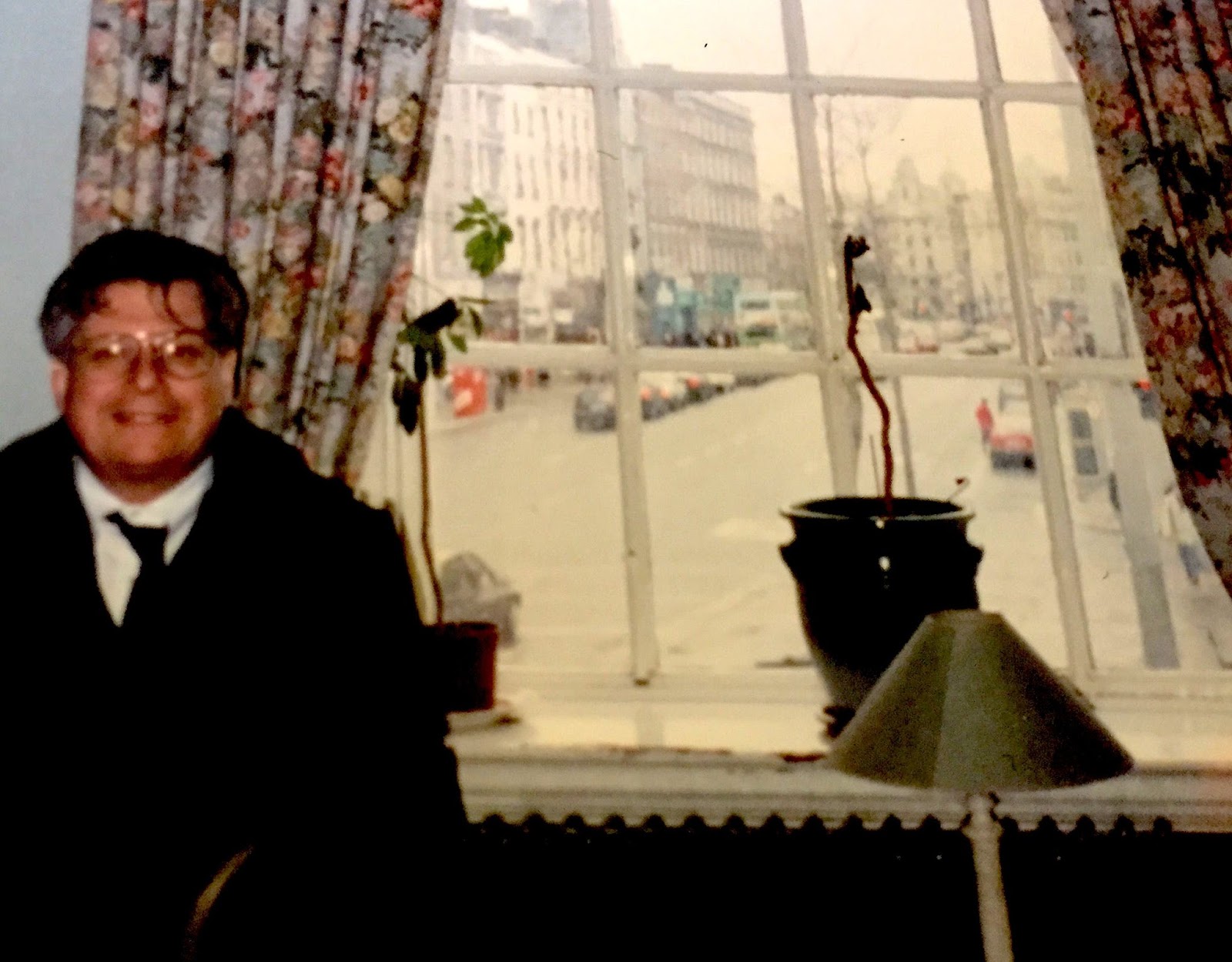
Visiting Randal's office at Trinity College,
Dublin, Feb. 12, 1994. The view is of
O'Connell Street. Photo by R Marlin.
My brother Randal most of his life has been a philosophy professor at Carleton University in Ottawa, Canada.

In 1993-1994 he took a sabbatical year and used it to bring his family to Dublin. He had an appointment at Trinity College, Dublin with a fine view of O'Connell Street.

I visited in February 1994, during the 50th anniversary year of the D-Day assault on Normandy. I got to see the memorial that my parents chose to honor my uncle Willem van Stockum after the war. He was shot down on June 10, 1944 while on a mission for the RAF.

A memorial was erected in France last year, on the 70th anniversary, to each of the two crews that were downed that night.

Randal on the Memorial Bench. Photo by JT Marlin.
The Irish memorial is simply a bench with the inscription: "To the Memory of Willem van Stockum / 30 November 1910-10 June 1944 by His Sister."

Spike Marlin and Willem van Stockum were roommates at Trinity. When Spike learned that Willem had a sister, he decided then and there that he was interested in marrying her, so fond he was of her brother Willem.

My Dad died in December 1994. Mom lived another 12 years.

My turn on the Bench. Photo by R Marlin.
Another member of the group was David Grene, a classicist who went on to be a co-founder of  the University of Chicago's Committee on Social Thought. He died after my father and before my mother, in 2002.

When my Dad died we made a gift to Trinity College, Dublin of another bench, named for my father, and we had the one for Willem renovated. They were placed on opposite sides of the entrance to the Book of Kells.

Saturday, June 6, 2015

WW2 | D-Day + 71–Normandy Landing)

D-Day Assault Plan.
June 6, 2015 is the 71st Anniversary of D-Day.

The few surviving veterans from World War II are fading away with an attrition rate of about 30 percent per year. I have interviewed one survivor at length.

My wife Alice and I went to France last June to pay our respects to those who died. We were in Normandy and Mayenne (south of Normandy).

My uncle Willem van Stockum is buried in Laval, Mayenne, along with his six crew-mates on a Halifax bomber flying out of an RAF base (Squadron 10) in Melbourne, Yorks., UK. The place was shot down after its mission was completed on June 10, 1944. Another seven in crew from another Halifax on the same mission are buried next to them. A book (Time Bomber, adult or YA) about him and his mission was written by Dr. Robert Wack and has a five-star review on Amazon with seven reviewers.

In preparation for our visit last year (about which I have written here1 here2 here3 here4 and here5), I assembled data on D-Day and World War II in Europe. My main source was a new book targeted at young people by Rick Atkinson, D-Day: The Invasion of Normandy, 1944, published by Henry Holt. It is meant to be used in schools and is adapted from Atkinson's #1 best-selling book The Guns at Last Light. It is on Goodreads' list of the 167 best books for kids about World War II here.

The listing I found gives Atkinson's book an average rating of 4. One librarian objected to the poor quality of the photos and their somewhat haphazard placement. Also, the book is definitely for the older YA market because the language does not make much allowance for expected vocabulary in the elementary school grades.

Deaths from WWII
  • Atkinson - Total 72 million people, or 28,000 people every day of the 2,174-day war (This is also the top Wikipedia figure.) Soviet dead 26 million - military 10.7 million, civilian 15 million. U.S. dead 419,000 - military 417,000 (out of 16 million who served), civilian 2,000 UK dead 451,000 - military 384,000 (out of 6 million who served), civilian 67,000 Canadian dead 23,000, all military (out of 1.1 million who served). German dead 8.8 million - military 5.5 million, civilian 3.3 million. European Jews killed in Holocaust - 6 million. Number of American soldiers buried in Europe (25,000 U.S. pilots killed behind enemy lines) 14,000.
  • UK Source (worldwar2.org.uk). Total dead 50-70 million. Soviet dead 26.6 million, of which 8.7 million soldiers died in World War 2. British 700,000 military and 60,000 civilian deaths. Poland’s dead were between 5.6 and 5.8 million. USA military dead: 416,800. German total 7.4 million, of which military dead and missing are 5.3 million.
  • History Channel Total dead 35-60 million. (That's a big range from the lowest estimate, especially when Atkinson and Wikipedia go up to 72 million.)
Military Force in WWII
  • D-Day Armada Allied Troops landed - 156,000 Vehicles landed - 30,000 Planes - 11,000 Ships and landing craft - 5,000 Parachutists - 13,000
  • Most Effective Bombers Used in Europe Britain Avro Lancaster, DeHavilland Mosquito (wooden, to avoid radar). USA B-17 Flying Fortress, B-24 Liberator, B-29 Superfortress. Germany Heinkel III, Junkers 87 Stuka, Junkers Ju-88.
  • Most Effective Tanks Used in Europe USA M4 Sherman Soviet T-34 German Panther (partly copied from Soviets), PzKfw Mk. IV Panzer, Tiger I/II.
U.S. Veterans in WWII

U.S. armed forces personnel who served in WWII between December 1, 1941 and December 31, 1946: 16.1 million.

The National World War II Memorial was dedicated on May 29 in Washington, D.C. Located between the Lincoln Memorial and the Washington Monument, it is the first national memorial dedicated to the men and women who served in the U.S. armed forces during World War II, including those who died in combat and the Americans who supported the war effort on the home front.

33 months The average length of active-duty by U.S. military personnel during WWII. 

73% The proportion of U.S. military personnel who served abroad during WWII. 

292,000 The number of U.S. soldiers, sailors, airmen and marines killed in battle in WWII. 

114,000 The number of other deaths sustained by U.S. forces during WWII. 

671,000 The number of U.S. troops wounded during WWII.

5.7 million The number of World War II veterans counted in Census 2000. The census identified the period of service for World War II veterans as September 1940 to July 1947.

475,000 The estimated number of WWII veterans living in California in 2002, the most in any state. Other states with high numbers of WWII vets included Florida (439,000), New York (284,000), Pennsylvania (280,000), Texas (267,000) and Ohio (208,000). See Table 529 at 

5.4 percent - The proportion of WWII veterans among the Clearwater, Fla., civilian population age 18 and over in 2000. Other large places (100,000 or more population) with high concentrations of WWII vets were: Cape Coral, Fla. (5.1 percent), Oceanside, Calif. (4.3 percent); and Scottsdale, Ariz.; Pueblo, Colo., Metairie, La., St. Petersburg, Fla.; Santa Rosa, Calif.; Mesa, Ariz.; and Independence, Mo. (all around 4 percent).

210,000 - Estimated number of women in 2002 who were WWII veterans. These women comprised 4.4 percent of WWII vets. See Table 530.

22% The proportion of all veterans in April 2000 who were WWII veterans.

Source: http://www.census.gov/Press Release/www/releases/archives/facts_for_features_special_editions/001747.html

Monday, December 8, 2014

WW2 | 70 Years Later

Alfred Eisenstaedt's famed photo of nurse
Edith Shain and sailor celebrating VE Day. 
In 2014 there were many memorials to D-Day and to those who lost their lives in that year. The winter of 1944-45 was deadly in Holland as the Nazis diverted what food there was to their own troops. In 2015 the events will be more celebratory, as victory was achieved in Europe on V-E Day - May 8-9.

Here are two posts that look ahead to 2015:

RAF No. 10 Squadron to Celebrate Its 100th Anniversary in 2015

V-E Day May 7-8, 1945 - UN Remembrance Days

Here are my ten posts this past year that related to D-Day, the most recent ones first. If you have a comment on any of these, please post it or let me know - email me at  teppermarlin(a t)aol.com:

1 Monuments Unveiled to 14 Airmen (Laval, June 6)
2 Willem van Stockum’s Last Letter Home
3 Omaha Beach
4 Total Allied Deaths in France, World War II
5 Vaufleury Cemetery - Forgotten Graves in another part of the cemetery
6 Vaufleury Cemetery - Ceremonies, 2014
7 My Third Visit to My Uncle’s Grave
8 Memorial Visit to Normandy, Laval
9 70th Anniversary of “A Soldier’s Creed” 
10 It’s 70 Years After D-Day in Normandy June 6, 1944

Tuesday, July 8, 2014

RAF PILOT | W. J. van Stockum's Last Letter Home, June 7, 1944

RAF Pilot Willem J. van
Stockum in uniform.
June 7, 1944

[RAF 10th Bomber Squadron, Melbourne, Yorkshire, England.]

Dear Mother,

I am curious to know whether you have noted the date of my last letter. I cannot tell you how great the satisfaction was to be one of those who dropped the first bombs during the Normandy invasion.

Officially we did not know it was to start on June 5 [the planes providing D-Day support would have taken off from England before midnight], but the instructions we got, the mysterious doings, our route and what we could expect while under way, made us fairly sure that this was The Day.

Crew of the Halifax MZ 684 probably in early June 1944.
Back row: R. K. Marshall, A. Mason, G. Daniel, F. Beales.
Front row: A. C. Perkins, W. J. Van Stockum, J. Ellyatt.
(Photo is not of the same crew that flew on June 10.)
We did our job in difficult circumstances, although there was not much resistance from the targets.

I am free tonight and am glad of it, for the pressure is intense and we have not had a moment’s rest in the past few days. Each of our missions requires hours of preparation. The flight operation itself takes six hours and after that there are debriefings etc. Then a meal, to bed, sleep, and again preparations.

Of course we did not know beforehand that it would be rather easy. The strain on the nerves is a real thing–it makes your breathing go faster. It will not be so easy in future, as the Germans get more information.

But I would not want to miss this time for anything, and I am very thankful that I resisted the temptation to go to the other station, where Bierens de Haanals is, for then I would now be between two squadrons and perhaps have missed all this.

My crew is perfect–calm, matter of fact, and one cannot find among them any signs of being nervous. I sometimes have the feeling I am the only one who is–but perhaps they think the same thing of me.

I feel everyone here is experiencing a great upsurge in morale. The B.B. (Body Building) programs are better and more imaginative. The whole station comes to see us off with their thumbs up in the air and this is a pleasant experience.

I know you and Hilda must be feeling the same way and understand how wonderful it is, so invigorating.

May 2011. Families of five of the seven crew members on the Halifax MZ 684
were represented at the Vaufleury Cemetery in Laval. Willem's tombstone
is round at top, from the Dutch Government.
[Page ends. Possibly the hand-written pages that constituted the “Soldier’s Creed”, which is reprinted at the end of Time Bomber,  followed the fragment and were removed. The following concluding fragment was nearby in the folder of Dutch letters left behind by my mother, Willem's brother. The translator from the Dutch thought it “not very probable” that it is the end of the same letter, but it might be.]

My roommate is a Belgian pilot aged 40 who doesn’t speak English. I spend much of my time with him, which is very good for my French. If only you could hear all the fantastic stories people tell here, more interesting than the most terrifying spy thriller!! My friend came here a few months ago and was in the Resistance in Belgium.

Did I write you that in London I saw Aunt Mia quite often? We sympathized with each other about our tastes in literature. We talked about Dostoyevsky and she told me you had written such a wonderful article about him. How nice there are people who remember this article. I would like to see it some time. I long to read it.

Very, very much love from your son,

Willem

[Note: His plane, the Halifax MZ 684, was shot down on June 10, 1944. The crew is buried in the Laval Valfleury Cemetery and a monument to them was erected on June 10, 2014 in Entrammes, near Laval. The letter above was written in Dutch, as Willem wrote in Dutch to his mother, Olga Emily Boissevain van Stockum, and in English to his sister, Hilda van Stockum. The letter was translated in 2003 as a favor for me by the late Dr. Engelien de Booy, cousin of HvS and daughter of Hilda Boissevain de Booy. Olga and Hilda Boissevain were very close–the two middle sisters of six. Before they had children, they promised each other they would name their first daughter after the other, and they did so. This seems to be the last letter Willem wrote home. The letter went to Washington, D.C. where Willem’s mother and sister lived. Willem’s praise for the courage of the crew will be fully appreciated by the relatives of the crew members. Five of the seven crew members on the MZ 684 participated in a family reunion in Laval in 2011. See www.boissevain.us/ and click on Willem_van_Stockum - JTM]

Friday, June 13, 2014

FRANCE | June 10–Remembering Airmen Downed 70 Years Ago

At the Air Force band concert on
June 9, the two crews, of the MZ 532
and the MZ 684, were displayed
on the screen above the musicians.
L to R: Deborah and Dr. Rex
Henderson by the grave of Rex's
father Tom, pilot of the MZ 532.
This and all following photos by
JT Marlin.
The memorials in honor of the 14 downed airmen at Vaufleury Cemetery on May 8, 2011 were more elaborate than this year.

That is because they were part of a larger celebration of V-E Day, the end of hostilities in Europe in 1945, and the Town of Laval turned out in large numbers.

But this year's memorial on June 10 was unquestionably more special for the family members who came. (Missing from 2011 were Nicola and Robin Sumner; Robin is the nephew of Daniel Gilbert.
2011 -  L to R: Nicola and Robin Sumner (nephew of Daniel Gilbert), Cpl Pamela Turney (great-niece of Fred Beales), Luke Shergold (son of Suzanne), Michael Hayes (Beryl's husband), Beryl Hayes (daughter of Edward Wicks), Martin Clegg (Suzanne's husband), Suzanne Clegg (Beryl's daughter), Ashley Shergold (Suzanne's son), John Tepper Marlin (nephew of Willem van Stockum), Silvia and John Ellyatt (son of John Elyatt).


Crew members of the MZ 532 as
shown on the monument (stele) at
St. Berthevin.
One reason is that in 2014 the memorial has been entirely focused on the airmen who crashed on that date in 1944. Those who were at the cemetery were there for one reason, to honor the two crews of the Halifax bombers that were shot down nearby on June 10, 1944.

Another reason this year was special is that the families of six crew members were represented by their families - one more crew member than in 2011. Also, 20 family members showed up to pay their respects, eight more than in 2011.

This year, three crew members from each plane were represented by family.

In 2011, from the St. Berthevin-crash plane, MZ 532, only Sgt. Edward C. ("Eddy") Wicks had family there.

Representatives of the families of Sgt.Wicks (on left) and Sgt.
Brotherton (on right), whose younger brother and three
more generations attended in 2014 for the first time.
This year, the pilot of the MZ 532, Australian P/O Thomas W. (Tom) Henderson was also represented by his son, Dr. Rex Henderson and Rex's wife Deborah, who came from Australia for the occasion. Sgt. Leslie Brotherton was represented by four generations - his younger brother, daughter and other family members.

From the plane that crashed in Entrammes, the MZ 684, three crew members were represented again, as they were in 2011 - the pilot, Dr. Willem J. van Stockum, F/O John Ellyatt by his son, and Sgt. Fred Beales by his great-niece Cpl. Pamela Turney, who was in the uniform of the Canadian Forces Air Command.

Crew members of the plane that
crashed in Entrammes, the MZ 684.
John Tepper Marlin, nephew of F/O
Dr. Willem J. van Stockum (pilot of
the MZ 684), and wife Alice Tepper
Marlin.  Photo w JTM camera.
The MZ 684 crew is of interest for a number of reasons. The plane included four Flying Officers, which in the anglophone military is equivalent to an army rank of Lieutenant. A Pilot Officer is equivalent to a 2nd Lieutenant.

The MZ 532, by contrast, had two Pilot Officers, the rest being Sergeants. In other words, the MZ 684 had twice as many officers aboard.

Cpl. Pamela Turney next to
the marker of her great-uncle,
Sgt. Fred Beales.
My uncle Willem van Stockum's grave site is marked as both Canadian and Dutch. Dutch, because he was a citizen of Holland (his grave marker is different from the other 13 because it was provided after the others were in place, by the Dutch Government). Canadian, because he was seconded from the RCAF, where he had been an instructor in flying the Halifax bomber. He is also variously identified in those who have written about him as Scottish (his Ph.D. in physics was from Edinburgh), Irish (graduate of Trinity College, Dublin, where he met my mother and father), and American (he was teaching mathematics at the University of Maryland when World War II broke out and was previously a fellow at the ).

Van Stockum's work as a mathematician, utilizing Einstein's equations, has earned him a place in the history of time travel and the father of scientific approaches to the subject. Dr. Robert Wack, an Army Major and pediatrician, has written a science-fiction novel, Time Bomber, centered on van Stockum's life and death.

View of gravesite looking away from the
flag - the MZ 684 end of the site. At left
is M. Cousineau of the Canadian Embassy
 in Paris, who attended with his wife.
At the ceremonies on June 10, representatives of the embassies of Australia and Canada were in attendance. Each embassy has several military attaches who travel to pay respects to nationals of their countries who died in prior wars and are buried in France.

Comment

If someone from the Dutch Government ever attends an event at Vaufleury, it would be good for them to know that when they asked my mother what she wanted on the tombstone, her answer was: "Greater love hath no man..."

It would be nice if this request were some day honored, especially since the Dutch Government wrote to my mother to ask what she wanted inscribed. The minister who officiated at the ceremony on June 10 cited that exact quote...

For those unfamiliar with Anglophone military ranks, the following guide may be helpful:
NaviesArmiesAir forces
Officers
Admiral of
the fleet
Marshal or
Field marshal
Marshal of
the air force
AdmiralGeneralAir chief marshal
Vice admiralLieutenant generalAir marshal
Rear admiralMajor generalAir vice-marshal
CommodoreBrigadierAir commodore
CaptainColonelGroup captain
CommanderLieutenant colonelWing commander
Lieutenant
commander
Major or
Commandant
Squadron leader
LieutenantCaptainFlight lieutenant
Sub-lieutenantLieutenantFlying officer
EnsignSecond
lieutenant
Pilot officer


Seamen, soldiers and airmen
Warrant officerSergeant major
Warrant officer
Warrant officer
Petty officerSergeantSergeant
Leading seamanCorporalCorporal
SeamanPrivateAircraft man