Saturday, January 31, 2015

MOVIES | American Sniper (Comment)

The Movie Extends the Story
Beyond the Book
I saw American Sniper last night with my wife Alice. It has six Academy Award nominations, including best picture and best actor, and has grossed $217 million so far [update: $249 million after the first three weekends] on an investment of $58 million.  It has surpassed the war movie that was previously #1 in box office receipts, Saving Private Ryan.

It is well scripted and acted. It is nominated for best picture and best actor.

On the other hand, the movie is controversial on several counts. It has been accused of glorifying killing and a war in Iraq that shouldn't have started. It has been described as propaganda and inaccurate in some details. The treatment of how guns should be handled in the home has become a focus of criticism (see Comment at the end).
  • Yes, it has spectacular battle scenes and the underlying story is authentic. Chris Kyle (Bradley Cooper) was a real Navy SEAL hero, born in 1974, the country's most effective sniper ever. He was really good at what he did.
  • Yes, the display of weaponry and military discipline in the movie is impressive. That is one reason that today's wars have a lower incidence of deaths among American soldiers than World Wars I and II. American weapons are the most advanced and so is the ability of U.S. armed forces to rescue injured soldiers and repair their injuries.
  • Yes, the movie fairly shows the great cost of the war for our warriors, veterans and their families, including Kyle. (It shows, not always with the same sympathy, the cost of the war for Jihadists and for Iraqi civilians.) A much higher proportion of soldiers now return with identified physical and mental injuries - the latter because our understanding of mental illness has not kept up with our ability to prevent or repair physical injuries.
  • Yes, Kyle did come home changed by the war, and resigned in 2009 to reconnect with his family. He took years to adjust. Then in 2013 he was shot to death by a fellow veteran he was trying to help. The fact that Chris Kyle died at the hands of another veteran says it all about the cost of the war in mental illness. 
  • Propaganda? Also yes, but not to my mind propaganda directed at warmongering. Countries at war tend to produce films that present their point of view.
The movie starts with Kyle's minister father teaching a young Chris to shoot and explaining that there are sheep, wolves and sheep dogs. The dogs protect the sheep from the wolves, and the father makes clear he doesn't want his two boys to be sheep or wolves. Chris had already shown himself to be a sheepdog. Then we see the inciting events of the Jihadist attacks in 1998 (when Kyle was 24) on the U.S. Embassy in Nairobi and then in 2001 on the World Trade Center.

The script is based on Kyle's autobiography (extending it, of course, to describe the circumstances of his death, and the subsequent memorials) and on the family side is reportedly a pretty accurate reflection of Kyle's story. Our American soldiers, veterans and their spouses and families deserve whatever appreciation and support we can give them.

From that perspective, the movie was on message. So far I have two issues with it:

First, it is a pity that the only American military people we see are men. Of course, mostly we are shown SEALs and they are put to physical tests that are hard for women to meet. But the portrayal of today's military in the movie gives a misleading impression that all soldiers are men. An article in the November-December issue of Foreign Affairs by Megan Mackenzie summarizes the situation in the year before Kyle's death:
Today, 214,098 women serve in the U.S. military, representing 14.6 percent of total service members. Around 280,000 women have worn American uniforms in Afghanistan and Iraq, where 144 have died and over 600 have been injured. Hundreds of female soldiers have received a Combat Action Badge, awarded for actively engaging with a hostile enemy. Two women, Sergeant Leigh Ann Hester and Specialist Monica Lin Brown, have been awarded Silver Stars -- one of the highest military decorations awarded for valor in combat -- for their service in Afghanistan and Iraq. 
Clint Eastwood may not have wanted to mix up his message, which relies on switching between the warrior in the field and his wife Taya Renae Kyle (Sienna Miller) and children back home stateside. Women are limited in what roles they can play on active duty. But women have been serving on the battlefield since the American Revolution. The last "yeoman (F)" from the World War I Navy died in 2007. Military spouses increasingly include men married to female soldiers. The Department of Defense in January 2013 announced it is seeking to open up more active duty positions to women. Ironically, in American Sniper, the only women we see actively fighting are on the Jihadist side.

Second, we don't get to learn much about the enemy except that the target is called The Butcher and he executes his victims with a power drill into the head. In a MercatorNet article, Australian Zac Alstin usefully separates the Islamic faith in general from its violent offshoot, mostly Salafi Jihadism. Salafism is a traditionalist movement within Sunni Islam. Jihadism is a violent movement within Salafism.

Islam > Sunni > Salafism > Salafi Jihadism

The Sydney siege, Alstin says, was perpetrated by an Iranian, which was surprising because Iranian Muslims are predominantly Shiites. But the perpetrator turns out to have converted to Sunni Islam shortly before the siege. He pledged allegiance to the head of the Salafi Jihadist Islamic State. The article continues:
[T]hat’s a little like a Roman Catholic "converting" to a break-away Adventist group and calling the Pope the Antichrist. ... Is Salafi Jihadism inherently violent? Yes. Are all Muslims Salafi Jihadists? No. Is it possible for a non-Salafi Jihadist Muslim or a non-Muslim to convert to Salafi Jihadism? Yes.
Salafi-Jihadism is a relatively new name for an evolving movement. I recommend a RAND Corporation report on this released last year. Americans need to know more about who their enemy is, and who it is not.

Comment on Using Guns at Home (the Scene at the End)

February 6, 2015: Gail Collins, in The New Yorker, says that the scene at the end where Chris Kyle points a loaded gun at his wife and says, jokingly, "drop them drawers" is "insane". I have to agree. The idea that leaving the gun on top of a door frame is a safe place for it is likewise troubling. 

Tuesday, January 13, 2015

WW2 | 7. Escaping Nazi Holland–Hans de Beaufort (Updated Feb. 13, 2016)

The Westerbork, Holland, Concentration Camp, one of many in Holland.
Within five days of the Nazi invasion of Holland in May 1940, after the devastating bombing of Rotterdam, the Dutch Government capitulated to the Germans. Jewish residents of Holland, and many refugees from other countries, were trapped. So were others hunted by the SS, which was put in charge of Holland. (In other countries, the German Army command was a less thorough hunter.) It was difficult for those that the Nazis hunted to escape.

Ironically, Hitler used to make fun of sports hunters who used guns to kill their prey. He did not think that gave the animals a sporting chance. But in their hunt for human prey, Hitler's men were beyond ruthless.

What Happened to Jews Trapped in Holland

The Nazi invaders in Holland pursued their policy of racial cleansing in six steps:

1. The SS identified all Jewish people in Holland. This took the form of looking for lists with addresses. Unfortunately, in Holland this was an easy matter. Charities were supported by taxes, with allocations based on membership in each religion. Therefore everyone resident in the country was identified by religion. It was a simple enough matter to find these lists in official or private hands. Where these lists were found not to be complete, the SS would block off an area and search every house, as they did for their razzia recruitment raids, demanding papers for every resident.

2. It started slowly, but the Nazi occupiers in the Netherlands increasingly restricted those identified as Jewish from leading a normal life. Schools were closed to them, jobs, meeting places, transportation modes. In Amsterdam they were forced to live in ghettoes. Though many Jewish persons just waited and hoped that the war would be won by the Allies, which happened eventually, some of them tried to escape their fate.

3. They then pursued a procedure repeated in other occupied countries. I have investigated in the departmental Archives (in Laval), how Vichy France conducted their Jewish Policy in the Mayenne. Once identified, all Jews were required to make lists of all of their assets, under pain of severe penalties. Based on what I found in the Mayenne, compliance appears to have been high. Well-off people must have been misinformed about the use to which the list of assets would be put. Perhaps they were hoping that their assets would buy lenience from the authorities.

4. Once the assets were identified, the owners were required to bring in all titles, certificates, jewelry or cash for inspection. Once brought in, these assets were seized. They fueled the Nazi march as well as the energies of the SS in tracking down and deporting Jews. Doubtless some of the assets were not documented and went into the hands of the SS.

5. When all assets were accounted for, the owners were deported to concentration camps. The SS first sent them to the Westbork concentration camp in Drenthe, the Netherlands, where before the Occupation the Dutch brought Jewish refugees to be resettled. From Westbork they were taken in cattle-cars to death camps in Germany or, even more likely, Poland (most likely in Auschwitz, where between 1 and 2 million Jewish prisoners were killed; or Sobibór).  More than 100,000 Jewish people brought from Holland were gassed and cremated. It is not clear if, when they were being deported, they knew where they were going. Many were told, or expected, that they would be put to work in "labor camps". In fact most were on lists from the beginning to be exterminated.

6. In the camps, Jews were put to work (in Auschwitz, they were employed by the I. G. Farben plant). If they couldn't do the work, or were worn out, or if they caused trouble of any kind, they were sent to the Zyklon B chambers and then the ovens.

I am indebted to Charles Boissevain, who was six years old in Holland when the Nazis invaded, for information on how the Nazi procedures worked in the Netherlands, which he has described to me in emails in January 2015.

How Jews Escaped

The job of the Resistance was to intercept the procedures at some point to provide Jews with an escape route. It was not easy because the Netherlands has a total area of 16,000 square miles (41,500 sq. km.), about twice the size of New Jersey. Of this area, inland water accounts for nearly 3,000 square miles or about 7,600 square km.

Jean Michel Caubo
1. Some tried to escape the country, from the very first day of the war, usually following the Dunkirk route, escaping by boat, and then finding their way to the UK. They traveled in very small boats, even canoes, which were not meant for crossing the North Sea. Apart from the perils of the sea, German warships patrolled the waters and mines were left to blow up marine transportation. Many of those who tried to cross either were lost at sea or were captured by the Nazis. A friend of Charles Boissevain has written the stories of some of those who actually made the escape, the "Engelandvaarders" (England Sailers). His book will be published in May 2015. A monument to them was recently unveiled in Holland.

2. There are just three ways out of the Netherlands other than by air - Germany, the English Channel, or Belgium:
  • To Germany. Most of Holland's land border is with Germany. But going to Germany was like putting your head into the mouth of a crocodile.
  • Via the North Sea to the UK. Holland has a long coast to the north and west, bordering on the North Sea. The UK is close and was an attractive destination, but the trip, as mentioned, was dangerous. 
  • To Belgium. Belgium was much safer than Holland, perhaps because the Belgians spoke  French as well as English and the Nazis felt less at ease there. The famous Dutch Jewish violin player Theo Olof succeeded in surviving in Brussels. 
  • Via Belgium to Paris. The best plan was to go through Belgium to France (and preferably from there to Switzerland or Spain, which were not occupied by the Nazis). The so-called "Dutch-Paris Line" transported refugees from the Netherlands to the Gare du Nord in Paris. Altogether an estimated 1,080 people were enabled to escape from the Netherlands this way, about 800 of them Jewish. The rest were bailed-out RAF pilots who had been rescued (112) or were other Nazi targets (170), most of them being hunted because of their work with the Dutch Resistance. They all were met in the Gare du Nord by a French-residing Dutchman, Jean Michel Caubo. The French Railways cooperated with him. He gave the refugees shelter and food and then handed them over to French Resistance workers, who eventually brought them to the Swiss and the Spanish border. Caubo rescued all of the previously mentioned 800 Jewish fugitives. He was caught because of the negligence of a co-worker. He was questioned, tortured, and then brought to a Nazi concentration camp where he was killed. After the war he was posthumously awarded a UK decoration, the U.S. Medal of Freedom, the Dutch Resistance Memorial Cross, and the French Croix d'Honneur. But, so far, he is not listed in the Yad Vashem.
I was recently contacted by Charles Boisevain who summarized the available data:
During the war some 7,900 - 9,000 persons escaped the Netherlands, especially in the beginning. Official figures, published in 1995 by the Dutch Verzetsmuseum (Resistance Museum):
4,000 soldiers and other military - especially in the beginning of the war.  800 foreign pilots - some 200 of them by the socalled Dutch-Paris Line.1,700 England voyagers (Engelandvaarders) - some 170 in small boats, the rest via Belgium and France. A couple of them also by the Dutch-Paris Line.6,500 altogether, many of them via the Dutch-Paris Line.1,400 - 2,500 Jews, who were until August 1942 admitted to Switzerland, some 800 of them via the Dutch-Paris Line!7,900 - 9,000 persons altogether. Some 1200-1500 via the Dutch-Paris Line. This D-PL was the train arriving at the Gare du Nord in Paris. There they were picked up by a very brave Dutchman, Caubo, who lived in Paris for 20 years and worked around the train organisations. He brought them to others who could help them further.
Charles Boissevain has been trying to get a Yad Vashem award for Caubo:
Jean Michel Caubo saved/rescued some 800 Jews and paid for it with his life. In 1944 he was caught and died in a concentration camp. The Yad Vashem Authority in Jerusalem, which honors with a Yad Vashem Award the so-called Righteous Among the Nations, would not give the award to Caubo. In 2009 Maarten Eliasar (a Jewish physician), Dick Verkijk (a journalist now living in the USA) and I tried again. We collected some 300 signatures via the newspaper Trouw from many persons - well-known Dutch politicians and others, Dutch and Israeli rabbis etc. You can read the Appeal (in English) and half of the names on the internet. 
Was there some military or other organization that helped the soldiers or escapees? Charles says:
My father Robert Lucas Boissevain was not a member of [such an] organisation, though he may have helped some individuals. Keep in mind that he had a rule that he never informed anybody (certainly not his family, wife and children!) to protect them. [Likewise,] neither the pilots nor the England voyagers nor the escaping Jews had any organisation. So my father could not have been a member of any organisation that helped persons to save their lives abroad. However, it is possible that he helped individuals, perhaps it was likely, nobody knows. 
Helping Aviators Escape–Hans de Beaufort

Hans de Beaufort was the son of Dr. Lieven Ferdinand (Fik) de Beaufort and Catharina Josephina (Teau) Boissevain de Beaufort (1885-1922, NP 69), youngest daughter of Charles the newspaper editor. She died very young in 1922. Hans was shot by the Nazis in a Dijon prison in 1942.

He had been engaged in forging credentials for downed Allied air crew in Holland so that they could enter Switzerland. He was a competitive motorcycle racer and used his skills to transport airmen. The top prize now in Dutch motorcycle racing is now the Hans de Beaufort Cup, which is awarded on the basis not only of racing skill but also character in the form of persistence and decency.

My mother, Hilda van Stockum, was sent a copy of Hans's last letter to his father before he was executed. She translated it for me two years before she died in 2006. It is very moving. I have posted it here [click on Word doc] along with some information about the Hans de Beaufort Cup.
  
The above post is a draft of a chapter of a forthcoming book: The Boissevain Family and the Dutch Resistance, 1940-45.

To see a chapter outline and links to other chapters, go here.

Thursday, December 25, 2014

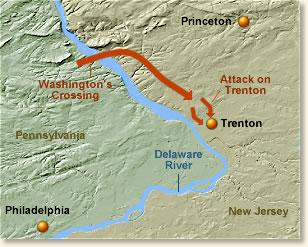
YOUNG AMERICA | Dec. 25–Washington Attacks Trenton

Washington Crossing the Delaware, Emmanuel Leutze, 1850
On this day in 1776 George Washington led the Continental Army across the Delaware River in a surprise attack on Hessian mercenaries.

The previous August, the British army arrived–one-fourth of them Hessian soldiers from Germany. The Brits invaded Long Island and forced the Continental Army to Manhattan. The British then attacked Manhattan and forced Washington's troops to retreat along the Hudson River to New Jersey. The British followed, chasing the Americans across the Delaware into Pennsylvania.

At this point the American rebels seemed to be crushed. General Washington was on the run. General Cornwallis was satisfied that the Continental Army was not going to be a threat, having had many defeats and no victories in more than five months.

American morale was low, with many men sick and wounded. Shabbily dressed and poorly trained, they were deserting at high rates. On top of all that, enlistments of most of the militias under Washington's command were due to expire at the end of December and many would be going home. Even Washington thought privately that the jig might be up for the Revolution. By the following spring there would be no army left.

A Marker Nine Miles Upriver from Trenton
Washington had to do something. Then he got word that about 1,500 Hessian soldiers were camped across the Delaware in Trenton. The Hessian mercenaries, one-fourth of the British forces in America, had a deserved reputation as skilled, effective soldiers. The only way for his irregulars to have a chance of defeating them, even with superior numbers, was a surprise attack. Washington decided to risk everything on an attack.

The weather was terrible, with snow, sleet, and gale-force winds. Washington decided the weather would work in his army's favor, because no one would imagine that the Continental Army would attack during a blizzard.

A few hours before attempting the mission, Washington read aloud to his soldiers from Thomas Paine's The American Crisis. The army was divided into at least three different groups to cross the Delaware, each with a different destination point around Trenton; Washington led one group and put commanders in charge of the others. The river was moving quickly, carrying huge chunks of ice, and they were traveling through a blinding snowstorm.

On Christmas Eve, 2,400 men, 18 cannons, and some horses crossed the river in small boats. Only Washington's group persevered through the brutal weather–the other commanders turned their troops around.

Washington's army crossed nine miles northwest of Trenton.
Washington's men marched the nine miles on Christmas Day to Trenton, many of the soldiers with frostbitten feet as they marched on snow barefoot or with rags tied around their feet.

The Tide Was Turned

Early morning December 26, the Continental Army attacked Trenton, surprising a camp composed entirely of unprepared and hungover Hessians. After the loss of their commander, the Hessians surrendered. Washington's victory was complete but his situation precarious. Taking  900-1,000 soldiers captive, they retreated back across the river to Pennsylvania.

It wasn't fully clear at the time, but this victory turned the tide toward the Revolutionaries. It restored everyone's faith in the Continental Army's abilities.

The battle's outcome gave Washington and his officers the confidence to mount another campaign. On December 30 they again crossed the Delaware, this time winning another victory at Trenton on January 2, 1877 and then pushing on to Princeton, where they defeated the British on January 3. The victories stunned the British and were a magnet for support of the new nation by potential allies– France, Holland and Spain.

Eye Witness Report

Elisha Bostwick, a soldier in the Continental Army, said in his memoirs of the battle:
[We] encamped on the Pennsylvania side [of the Delaware] and there remained to the 24th December. [T]oward evening [we] began to re-cross the Delaware but by obstructions of ice in the river did not all get across till quite late in the evening, and all the time a constant fall of snow with some rain, and finally our march began. 
[General Washington rode by and said:]  "Soldiers, keep by your officers. For God's sake, keep by your officers!" Spoke in a deep and solemn voice. ... Our horses were then unharnessed and the artillery men prepared. We marched on and it was not long before we heard the out sentries of the enemy both on the road we were in and the eastern road, and their out guards retreated firing, and our army, then with a quick step pushing on upon both roads, at the same time entered the town. Their artillery taken, they resigned with little opposition, about nine hundred, all Hessians, with 4 brass field pieces. When crossing the Delaware with the prisoners in flat bottom boats the ice continually stuck to the boats... [T]he next day [we] recrossed the Delaware again and returned back to Trenton, and there on the first of January 1777 our years service expired, and then by the pressing solicitation of [General Washington,] a part of those whose time was out consented on a ten dollar bounty to stay six weeks longer, and although desirous as others to return home, I engaged to stay that time.
Sources: Garrison Keillor, Writer's Almanac, December 25, 2014. Henry Steele Commager and Robert B. Morris, The Spirit of 'Seventy Six (1958). David Hackett Fischer, Washington's Crossing (2004). "Washington Crosses the Delaware, 1776," EyeWitness to History (2004).

Sunday, December 21, 2014

PEACE | Dec. 24–200 Years, USA and Britain (Comment)

A Celebratory Poster of the Treaty, 1814.
Note the Union Jack does not show the St.
Patrick's Saltire, which was added in 1800,
nor do the stars show on the Stars and Stripes. 
(The following post was published in the East Hampton Star of December 25, 2014. This may be the only newspaper in the United States that took note of the 200th anniversary of peace between Britain and America.)

The Treaty of Ghent “A Treaty of Peace and Amity between His Britannic Majesty and the United States of America” was signed on December 24, 1814.

James Madison declared war originally because British Orders in Council made it harder for the United States to trade with France, and because the British Navy was seizing (“impressing”) sailors on colonial ships and putting them on Navy ships.

The British Government repealed the Orders in Council, ending the curb on trading, but impressment remained. If the British had given up the right to impress American sailors, Madison might have called off the war.

Russia's Czar Alexander I in March 1813 offered to host negotiations, but the British were winning and refused. In the fall of 1813, British foreign minister Lord Castlereagh offered to negotiate directly with the United States. The two countries picked Ghent in Eastern Flanders as the venue because it was a neutral city. Everyone's goal was to end the fighting, which was much too expensive for both countries. The two teams were:
  • For the United States - John Quincy Adams, chief negotiator; Henry Clay, the hawk (the "bad cop"); Albert Gallatin, Treasury Secretary; James A. Bayard, moderate Federalist; and Jonathan Russell, chargé d’affaires for Madison in Paris. It took the Americans six weeks or more to communicate with Washington, D.C. so they were negotiating largely on their own. The U.S. team wanted to restore territory to what it was before the war, the status quo ante bellum.  
  • For the British - Foreign Secretary Lord Castlereagh and Secretary for War and the Colonies, Lord Bathurst, who chose not to attend the talks and instead, they sent a less-skilled team -  admiralty lawyer William Adams; impressments expert Admiral Lord Gambier; and Undersecretary for War and the Colonies Henry Goulburn. The British negotiators wanted uti possidetis, that each side could keep what it had won militarily, such as Detroit and Mackinac Island.
Admiral of the Fleet James Gambier (L, with Treaty) shakes hands with the
U.S. Ambassador to Russia, John Quincy Adams, as the British
Undersecretary of State for War and the Colonies, Henry Goulburn
 (R, with red folder), and other negotiators look on.
The outcome of the Treaty was favorable for the United States, perhaps because the war was going well for the Americans at the time the Treaty was signed:
  • The Americans seemed to be losing early in the war with the burning of Washington. But Lieutenant General Sir George Prévost and a naval squadron under Captain George Downie engaged in Plattsburgh with New York and Vermont militia and U.S. Army regulars, under the command of Brigadier General Alexander Macomb, supported by ships commanded by Master Commandant Thomas Macdonough. The British failed to take Lake Champlain and fled north after the battle. Fort McHenry in Baltimore then withstood a severe attack and inspired the National Anthem, "The Star Spangled Banner".  News of these two battles was the last information that negotiators in Ghent received. 
  • The British did not get respect for the independence of Native lands in the state of Ohio, and in the Indiana and Michigan Territories. The British wanted this reserved land to be a buffer state to protect Canada from American annexation, but Clay would not give it up. The British did not get any territory in northern Maine, or demilitarization of the Great Lakes or navigation rights on the Mississippi. Lord Castlereagh asked the Duke of Wellington and his advice was for them to take the status quo ante bellum. 
On December 24 the negotiators agreed on the 3000-word Treaty. After approval by the two governments, hostilities ended and “all territory, places and possessions whatsoever, taken by either party from the other during the war” were restored to what they were before the war.  The United States is considered to have won the war, as the Canadian historian and War of 1812 expert Donald E. Graves concludes:  What Americans lost on the battlefield, "they made up for at the negotiating table.” The United States never did get the British to promise not to impress American sailors, but as hostilities in Europe ended, this issue ceased to be such a concern.

After the signing of the Treaty and before the combatants got word, the British attacked New Orleans on January 8, 1815 with a large army. It was overwhelmed by a smaller and less experienced American force under General Andrew Jackson (1767-1845) in the greatest U.S. victory in the war. The news of the Treaty and the outcome in New Orleans reached a delighted American public at about the same time.

Comment

It is remarkable that the Treaty of Ghent has held up for 200 years. But the Treaty does not imply a  "Special Relationship", just a cessation of hostilities. In fact, with the opposition of many Irish Catholics to the U.S. entry on the side of Britain in the Great War, the Special Relationship is really not cemented until the threat of Hitler brings together the United States and Britain, first with Lend-Lease and then with the U.S. declaration of war in 1941.

Wednesday, December 10, 2014

FAMILIES | CHAMPS Closes Down

L to R: Deborah and Jennifer
Fink, founders of CHAMPS.
I just received the following letter from Jennifer Fink. The photo at right was not part of the letter. I add it as a way of saying thanks to them for the good things they achieved although they ran into unexpected resistance and have recognized that the resistance wasn't going away...
Dear Operation CHAMPS Supporters,
This morning, with deep sadness, I am announcing that Operation CHAMPS will shut down.
Attached is our final statement that we will be posting on social media and our website. We reached this decision reluctantly, following weeks of distorted and destructive attacks from a group of adult children of military Servicemembers (Brats). Although the situation began as a mere difference of opinion regarding the “CHAMPS” terminology, the Brat attacks quickly escalated and became increasingly abusive. Some of our volunteers have been threatened, and as you know, your organizations have been besieged with posts, tweets, emails and mail requesting the withdrawal of your support. This controversy has become a significant distraction to many of your worthy organizations. Hence, we have made the decision to close our doors.
When Debbie and I set out on this journey a few years ago, we envisioned an organization that would be at the heart of a community where military families felt supported, understood, and appreciated by their civilian counterparts nationwide. Our path may have ended prematurely, but we are incredibly proud of the footprints we have left behind. Together, we were able to provide thousands of hours of free child and respite care to families of Wounded Warriors, Servicemembers, and veterans, and deliver morale-building, uplifting educational programming to thousands of elementary school-aged children living in the United States and abroad.
Moreover, Operation CHAMPS' legacy leaves a "Full Force Committee" bringing together the five military branch associations to collaborate on behalf of our military-connected children and their families. We find comfort in knowing that their collaborative efforts will continue. None of this would have been possible without your support. Because of Champions like you, we were able to bring joy to countless children and relief to our community’s Servicemembers, spouses and caretakers. We plan to use the rest of Operation CHAMPS funds on purchasing holiday gifts for our Wounded Warrior, military, and veteran families. Our high school and college volunteers will be involved in the purchasing, gift-wrapping, and delivery of these holidays gifts to our deserving Wounded Warrior, military, and veteran families. We believe this is a most befitting way to say farewell.
While Operation CHAMPS’ journey has ended, we have notified our team of dedicated volunteers that we will be happy to assist them in transitioning to volunteer with some of your organizations that would best suit their interests and locations.
Please feel free to contact us with any questions, comments, or concerns. On behalf of Operation CHAMPS’ Board of Directors, volunteers, supporters and the countless military families touched by our programs, we thank you.
V/r,
Jennifer E. Fink, Founder & CEO, Operation CHAMPS, P.O. Box 342431, Bethesda, MD 20827 - 301.758.6717 - www.OperationCHAMPS.org 

Monday, December 8, 2014

FAMILIES | BRATs vs. CHAMPs

The BRAT medal.
In December 2013, I posted something on a new book called CHAMPs, which stands for Child Hero Attached to Military Personnel.

The idea behind the book is that it would replace the existing term BRATs, which in one etymology (see below for others) used to mean "British Regiment Attached Traveler", but came to mean a child that is restless and not totally familiar with local behavioral conventions.

Brats are not necessarily military kids. I was a U.N. Brat and there are Embassy Brats. My Dad worked for the OSS during the war and when the United Nations was created in San Francisco, he was at the conference on behalf of the U.S. Budget Bureau. He became the Secretary of the Provisional International Civil Aviation Organization and worked for them for nearly two decades, when I was growing up. He was then appointed Senior Director, the #3 spot in the Office of the High Commissioner for Refugees. So we lived all over - in Washington, DC, Montreal, Dublin, Paris and Geneva and I attended schools and universities in Montreal, Dublin, Yorkshire, Rhode Island, Massachusetts, Oxford and Washington, DC.

The CHAMPs book has since come under attack. Guess what? Military children actually like being called BRATs, which is said to stand for (see medal above):
  • Brave,
  • Resourceful,
  • Adaptable,
  • Tolerant.
This acronym is not the only one associated with the term "brat", nor does everyone agree that an acronym is the origin of the term. Wiktionary says it derives from an Old English slang term meaning "beggar's child" - originally from northern and western England and the Midlands dialects - from the word for a "makeshift or ragged garment"; probably the same word as Old English bratt.

There are nearly 30 comments on my post last year, all of them defending the Brat moniker. There is a petition on Change.org to use Brat as the preferred term. It has 4,000 signatures. Apparently they "need" 100,000 signatures. The petition is here.

I've emailed Debbie Fink, author of CHAMPs, to see if she has anything further she wants to say.

Postscript

The next letter I received from Debbie Fink was an announcement that Operation CHAMPS is closing down. http://warriors-families.blogspot.com/2014/12/champs-closes-down.html

WW2 | 70 Years Later

Alfred Eisenstaedt's famed photo of nurse
Edith Shain and sailor celebrating VE Day. 
In 2014 there were many memorials to D-Day and to those who lost their lives in that year. The winter of 1944-45 was deadly in Holland as the Nazis diverted what food there was to their own troops. In 2015 the events will be more celebratory, as victory was achieved in Europe on V-E Day - May 8-9.

Here are two posts that look ahead to 2015:

RAF No. 10 Squadron to Celebrate Its 100th Anniversary in 2015

V-E Day May 7-8, 1945 - UN Remembrance Days

Here are my ten posts this past year that related to D-Day, the most recent ones first. If you have a comment on any of these, please post it or let me know - email me at  teppermarlin(a t)aol.com:

1 Monuments Unveiled to 14 Airmen (Laval, June 6)
2 Willem van Stockum’s Last Letter Home
3 Omaha Beach
4 Total Allied Deaths in France, World War II
5 Vaufleury Cemetery - Forgotten Graves in another part of the cemetery
6 Vaufleury Cemetery - Ceremonies, 2014
7 My Third Visit to My Uncle’s Grave
8 Memorial Visit to Normandy, Laval
9 70th Anniversary of “A Soldier’s Creed” 
10 It’s 70 Years After D-Day in Normandy June 6, 1944